


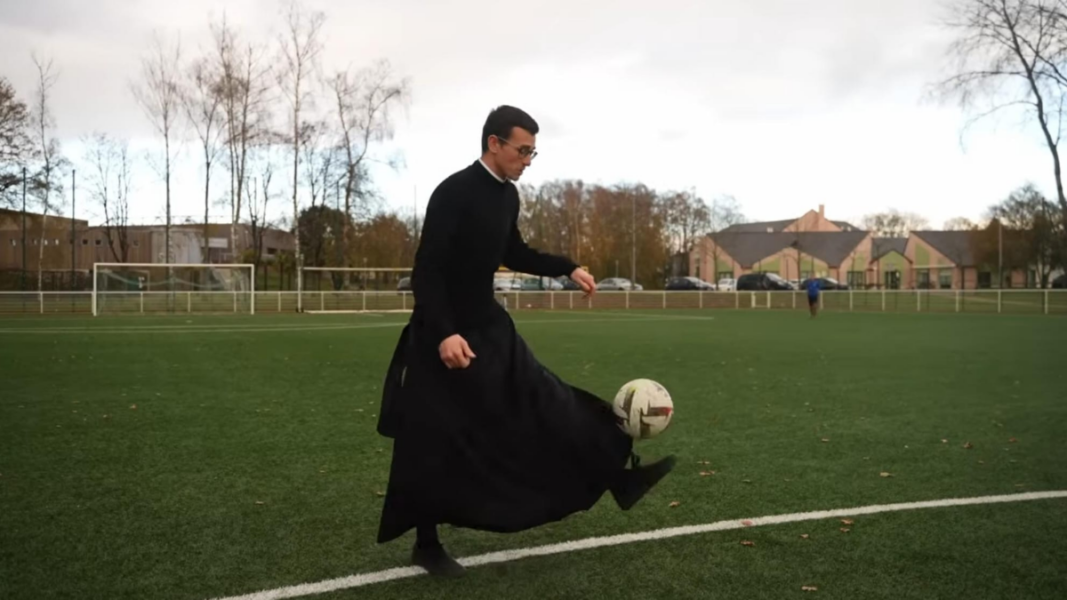
In the small town of Évron, in the Mayenne department, the seminary of the Communauté Saint-Martin has become one of the most watched places in the French ecclesiastical landscape. A recent report, built with a light tone—soccer tournament, ball challenges, impromptu catechesis questions—ends up showing something deeper: how a generation of future priests is being formed today in a country where institutional Catholicism is dragging a severe crisis of credibility and vocations.
Amid jokes about teams, shots at the crossbar, and a goalkeeper described as “monumental,” three seminarians—Antonios, Augustin, and Constantin—expose the reasons for their vocation without academic rhetoric. One speaks of a “falling in love,” but not with a person but with God; another places his call in an intense experience of Christ’s love at 17 and 19 years old, even to tears; a third recalls a communion during a World Youth Day as a turning point, later linked to a growing attraction to Eucharistic adoration. In all three accounts, a constant appears: they do not present their decision as an escape from the world, but as a positive choice of belonging and availability.
A life structured around prayer and study
Daily life at Saint-Martin is organized with precision. The day begins early with prayer, followed by a long block of silent mental prayer with biblical meditation. The Liturgy of the Hours is sung in common, with stable use of Gregorian chant. The curriculum combines philosophy and theology in a classic itinerary of priestly formation, to which apostolic activities—catechesis, visits to the sick—are added, along with specific human formation, from theater to learn public speaking to regular sports practice. Nighttime silence is not an aesthetic detail, but a discipline considered necessary to sustain interior life.
The pedagogy of the habit and priestly visibility
One of the most visible features is the progression in the use of the habit. Upon entering, seminarians wear suits and ties, partly to eliminate comparisons and partly as training in constancy. The cassock is introduced in stages: first reserved for moments of prayer and from certain courses onward; then for ordinary use within the seminary; finally also for family visits. They justify it as a missionary sign in a secularized society and as a permanent reminder of identity and coherence. They emphasize that the first time it is worn is not in a solemn act, but serving in the dining hall, as a symbol of service.
Celibacy and assumed renunciations
When celibacy is addressed, they do not evade the issue. They describe it as a process of maturation until it becomes a real and conscious choice, not mere legal imposition. They link it to the proclamation of the Kingdom and the witness that human love does not exhaust man’s vocation. They recognize its practical difficulty, along with other less visible renunciations: distance from family and friendships, and the transformation of one’s self-image.
The abuse crisis and human formation
The most delicate point is the abuse crisis. They admit that they carry a legacy they did not choose and that there is fear of being automatically associated with those crimes. The response they present is not defensive, but formative: they insist on the centrality of human maturity and mention psychological accompaniment as a normal part of the process. The logic is preventive and realistic: knowing oneself, identifying fragilities, and avoiding any form of double life. In a context of public distrust, they maintain that the only credible response is transparency and service.
Data and profile of the Communauté Saint-Martin
Founded in 1976 by Father Jean-François Guérin and canonically erected in 2000, the Communauté Saint-Martin is a clerical association of pontifical right that trains diocesan priests in common before sending them to serve in parishes entrusted to the community. According to figures published by the community itself in recent years, it has more than 180 priests and deacons, around a hundred seminarians, and a presence in more than 25 French dioceses, in addition to missions in Africa.
In certain recent courses, it has concentrated one of the largest numbers of seminarians in formation in France, in a country where the total annual ordinations usually hover around a hundred for all dioceses. Its profile is identified as traditional in liturgical and disciplinary matters, although it celebrates according to the ordinary Roman rite. The stable use of Latin in parts of the liturgy, Gregorian chant, the cassock as ordinary internal attire, and a strong community life mark a contrast with more decentralized formation models adopted in past decades.
In a country where Sunday practice is minority and trust in the clergy has suffered deep deterioration, the Évron case shows a defined strategy: strengthen identity, discipline, and integral formation as a response to the crisis.