


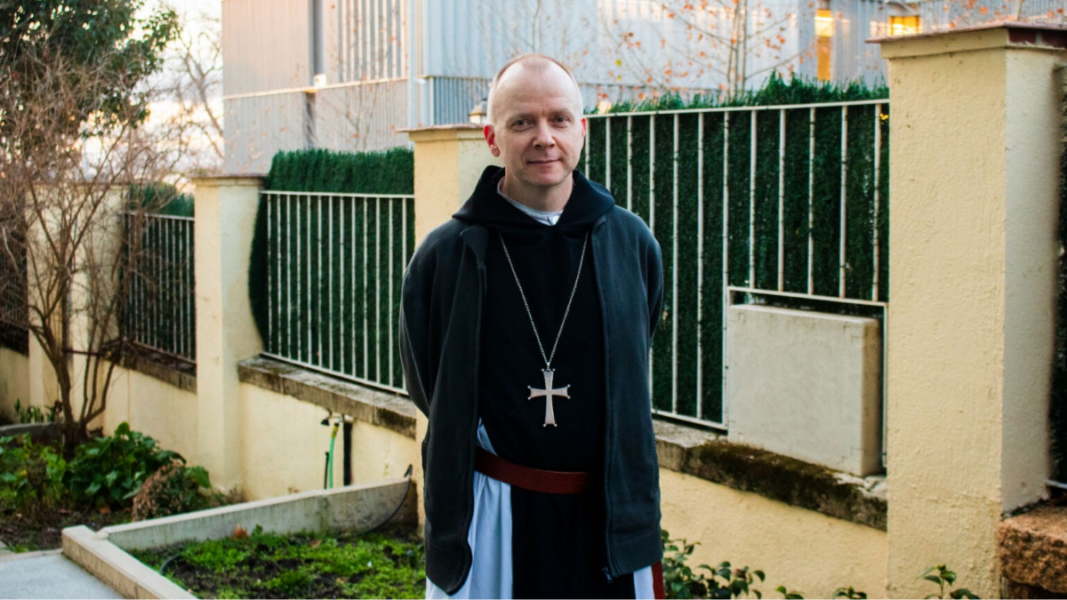
The Trappist monk and Norwegian bishop Erik Varden, who is in charge from this Sunday of preaching the Spiritual Exercises to the Pope and the Roman Curia, has emphasized the centrality of the liturgy for understanding the time of Lent and preparing adequately for Easter. In an interview granted to the magazine Ecclesia, Varden warns: “If we allow the liturgy to speak and do not turn it into something banal and boring, the mystery of Lent will be revealed to us.”
On the occasion of the publication in Spain of his book Heridas que sanan (Encuentro), the bishop proposes meditating on the wounds of Christ in the Passion as a path to understanding and healing one’s own wounds as a contemporary man.
The wounds of man and the wounds of Christ
In his new work, Varden starts from a medieval Cistercian poem, the Rythmica Oratio, attributed to Arnulfo de Lovaina, to explore the wounds of the Crucified. From there, he proposes a reflection for this Lenten season: wounds exist, they are real, but they do not have the last word.
The bishop points out that today’s society oscillates between hiding wounds and turning them into an identity. In the face of this double temptation, Christianity offers a different realism: recognizing that man is wounded, but affirming that he is more than his wounds and that these can become an occasion of grace.
Contemplating the wounds of Christ, he explains, is also contemplating what sin does to man. “The wounds of the crucified Christ are wounds that I inflicted,” he recalls, evoking the spiritual intensity of Holy Week. However, the Cross is not the end. Easter is a passage. The Risen One appears glorious, but keeps the wounds: the wound is not denied, it is transformed.
Lent: examining the heart before the Cross
For Varden, Lent is a privileged moment to ask oneself whether the heart remains sensitive to the mystery of the Cross or whether it has hardened due to routine and overexposure to images and news.
In a world saturated with information and tragedies, the risk is the numbing of conscience. The bishop recalls that it is not about living every calamity with an unbearable burden, but rather avoiding the heart becoming impermeable to the suffering of others and to Christ’s self-giving love.
The Lenten season, he insists, invites us to look at the Cross with new eyes: to become aware that the almighty God accepted fragility and allowed himself to be wounded out of love. Art, music, and literature can help recover that contemplative gaze that breaks indifference.
The liturgy, pedagogy of the Church
In response to the question of how to live this time deeply, Varden is clear: “By delving into the liturgy of the Church.” The liturgy, he affirms, is a great pedagogy. Its signs, silences, texts, and gestures direct attention and educate conscience.
That is why he warns of the danger of banalizing it. If it becomes something routine or superficial, it loses its formative power. On the other hand, if one participates in it with docility, it leads to the mystery and truly prepares for Easter.
In this sense, he considers the liturgy to be a crucial key for evangelization. Not the only one, but the most significant, because it is the place where the Church proclaims and actualizes the mystery of Christ.
Proclaiming the Risen Christ
On the threshold of Lent, Varden’s words remind us that this time is not an intimist exercise nor a simple moral adjustment. It is a school of contemplation, a purification of the heart, and a real preparation for Easter.
If the liturgy speaks and the Christian listens, the mystery is revealed. And Lent ceases to be a custom to become a path of conversion.