


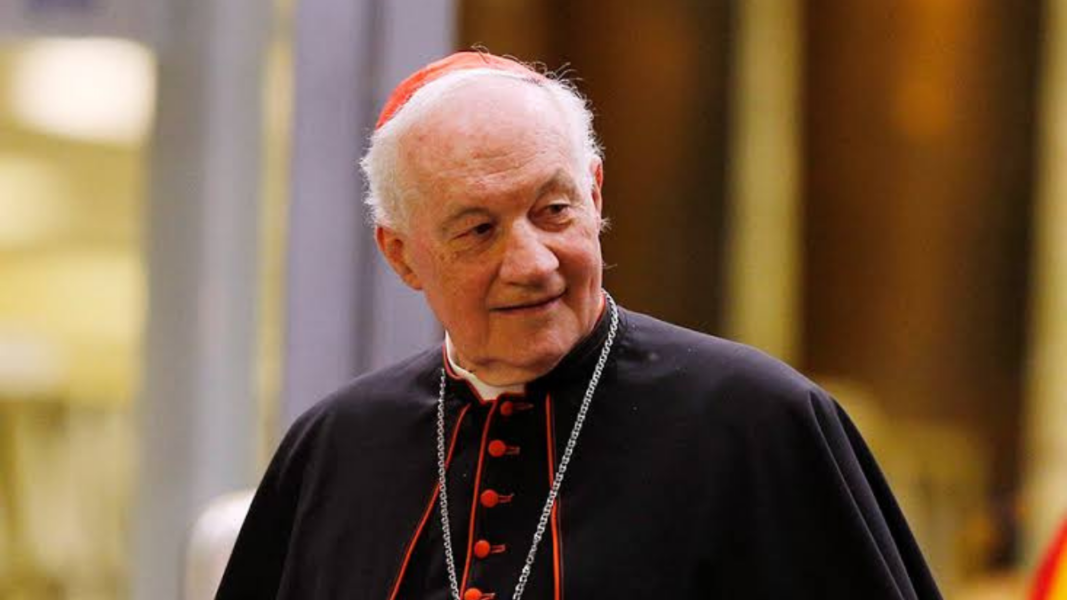
Charism is subordinate to apostolic authority.
A commentary by Martin Grichting
Your Eminence:
In an article published on vaticannews.va, you have attempted to legitimize the fact that Popes Francis and Leo XIV have de facto annulled the Second Vatican Council with regard to the relationship between the sacrament of orders and the potestas sacra (LG 21). These popes have appointed laypeople to ecclesiastical offices that involve the exercise of the potestas sacra, for which these laypeople, however, lack the capacity due to the absence of the sacrament of orders.
You try to justify this approach with the charisms generated by the Holy Spirit. At the same time, in three points of your text, you emphasize that it is necessary to deepen the study of the importance of charisms in the Church and their relationship with the office of governance, as well as the work of the Holy Spirit in the sacraments and in the Church. Of course, everything contained in the Sacred Tradition and in Sacred Scripture can and must be continually deepened. But if it were true that there are significant ambiguities regarding the relationship between charisms and the ministry of governance—which I doubt—with your argumentation you unmask the work of the popes cited as arbitrary acts. In fact, if important matters are not sufficiently clear from a doctrinal and theological point of view, faits accomplis cannot be created, as has happened. This is not prophetic, but irresponsible and creates divisions.
Although there can always be nuances and deepenings of the Church’s doctrine, one thing is certain, based on the Sacred Tradition and Sacred Scripture: charisms have always been subject to the offices of teaching and governing instituted by Jesus Christ: Test everything; hold fast to what is good (cf. 1 Thess 5:21). The Second Vatican Council confirmed this when it said of charisms: «The judgment of their authenticity and of their orderly exercise belongs to those who have authority in the Church» (LG 12).
There has never been a Church of Jesus Christ and, alongside it, a Church of the Holy Spirit. There is a single office of teaching and governing in the Church, in which charisms also exist, but these must be recognized and ordered by the successors of the apostles. The sacrament of orders is, therefore, contrary to what you claim, the only source of the power to govern that exists in the Church. And it is not, as you claim, a mere «custom,» but an essential part of the Church’s doctrine. Charisms, on the other hand, are by no means a prerogative of the laity with which they could presumably assert themselves before the clergy: the Holy Spirit «distributes special graces among the faithful of every condition,» as the Second Vatican Council teaches with regard to charisms (LG 12).
Revelation concluded with the last apostle (DV 4). Therefore, the Holy Spirit cannot, after 2000 years, become a competitor to the Son of God. It cannot arouse charisms that, alongside the hierarchical-sacramental nature of the Church created by the sacrament of orders, create a second para-sacramental basis on which the capacity to obtain offices linked to the potestas sacra could exist. But that is precisely what you suggest. We would then have a conflict of competencies in the Trinity: the Spirit as a competitor to the Son. Who should mediate? The Father? Or would a sustainable compromise be considered worthy and suitable, in the sense of a synodal discernment, to restore intratrinitarian peace?
We will achieve nothing with sleight-of-hand tricks. Unfortunately, you use them. On the one hand, you are right: a woman can assume governance functions in a state entity like the Vatican City State, created in 1929 through a concordat between the Holy See and Mussolini. The Vatican is not a divine revelation. No potestas sacra is needed to direct a communications department or a Vatican library. However, in the constitution of the Curia «Praedicate Evangelium» it reads: «Each curial institution fulfills its mission by virtue of the power received from the Roman Pontiff, in whose name it operates with vicarious power in the exercise of his primatial munus. Therefore, any faithful can preside over a dicastery or organism, taking into account the particular competence, governance power, and function of the latter» (II.5). This goes far beyond what you mention regarding the activities of laypeople in the Vatican. If «Praedicate Evangelium» is taken literally, you could have been replaced by a layperson instead of Cardinal Prevost. As prefect of the Congregation for Bishops, you did not appoint diocesan bishops. But you signed the decrees by which bishops were appointed as apostolic administrators of certain dioceses. Therefore, according to «Praedicate Evangelium,» a layperson—man or woman—could appoint a bishop to a diocese. Do you really want to justify «Praedicate Evangelium» with the devastating consequences this document has for the sacramentality of the Church?
Your argument about the «prefect» of the Dicastery for Religious is also manipulative. You are right when you state that the power exercised within religious communities is not potestas sacra. In fact, religious orders are not part of the Church’s sacramental-hierarchical constitution. Jesus Christ sent the apostles, but he did not found religious orders. Therefore, the directive power in religious orders does not derive from the apostolic office, but from the freedom of association of the faithful or, if you prefer, from the charism. It is not honest to equate this power with the Church’s potestas sacra over these structures, as you do. One thing is power within religious orders and another is potestas sacra over religious orders. Religious orders, as charismatic entities, are in fact subordinate to the apostolic ministry. The charism of religious orders is examined, recognized, and ordered by ordained pastors. When a layperson presides over this area of the apostolic office, they examine charisms in the sense of the ordained ministry. This is the task of those who have received the sacrament of orders, not of laypeople. The power of an abbess, on the other hand, lies in a different plane.
Added to this is the fact that, as is well known, there are also clerics in religious orders. With regard to the latter, potestas sacra also exists in religious orders (CIC, can. 596 § 2). Now, a layperson is in charge of tens of thousands of clerics and exercises potestas sacra over them. In this way, the sacramental and hierarchical nature of the Church is inverted in the name of the Holy Spirit’s charisms. You justify it with the attempt to involve laypeople more in the Church’s mission. In this way, you place gender equality above the Church’s sacramental nature. Thus, a criterion foreign to the Church is considered more important than one internal to it. In this way, you are the face of the tragic secularization of the Church of our days.
One can only speculate on what the true objectives are that you pursue with your stance. Perhaps they are not theological at all, but political or personal. In any case, with your thesis that there exists a pneumatological capacity, independent of the sacrament of orders, to assume potestas sacra in the Church, you are treading a path that leads to schism.
Moreover, you attempt to legitimize an ecclesiastical policy strategy of «opting out»: the Pope can exempt himself from respect for the doctrine sanctioned by the Second Vatican Council in LG 21. According to the canonical model of the Pope, bishops are already being asked to soon be able to appoint laypeople as vicars general. You also hint at something similar. The prefect of the Dicastery for the Doctrine of the Faith has recently offered the Priestly Fraternity of Saint Pius X to negotiate the minimum requirements for full communion with the Church. Are the «Sacrosanctum Concilium» and «Dignitatis Humanae,» or parts of them, subject to negotiation in the sense of an opt-out for traditionalists? Could Africans then invoke an opt-out with regard to polygamy, Belgians with regard to assisted suicide in ecclesiastical institutions, Amazonians with regard to Pachamama, and Germans with regard to their «synodal way»? An opt-out Church will be a balkanized Church, an anglicanized Church. And it is already clear where this will lead: to national Churches, to schism.
The Second Vatican Council uttered a wise phrase about charisms: «Extraordinary gifts should not be rashly sought nor should the fruits of the apostolate be presumptuously expected from them» (LG 12). Indeed, we must not expect, in the sense of millenarianism, a new Church of the Holy Spirit, of which you probably would not want to be the Joachim of Fiore. The solution for all—whether the Pope, a cardinal, a bishop, a priest, or a layperson (even consecrated)—consists in proceeding on the basis of the Church’s immutable doctrine, in which the Spirit of God leads us ever more deeply. The most recent Magna Charta in this matter is the Second Vatican Council, which did not reinvent the Church, but through which the Church reaffirmed its perennial doctrine in the present. Instead of playing with the fire of a chimerical Church of the Holy Spirit, it is necessary to finally recognize this Council in its text, but without trying to consider it as a springboard for a new Church. Only this serves the unity of the Church.
Read also: Ouellet defends Francis’s decisions on the appointment of laypeople in the Roman Curia