


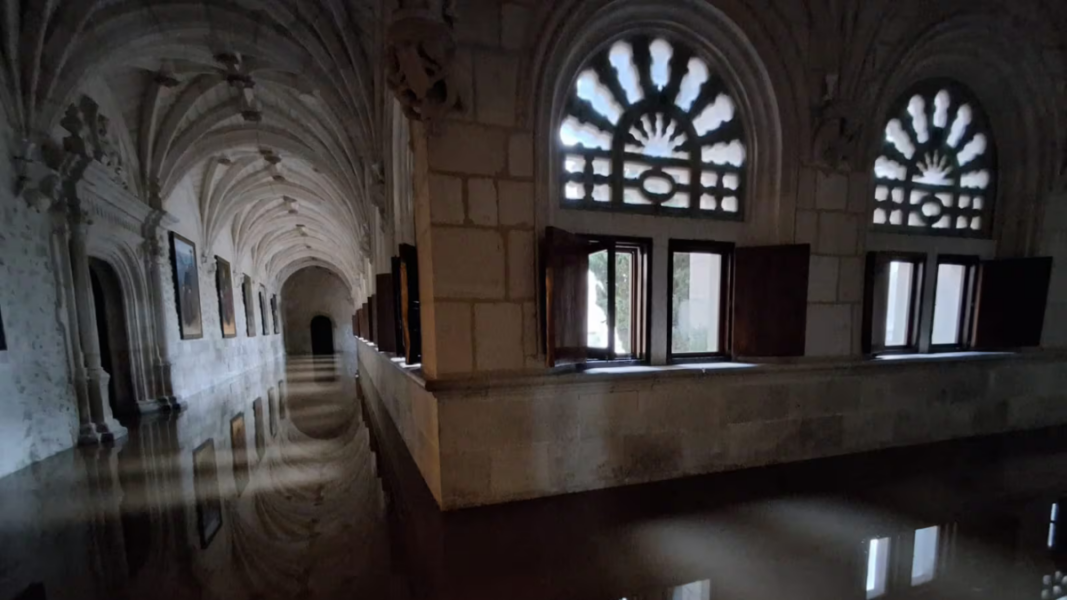
The rise of the Duero River following the release from the Cuerda del Pozo reservoir has caused significant damage to the Monastery of Santa María de la Vid, in the province of Burgos. According to Cadena SER, the water has flooded various dependencies of the religious complex, forcing the suspension of visits for several weeks while cleaning and damage assessment tasks are carried out.
The persistent rains of the last few days and the saturation of the reservoir increased the river’s flow, which eventually overflowed in this riverside area.
Water in the cloister and in high-value heritage spaces
The first leaks were detected during Saturday night, but it was in the early hours of the morning when the situation worsened. The water entered through the oldest part of the building, affecting the kitchens and the cloister. Subsequently, the river also entered through the sanitation system, which forced sealing the sewers with soil to stop its advance.
The flooding reached spaces of special historical and religious relevance, such as the main church, a chapel, the sacristy, and the four galleries of the cloister with its central patio. Firefighter teams worked for hours to pump out the accumulated water, and the drainage tasks will continue in the coming days.
The monastery’s prior has stated that the enclosure will remain closed to the public for several weeks, the time necessary to thoroughly clean the affected surfaces and prevent sedimentation from causing structural damage or deterioration to the historical materials.
A key enclave of Castilian religious heritage
The Monastery of Santa María de la Vid is one of the most emblematic monastic complexes in the Ribera del Duero. Founded in the Middle Ages and linked to the Order of San Agustín, the complex has undergone expansions and reforms over the centuries, combining Gothic, Renaissance, and Baroque elements.
In addition to its religious function, the monastery has historically been a reference cultural and academic center. For centuries, it housed theological and philosophical studies, and today it continues to be a place for spiritual retreat, training, and pilgrimage.
The town manages to contain the water’s advance
While the monastery suffered the direct consequences of the overflow, the urban core of La Vid managed to avoid major damage to homes thanks to the quick intervention of the deputy mayor and several neighbors.
In the face of the rising river level, emergency measures were activated to build containment barriers with sand and gravel at strategic points, protecting both the houses and the municipality’s electrical transformer. The damage in the urban area has been limited mainly to flooded agricultural lands.
Incidents in the water supply in the region
The impact of the flood has extended to other localities in the Ribera. In Roa de Duero, the drinking water booster pumps were rendered unusable after being flooded, which forced rationing consumption while ensuring supply through alternative resources.
In the case of the La Vid Monastery, the coming weeks will be dedicated to precisely assessing the extent of the damage and restoring the necessary conditions for its reopening. Beyond the temporary interruption of visits, the priority will be to preserve an architectural complex that is an essential part of the religious and cultural heritage of Castile and León.