


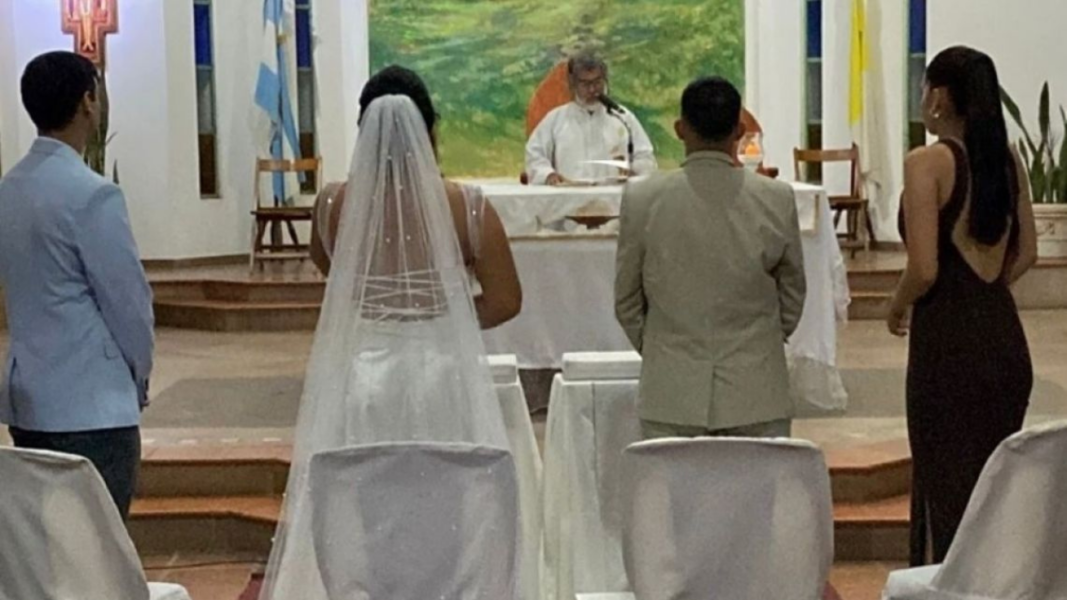
The Archbishop of Corrientes (Argentina), Mons. José Adolfo Larregaín, has declared that the marriage celebrated on January 28 in the Church of Our Lady of Pompeii between two transgender people lacks canonical validity and will be annulled by formal decree. The prelate himself reported this in statements collected by Crux.
The ceremony was celebrated according to the Catholic rite by Fr. Fernando Luis Gómez and had as contracting parties Solange Ayala —a person born male who identifies as female— and Isaías Díaz Núñez —a person born female who identifies as male—. According to Ayala, the couple followed the usual procedures and initially received pastoral approval to celebrate the marriage.
Reaction from the Archdiocese
After the celebration became public, both the Archdiocese of Corrientes and the parish issued statements.
In its statement of February 8, the Archdiocese recalled that marriage, as a sacrament, requires the fulfillment of essential conditions for its validity and lawfulness in accordance with canon law and the tradition of the Church. The document pointed out that the omission of such conditions can generate confusion among the faithful and that the archdiocesan see had not received the required ecclesiastical documentation for the formal processing of the case.
Mons. Larregaín explained to Crux that, in situations like this, the marriage is considered null “ipso facto”, that is, by the very fact of not meeting the requirements of “matter and form” necessary for a valid sacrament. He added that, although the nullity operates automatically, a formal decree will be issued to provide legal record.
The archbishop emphasized that pastoral welcome to all people, including those who identify as transgender, does not imply the administration of sacraments when the conditions required by the Church are not met. He also referred to Pope Francis’s declaration Fiducia Supplicans on blessings, insisting on the need to avoid confusion with the marriage rite.
The Parish and the Pastor
For its part, the Parish of Our Lady of Pompeii did not issue further statements or declarations after the publication of a letter from its pastor, Fernando Luis Gómez, in which they committed to strengthening the interview, preparation, and verification procedures for the contracting parties in order to avoid similar situations in the future.
By the Voice of a Few
According to canon law expert Ricardo Lugo, cited by Crux, the request was initially accepted because, from a civil and registry perspective, the contracting parties were listed with different sexes, which in his opinion would meet the formal requirements both civil and ecclesiastical. Lugo stated that the majority of the local community did not express objections, although a minority group filed a complaint with the archbishop, which initiated the canonical procedure.
LGBT Activists Expect a Cultural Transformation
For his part, Sergio Petroni, an LGBT Catholic activist in Buenos Aires, told Crux that changes in the Church regarding the sacramental recognition of same-sex or transgender couples are processes that advance slowly. Petroni expressed that he considers it unlikely that the celebration of LGBT marriages will be authorized in the short term, although he defended the active presence of LGBT faithful within ecclesial life as a path to cultural transformation.