


By: Yousef Altaji Narbón
Stand up before the gray-haired, honor the person of the elderly, and fear your God (Lev 19:32). The elderly: object of repulsion, marginalization, obsolescence, and forgetfulness. This is how the revolutionary world repays the elderly, once their useful life—according to their terms and way of thinking—ends and they become a burden to society, a matter of time before they perish. The book of Leviticus stands in holy opposition to the aforementioned as the typical behavior of a neopagan culture. The elderly constitute an essential part of Christian civilization. What do I say? More than that! In a vital and indispensable part of the order instituted by God in the earthly order; so important that the Heavenly Father God identifies with the figure of the elderly. We, who desire to restore all things in Christ, as St. Pius X well established as the apex of his pontificate, cannot forget or overlook this relevant apostolate which consists in helping or caring for the elderly.
The importance of the elderly
Usually—and with great sadness—one does not look beyond the physical in relation to the figure of the elderly, but it is in the supernatural plane where the jewel that lies within the person of the third age can be seen. The Sacred Scriptures are our reference for understanding the invisible value (and even more transcendent than the visible) of the elderly: “They shall still bear fruit in old age; they shall be full of sap and green” (Psalm 92:15); “Then Abraham breathed his last and died at a good old age, an old man and full of years, and was gathered to his people” (Gen 25:8); “But they had no child, because Elizabeth was barren, and both were advanced in years” (Luke 1:7). From these biblical quotes, we can draw several specific conclusions. God grants wisdom to the elderly, to those who have reached the old age of their life; to such an extent is it granted that “they shall be full of sap and green.” It sounds contradictory to be at the end of life while giving full greenness. This is how Eternal Wisdom works: after long years, one grows in experience and God blesses those who have walked obediently their path with all kinds of graces until growing like the cedar of Lebanon (Psalm 92:13). This tree is strong, robust, and reaches its splendor the more years of life it has. This is exactly the case with adults from the supernatural perspective, which far surpasses the tangible in the physical plane, consisting of pains, weight loss, fatigue, illnesses, and bodily emaciation.
Let us look at the life of the just Abraham. In the previously cited biblical verse, the entire life of this holy patriarch is described in a few words. Let us fix our gaze on the detail of the triple mention that the author of the sacred book of Genesis makes: “good old age, old man, and full of days”; this is what the life of the elderly consists of. Only these people can reach a state of such union with God, combined with the fullness of all earthly things, having traversed the long stretch of Christian life. In another vein, we have the blameless—to use the exact word used in the Sacred Text—Saint Elizabeth and Saint Zechariah. In brief stanzas of the Sacred Scriptures, the level of piety of these two vital figures in the life of Our Lord Jesus Christ is illustrated. They are highlighted by the great miracle that occurs at the twilight of both their lives. In the old age of the aforementioned is when God dispenses his copious mercy to announce to them the coming of the great prophet Saint John the Baptist. This is the kind of fruits that old age yields when fully utilized according to divine precepts.
In other sections of the history of salvation, one can tacitly appreciate not only the importance, but the indispensability of the adult in everything. When Christ, in the arms of his parents, is presented in the temple to fulfill the precept of the old law, one must ask who are the first two to recognize the coming of the Messiah: some elderly people. Simeon and Anna, two long-lived people with a spiritual depth like no other. In a certain way, it is Simeon, an elderly man blessed by God, who gives the first words of public praise toward the God-Man, since we can read exactly what God put in his mouth to proclaim the wonders of that divine event. This is the same case with Anna, who gave great praise to the Almighty because she has finally seen the Savior (Luke 2:38). Transporting ourselves to the last book of the Bible, the figures of the elderly are seen as God’s chosen ones to the point of rendering supreme worship to the spotless Lamb. What other proofs do we need to see the relevance—I dare to say—divine of those advanced in age? From them we can learn an unimaginable amount of knowledge of all kinds to form our lives with thoughts and guidelines proven by time. From them we can learn how to approach God, since they are increasingly closer to Him, not because they are near death, but because of the level of mystical union with Him.
Making a brief journey through the history of Christendom, one can explicitly appreciate in what way the elderly form an elemental part of the Christian order. These were mainly the ones who made weighty decisions, the references for some topic, and the guardians of a people’s history. It is no small responsibility imposed on adults. All the biblical teachings previously stated were applied with clarity. Another example is when in the Christian families of yore, the elderly was the one who received the greatest honor and respect for his task of transmitting the family history to his heirs; in this way, the genealogy is prolonged and continued with his memory. All this and much more was the role of this sector of the population that endowed a people with virtues, knowledge, and experience.
What does the apostolate with the elderly consist of?
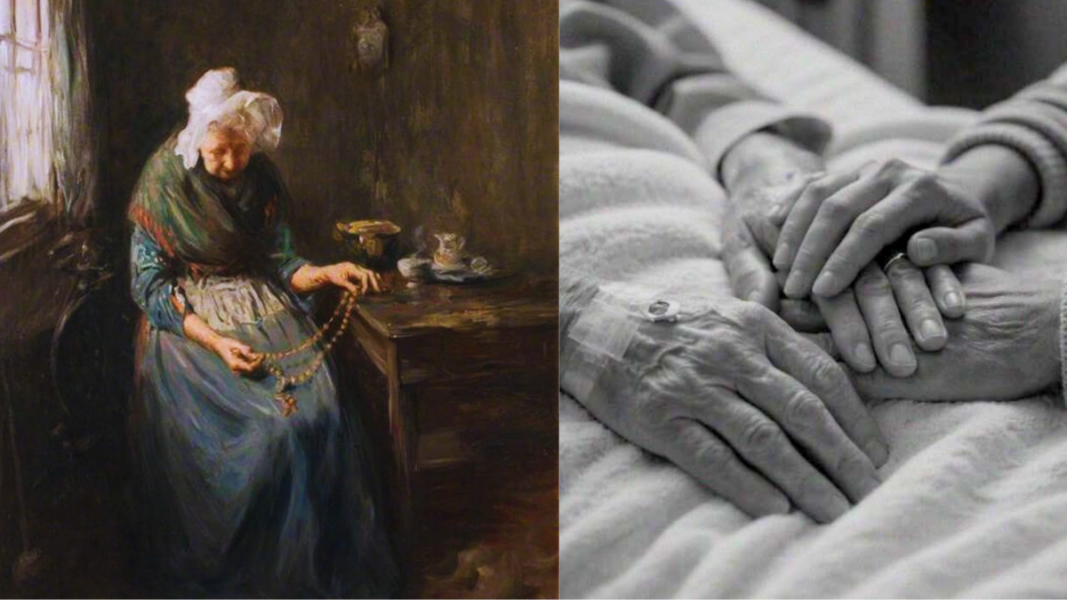
This apostolate, which has been forgotten because it has been taken for granted, needs to be resurrected for its value both for them and for oneself. It calls the attention of the trained observer that honor is given to the Pro-Life struggle, which is of immeasurable value, but sometimes seems to eclipse this apostolate which is also properly Pro-Life. Now, specifying quickly, this tender apostolate consists in being a disinterested and dedicated servant of the suffering Christ. Serving a member of this demographic sector is like being an angel aiding Our Lord Jesus Christ in the desert, just as in the midst of his painful death on the Cross. In case they have some pain—whether physical, moral, or spiritual—our task is to alleviate the burden to make the most of the cross placed on their shoulders for the sake of their own salvation, combined with obtaining an innumerable multiplicity of graces that can only be received in that condition. We have the duty to be balms in that last stage of life in which they may feel alone, discouraged, or prone to stray from the truth to live the comfort of neopagan modernity.
This apostolic work is not very easy; in fact, it can be quite difficult because of the character of the person we are helping. If this is the case, oh brother, your reward will be greater! The heavier the cross, the greater the merit, and we will be able to glimpse Christ more in our beloved advanced in age. The beauty of this apostolate is that it is very simple; it does not require much to complete in a delightful way.
Having said the above, getting to the heart of the matter, one will wonder in what exact way such work of love for the neighbor is carried out. There is no precise formula or step-by-step for this, but there are certain fundamental notions, whose content is as follows. First, one must know the person(s) with whom we are to develop this apostolate. Of course, if it is our grandparent, this step is quickly assimilated by the closeness of familiarity. Otherwise, one can start getting to know this person as one would in any other situation. Before continuing, what was said in the previous sentence indirectly touches on a point of preeminence, which is convenient to clarify without any ambiguity. The elderly are not old furniture that one can move or do with them whatever is within our power; they are not crafty crows that we must silence because their voice is bothersome; they are people who have every right to express their thoughts on matters that concern them; they are not guinea pigs for conducting scientific experiments with sedative medicines to dull them to the point of losing the use of their bodily faculties; they are not irrational beings who have no tastes, preferences, and opinions; they are as human as the one reading this article —even the elderly suffering from some type of cognitive degenerative condition—.
Having clarified unequivocally what was exposed in the preceding paragraph, let us continue with the suggested guidelines and steps. Second, there is an endless sea of things that can be done as a vehicle for this blessed apostolate. These activities can be both pious and secular. Some pious suggestions may be, but are not limited to: praying the Holy Rosary with them (or for them), some devotion of their preference, reading the readings of the day, sharing a moment of spiritual meditation with them, reading some pious text from the saints, recounting known episodes from the Sacred Scriptures and relating them in an entertaining way, reviewing the lives of the saints; if it is Sunday and their condition does not allow them to go to Holy Mass, the texts of the same can be read to unite spiritually with the Holy Sacrifice. These are some ideas that will be of enormous benefit in the supernatural plane for both.
In the secular plane, a variety of stimulating activities can be carried out with them. Below is a diverse trio of ideas: a conversation on topics of their interest, that they recount special moments of their life or historical moments they lived, depending on their level of physical mobility, puzzles can be done or some board game played, reading a simple book of their preference, painting or coloring, eating something delicious together, listening to their favorite music, telling them about one’s life—this makes them feel important—, another phenomenal idea is to do productive activities with them because it makes them feel useful in the earthly plane. One can politely ask for their help with minimal things like folding clothes, setting the table, helping with the kitchen, counting some numbers of something, making them participate in some aspect of our state in life duties, among other initiatives in which their help can be incorporated.
Amid all this, the crucial thing is to exercise creativity to devise activities and tasks to share with our dear elderly. Ask the Holy Spirit for constant apostolic zeal with our loved ones so that we can always guide them so that everything is for their spiritual edification and the greater glory of God. All the above extends even more to bedridden elderly, whom we must treat with special love because of their condition of almost absolute vulnerability. In them, Christ can be seen with even greater clarity because the wise words of St. Camillus de Lellis can be applied, who preached: “The sick are the heart of Christ.” This is totally true; these are like living tabernacles, how so?, one would ask scandalized, using a simple but pious logic. If these grandparents are bedridden, they are in a state of grace through a holy confession, they receive Holy Communion; Christ literally lives in them with purity. In a certain way, they carry Our Lord Jesus Christ just as He wants to be carried: with a simple, pure, and repentant heart; this is exactly living an anticipation of heaven on earth. Their prayers, penances, pains, and sacrifices are significantly more valuable in the eyes of the merciful Sacred Heart.
Final considerations
To conclude this writing, which I hope will serve as a spark to ignite the flame of the apostolate in those whom Divine Providence has disposed to serve the elderly, it is appropriate to make some considerations, united with a severe warning for all. St. John of God tells us with great love: “Pray to Our Lord Jesus Christ that what you do and your sons and daughters, everything be for the service of Our Lord Jesus Christ and of our Lady the Virgin Mary.” (Cf. First Letter to Gutierrez Laso). All the service we can give to adults, from the simplest to the most unpleasant, must be done to serve Jesus and Mary. We cannot lose sight of the value of small actions done out of love for God. Even the Sacred Scriptures tell us very clearly that giving a glass of water to a poor person is a gesture of incalculable value in the eyes of the Most High. How much higher will the service be toward a vulnerable and dependent poor elderly person? We can take guidelines based on the well-known Decalogue of the Servers of the Sick inspired by the instructions of St. Camillus de Lellis, such as: “Honor the dignity and sacredness of my person, image of Christ, above my fragility and limitations… Care for me as you would want to be cared for, or as you would do with the most beloved person you have in the world… Share my anxieties and sufferings: even if you cannot take away the pain, accompany me. I need your human and gratuitous gesture that makes me feel like someone and not something, or an interesting case.” These must be the mottos to take as a banner in all our conduct with adults. Just pondering the expansion and possible fruit of the apostolate outlined here, the devout soul rejoices in holy fervor wanting to start immediately serving the suffering Christ in the neighbor.
All this sounds phenomenal seen with the eyes of faith, but few are those who do this apostolate. In reality, they do the opposite with the elderly, as was said at the beginning, but it is necessary to insistently reiterate. The Supreme and Almighty Judge has issued his sentence in advance for worldly men who abandon their parents in nursing homes, do not call or visit them, treat them badly, see them as a burden, and, as if that were not enough, tacitly await with some longing the day they die. So prays the holy book of Sirach 3:14-18: “My son, help your father in his old age and do not grieve him during his life. If he loses his reason, show forbearance; do not despise him because you are in your full strength; piety toward a father will not be forgotten, and instead of sin, you will gain prosperity. In time of trouble, the Lord will remember you, and as the snow melts in a warm day, so your sins will melt away. As one who blasphemes is he who abandons his father, and cursed by the Lord is he who angers his mother.” These are the accusing words of a God who rises for the weak and in turn curses the proud and filthy conduct of these people. Have full assurance of the coming of divine vengeance on these cursed subjects who, by their apparently powerful behavior with the elderly, are digging their own grave.
The present author has previously spoken about his grandparents in the article titled Who are the genuine Traditiones Custodes? With the passage of time, one continues to learn to love one’s loved ones advanced in age even more. One never knows the day they will be called to render accounts before the divine tribunal, so it is appropriate to appreciate every moment one enjoys their presence. Beatriz, Shawquia, Tahsin, Jaime are names that only evoke joy in the heart of the one writing these words. They guard—the first two who still live by the grace of God—the integrity of a full life and having borne good fruits; in this they resemble what is written about Abraham in his long days of satisfaction. The other two who were called after having lived with the affection and respect due to a pater familias. The elderly are a treasure for us, so accustomed to instant novelty notably lacking in all sacred depth. Let us take advantage of this opportunity to care for the most vulnerable and gain heaven both for them and for ourselves; let us always be the angels we want to have in our old age to make the holy passage to eternity as God expects of us.
Note: Articles published as Tribune express the opinion of their authors and do not necessarily represent the editorial line of Infovaticana, which offers this space as a forum for reflection and dialogue.