


With the Sunday of Quinquagesima, the Roman liturgy reaches the very threshold of Lent. If Septuagesima taught us to enter slowly, and Sexagesima forced us to ask ourselves if the Word found soil, Quinquagesima goes deeper: it tells us what kind of Word this is and where it leads. The liturgy stops speaking in indirect parables and becomes direct: Jerusalem appears, the Passion is announced, and it is revealed that the Christian way, to reach glory, must first pass through the accepted Cross. There is nothing here of sentimentalism. Nor of harshness. There is naked truth, spoken with impressive serenity.
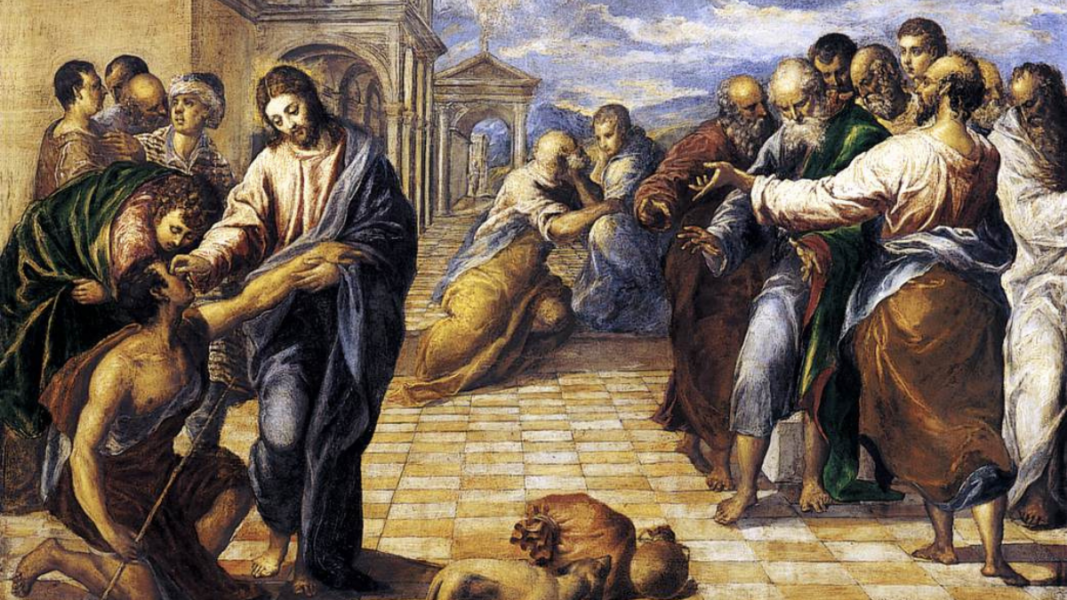
In the Gospel, Christ clearly announces what is going to happen: Ecce ascendimus Ierosolymam. He will be handed over, mocked, scourged, crucified… and he will rise again. But the text adds a decisive phrase: “they understood none of this.” Because the Cross is not understood from outside nor assimilated by pure intelligence: it is only comprehended when one follows it, following Him who carries it. That is why immediately after, the episode of the blind man of Jericho appears as an interpretive key: to understand the mystery of the Cross, light is needed, and that light is implored. The blind man does not argue or analyze: he cries out and cries out, in insistent supplication, and when he sees, he follows Jesus. Before entering Lent, the Church teaches us that one only begins to understand the Passion by asking to see: Domine ut videam!
The Epistle of this Sunday is one of the most well-known Pauline pages: the hymn to charity, which, placed here at the gates of Lent, acquires particular depth. Paul does not speak of a kindly feeling, but of a way of being: a charity that bears all things, believes all things, hopes all things, endures all things. There is no sweetening: the charity described by the Apostle is exactly the one that will be manifested in the Passion of Christ. Thus, the liturgy establishes a powerful link: the Cross announced in the Gospel and the charity described in the Epistle are the same reality. Before any penitential practice, the Church issues a decisive warning: without charity, sacrifice is emptied. Lent is not a moral gymnastics; it is a school of crucified love.
The liturgical prayers of the day are a supplication for interior sight, insisting on one point: the blindness of the heart and the need to be healed. Strength is not asked for to do great things, but light to understand and follow. The Church recognizes herself as in need of grace; she confesses herself as a disciple who walks behind Jesus, learning the paschal mystery. This prayerful tone is key: just before the Lenten austerity begins, the liturgy teaches that lack of will is often a lack of supernatural vision.
Quinquagesima is the threshold of the desert; with the Alleluia absent, the Cross has been announced and charity defined: the blind man has recovered his sight. The liturgy places us behind Christ who ascends to Jerusalem and asks us, without drama: do you want to see?, do you want to follow Me?, do you want to love like this?
This Sunday of Shrovetide is decisive for the Christian to understand that Lent will be learning to love to the extreme. On Wednesday there will be ashes and fasting, and we will not be able to reproach Quinquagesima for not having told us the truth, for not having made us ask for light, for not having pointed out the way.
By: Mons. Alberto José González Chaves