


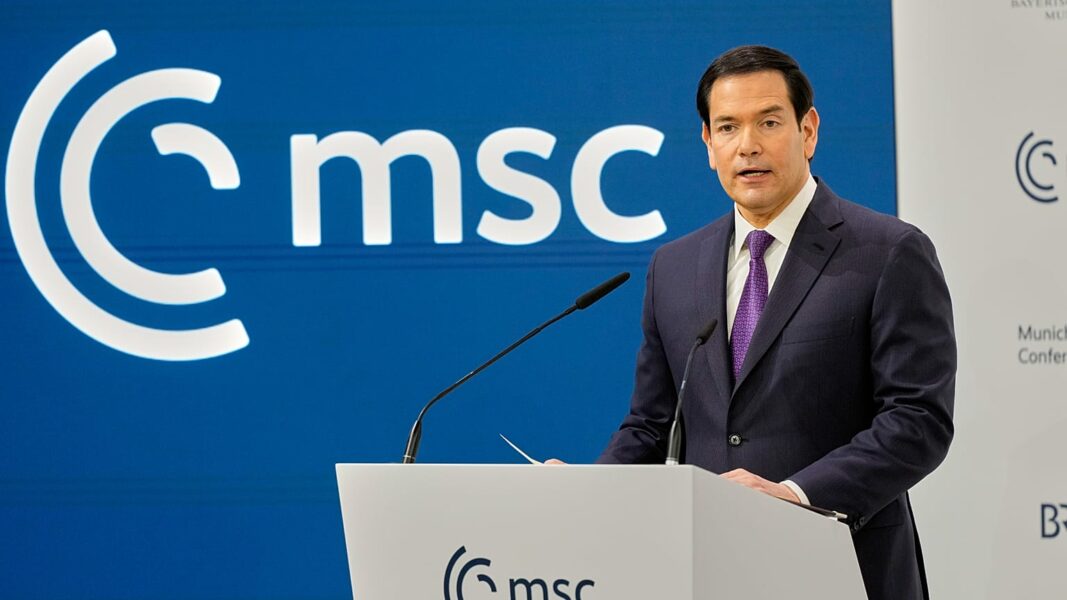
The United States Secretary of State, Marco Rubio, delivered an important speech yesterday at the Munich Security Conference, in Munich (Germany), in a plenary session followed by a brief question and answer period.
The speech was an explicit reconstruction of the notion of the West in a Christian civilizational key. Not as a technical plea on security nor a conventional diplomatic piece: but as an identity-based claim. From a Catholic civilizational perspective, for Rubio the axis is not NATO nor the balance of power, but the historical consciousness of a shared spiritual tradition.
Rubio formulates a central thesis: Europe and the United States are not united only by strategic interests, but by a shared heritage that sinks its roots in the Christian faith, in law, in the medieval university, in the scientific revolution born on European soil. The West is not presented as a liberal abstraction, but as a concrete civilization with defined religious and cultural foundations. The insistence on faith as a structural element of the transatlantic bond introduces a break with the post-historical universalism that dominated Western discourse after 1989.
The diagnosis is also moral. Western elites are accused of having embraced an illusion: the “end of history,” unlimited trade, the dilution of sovereignty in international organizations, the indiscriminate opening of borders, energy subordination, and deliberate deindustrialization. From this optic, the problem is not merely economic or military, but a loss of confidence in one’s own historical legitimacy. The West would have internalized a narrative of guilt that paralyzes it.
The proposal is restorationist. Reindustrialization, energy sovereignty, migration control, reform of multilateral institutions, technological strategic autonomy. But the core is not technical: it is anthropological and cultural. It is argued that armies do not fight for abstractions, but for concrete peoples and specific ways of life. At that point, the speech aligns with a classical conception of politics as the defense of a determined historical community.
From the Catholic civilizational angle, the decisive element is the explicit affirmation that the transatlantic alliance rests on a shared Christian tradition. The Sistine Chapel and the Cologne Cathedral are invoked not as tourist ornaments, but as symbols of a worldview that shaped Europe and, through it, America. Western civilization is presented as unique, distinctive, and irreplaceable.
Thank you very much.
Today we gather as members of a historic alliance, an alliance that saved and changed the world. As you know, when this conference began in 1963, it was held in a nation—in fact, on a continent—divided against itself. The line separating communism from freedom ran through the heart of Germany. The first barbed wire barriers of the Berlin Wall had been erected just two years earlier. And only a few months before that first conference, before our predecessors gathered here for the first time, in Munich, the Cuban Missile Crisis had brought the world to the brink of nuclear destruction.
While World War II was still fresh in the memory of Americans and Europeans, we faced a new global catastrophe, carrying a type of destruction without precedent, more apocalyptic and final than anything humanity had known until then.
At the time of this first meeting, Soviet communism was in full expansion. Thousands of years of Western civilization were at stake. Victory was far from assured, but we were animated by a common goal.
We were united not only by what we fought against, but also by what we fought for.
Together, Europe and America triumphed, and a continent was rebuilt. Our peoples prospered. Over time, the Eastern and Western blocs reunified. A civilization became whole again.
The infamous wall that had divided this nation in two fell, and with it an evil empire, and East and West became one.
But the euphoria of this victory led us to a dangerous illusion: that we had entered, in the consecrated expression, the “end of history,” that from then on all nations would become liberal democracies, that the bonds created by trade would replace the very idea of nation, that the rules-based world order—a worn-out expression—would supplant national interest, and that we would live in a borderless world in which we would all be citizens of the world.
It was a harebrained idea that ignored human nature and the lessons of more than 5000 years of written history. And it has cost us dearly. In this illusion, we adopted a dogmatic vision of unrestricted free trade, while some nations protected their economies and subsidized their companies to systematically undermine ours, close our factories, deindustrialize broad sectors of our societies, offshoring millions of middle- and working-class jobs, and entrusting control of critical supply chains to adversaries and rivals.
We have outsourced our sovereignty more and more to international institutions, while many countries invested in massive welfare states at the expense of their ability to defend themselves. And this while other nations launched the fastest military rearmament in human history, not hesitating to use force to pursue their own interests.
To please a climate cult, we have imposed energy policies that impoverish our peoples, while our competitors exploit oil, coal, natural gas, and many other resources, not only to fuel their economies but also to use them as leverage against ours.
And, in the name of a borderless world, we opened our doors to an unprecedented wave of mass migration that threatens the cohesion of our societies, the continuity of our culture, and the future of our peoples. We have made these mistakes together, and together we must now face the truth and move forward to rebuild.
Under the presidency of Donald Trump, the United States of America will once again undertake the task of renewal and restoration, guided by a vision of the future as proud, sovereign, and vital as the past of our civilization.
And although we are willing, if necessary, to act alone, our preference and our hope is to do so with you, our friends here in Europe.
The United States and Europe are bound by indissoluble ties.
America was founded 250 years ago, but its roots exist much longer on this continent. The men who built the nation in which I was born arrived on our shores carrying the memories, traditions, and Christian faith of their ancestors, a sacred legacy and an unbreakable bond between the Old and New Worlds.
We belong to the same civilization: Western civilization.
We are united by the deepest bonds that nations can share, forged by centuries of common history, Christian faith, culture, heritage, language, ancestry, and by the sacrifices our ancestors made together for the civilization we have inherited. That is why, sometimes, Americans can seem a bit direct and pushy in our advice.
That is why President Trump demands seriousness and reciprocity from our European friends: because we care deeply about your future as much as our own. And if we sometimes disagree, those disagreements stem from our deep concern for a Europe to which we are linked not only economically and militarily, but also spiritually and culturally.
We want a strong Europe. We believe Europe must survive, because the two great wars of the last century constantly remind us that our destinies are and will remain indissolubly linked.
Because we know that Europe’s destiny will never cease to have consequences for our own national security. And this conference, which focuses largely on these issues, is not limited to technical considerations: how much we spend on defense, where and how we deploy it. These issues are important, no doubt, but they are not fundamental.
The fundamental question is: what exactly are we defending?
Armies do not fight for abstractions. They fight for a people, for a nation, for a way of life.
That is what we defend: a great civilization that has every reason to be proud of its history, confident in its future, and determined to remain master of its economic and political destiny.
Here, in Europe, the ideas that sowed the seeds of freedom and changed the world were born.
Here arose the rule of law, universities, and the scientific revolution.
This continent has given birth to geniuses like Mozart and Beethoven, Dante and Shakespeare, Michelangelo and Leonardo da Vinci, the Beatles and the Rolling Stones.
And it is here that the vaults of the Sistine Chapel and the majestic spires of the Cologne Cathedral not only bear witness to the greatness of our past and the faith in God that inspired these wonders, but also herald the wonders that await us in the future.
But only by fully embracing our legacy and being proud of this shared legacy can we begin to imagine and forge together our economic and political future.
Deindustrialization was not inevitable.
It was a deliberate political choice, a decades-long economic project that deprived our nations of their wealth, productive capacity, and independence.
And the loss of our sovereignty over supply chains was not the result of a healthy and prosperous trading system: it was a deliberate and senseless transformation of our economies that made us dependent on others and dangerously vulnerable to crises.
Mass migration is not, nor has it ever been, a marginal concern. It is a crisis that is transforming and destabilizing societies across the West.
Together we can reindustrialize our economies and rebuild our capacity to defend our peoples. But the work of this new alliance must not be limited to military cooperation or the reconquest of past industries: it must also aspire to promote our common interests and new frontiers together, to unleash our ingenuity, creativity, and entrepreneurial spirit to build a new Western century.
Commercial space travel, cutting-edge artificial intelligence, industrial automation, flexible production, Western supply chains for critical minerals, not vulnerable to blackmail from other powers, and a joint effort to conquer market shares in the economies of the Global South.
Together, we can regain control of our industries and supply chains and prosper in the fields that will define the 21st century. But we must also regain control of our national borders, controlling who enters our countries and in what numbers. This is not about xenophobia or hatred: it is a fundamental act of national sovereignty. Failing to do so not only means abandoning one of our most basic obligations to our peoples, but also poses an urgent threat to the very fabric of our societies and the survival of our civilization.
Finally, we cannot continue to prioritize the supposed world order over the vital interests of our peoples and nations.
We do not need to abandon the international cooperation system we have created, nor dismantle the global institutions of the old order that we built together. But they must be reformed. They must be rebuilt.
For example, the United Nations still has enormous potential to be a tool for good in the world.
But we cannot ignore that, today, on the most urgent issues we face, they provide no answers and play virtually no role.
They have not been able to resolve the war in Gaza. It has rather been American leadership that has freed the captives from the barbarians and allowed a fragile truce.
They have not resolved the war in Ukraine. American leadership has been necessary, in collaboration with many of the countries present here today, to bring both sides to the negotiating table in search of an elusive peace.
They have been powerless to stop the nuclear program of Tehran’s Shiite radicals. For that, 14 precision-launched bombs from American B-2 bombers were necessary.
And they have not been able to address the threat to our security posed by a narco-terrorist dictator in Venezuela. It was U.S. special forces that had to intervene to bring this fugitive to justice.
In an ideal world, all these problems and many others would be resolved with firm diplomats and resolutions. But we do not live in an ideal world, and we cannot continue to allow those who openly and brazenly threaten our citizens and global stability to hide behind abstractions of international law that they themselves regularly violate.
This is the path that President Trump and the United States have taken.
This is the path we ask you, here in Europe, to follow with us. It is a path we have already traveled together and that we hope to travel together again.
For five centuries, before the end of World War II, the West did not cease to expand. Its missionaries, pilgrims, soldiers, and explorers left its shores to cross the oceans, colonize new continents, and build vast empires around the world.
But in 1945, for the first time since the time of Christopher Columbus, it began to contract. Europe was in ruins. Half of its territory lived behind an Iron Curtain, and the rest seemed on the verge of following. The great Western empires had entered an irreversible phase of decline. This decline was accelerated by atheistic communist revolutions and anticolonial uprisings that would transform the world and cover vast areas of the map with the red sickle and hammer in the years to come.
In this context, both then and now, many came to believe that the era of Western dominance had come to an end and that our future was doomed to be a weak and pale echo of our past.
But together, our predecessors recognized that decline was a choice, and it was a choice they refused to make. That is what we did together in the past, and that is what President Trump and the United States want to do again today, with you. And that is why we do not want our allies to be weak.
Because that weakens us. We want allies capable of defending themselves so that no adversary feels tempted to test our collective strength.
That is why we do not want our allies to be hindered by guilt and shame. We want allies who are proud of their culture and legacy, who understand that we are heirs to the same great and noble civilization, and who, along with us, are willing and able to defend it.
And that is why we do not want our allies to rationalize the failed status quo instead of recognizing what is necessary to remedy it.
Because we Americans have no interest in being the polite and orderly guardians of the controlled decline of the West. We do not seek to separate, but to revitalize an old friendship and renew the greatest civilization in human history.
What we want is a revitalized alliance that recognizes that what afflicts our societies is not just a set of bad policies, but a malaise related to hopelessness and complacency.
The alliance we want is one that is not paralyzed by fear. Fear of climate change, fear of war, fear of technology.
On the contrary, we want an alliance that boldly charges toward the future, and the only fear we have is that of not leaving our children nations that are prouder, stronger, and richer.
An alliance willing to defend our peoples, protect our interests, and preserve the freedom of action that allows us to forge our own destiny. Not an alliance that exists to manage a global welfare state and atone for the supposed sins of past generations.
An alliance that does not allow its power to be outsourced, coerced, or subordinated to systems beyond its control, that does not depend on others for the essential needs of its national life, and that does not maintain the courteous pretense that our way of life is just one among many and asks permission before acting.
And, above all, an alliance based on the recognition that we, the West, what we have inherited together is unique, distinctive, and irreplaceable. Because that is, after all, the very foundation of the transatlantic bond.
By acting together in this way, we will not only contribute to restoring a sensible foreign policy. It will give us back a clear image of ourselves. It will give us back a place in the world.
And, in doing so, we will confront and deter the forces that today threaten to make civilization disappear, both in America and in Europe. Now that headlines announce the end of the transatlantic era, let it be clear to all that this is not our goal or our desire.
Because for us Americans, our home may be in the Western Hemisphere, but we will always be sons of Europe.
Our history began with an Italian explorer whose adventure into the unknown to discover a new world brought Christianity to America and became the legend that defined the imaginary of our pioneering nation.
Our first colonies were founded by English settlers, to whom we owe not only the language we speak, but also our entire political and legal system.
Our borders were shaped by the Scots-Irish, that proud and sturdy clan from the hills of Ulster that gave us Davy Crockett, Mark Twain, Teddy Roosevelt, and Neil Armstrong.
The great heart of the Midwest was built by German farmers and artisans. They transformed the empty plains into a global agricultural powerhouse. And, by the way, they greatly improved the quality of American beer.
Our expansion inland followed in the footsteps of French fur traders and explorers whose names still adorn traffic signs and city names throughout the Mississippi Valley.
Our horses, our ranches, our rodeos, all the romance of the cowboy archetype, which has become synonymous with the American West, were born in Spain. And our largest and most iconic city was called New Amsterdam before taking the name New York.
The year my country was founded, Lorenzo and Catalina Giraldi lived in Casal Monferrato, in the Kingdom of Piedmont-Sardinia. José and Manuela Reina lived in Seville, Spain. I don’t know what they knew about the 13 colonies that had gained independence from the British Empire. But there is one thing I am sure of: they never would have imagined that, 250 years later, one of their direct descendants would return to this continent as the chief diplomat of this young nation.
And yet, here I am, recalling my own history, that our stories and our destinies will always be intertwined. Together we rebuilt a continent shattered after two devastating world wars.
When we found ourselves divided again by the Iron Curtain, the free West joined the brave dissidents fighting tyranny in the East. To defeat Soviet communism. We fought each other, then reconciled, then fought, then reconciled again.
And we shed our blood and died shoulder to shoulder on battlefields from Pyongyang to Kandahar.
Today I am here to clearly affirm that the United States is charting the path toward a new century of prosperity. And that, once again, we want to do it with you, our valuable allies and our oldest friends.
We want to do it with you, with a Europe proud of its legacy and its history.
With a Europe that possesses the spirit of creation and freedom that sent ships to unknown seas and gave birth to our civilization.
With a Europe that has the means to defend itself and the will to survive.
We must be proud of what we have achieved together over the last century, but now we must face and seize the opportunities of a new century.
Because yesterday is gone, the future is inevitable, and our common destiny awaits us.
Thank you.