


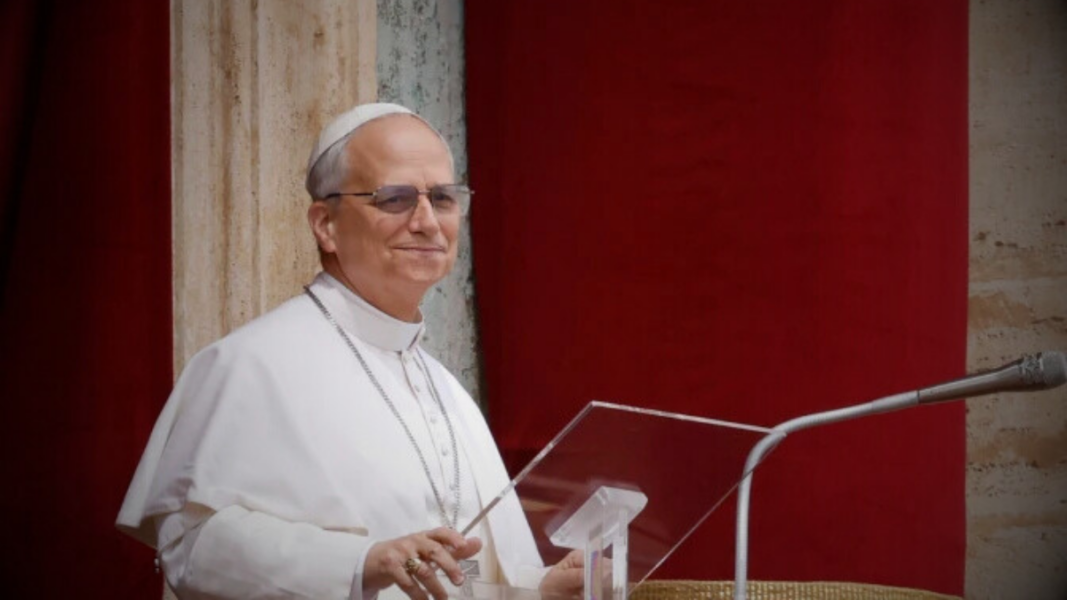
Leó XIV presided this Sunday, February 15, over the Angelus prayer from the window of the Vatican Apostolic Palace before the faithful gathered in St. Peter’s Square. In his introductory address, the Pontiff meditated on the “Sermon on the Mount” and emphasized that Christ did not come to abolish the Law, but to bring it to its full fulfillment, revealing its deepest meaning.
The Holy Father explained that the true justice of the Kingdom is not reduced to the external fulfillment of the commandments, but consists in the love that gives fullness to the Law. Jesus, he stated, calls for a “superior justice,” which goes beyond mere formal observance and demands an interior transformation that translates into respect, reconciliation, fidelity, and concrete care for one’s neighbor.
We leave below the complete words of Leo XIV:
Dear brothers and sisters, happy Sunday!
Today as well, we hear in the Gospel a part of the “Sermon on the Mount” (cf. Mt 5,17-37). After proclaiming the Beatitudes, Jesus invites us to enter into the newness of the Kingdom of God and, to guide us on this path, reveals the true meaning of the precepts of the Law of Moses, which are not meant to satisfy an external religious need and feel good before God, but to lead us into a relationship of love with God and with our brothers and sisters. That is why Jesus says that he has not come to abolish the Law, “but to fulfill” it (v. 17).
The fulfillment of the Law is precisely love, which realizes its deep meaning and ultimate purpose. It is about acquiring a “superior justice” (cf. v. 20) to that of the scribes and Pharisees, a justice that is not limited to observing the commandments, but opens us to love and commits us to love. Jesus, in fact, examines some precepts of the Law that refer to concrete cases of life, and uses a linguistic form—the antinomies—to show the difference between a formal religious justice and the justice of the Kingdom of God. On one hand, Jesus states: “You have heard that it was said to the ancestors,” and on the other: “But I say to you” (cf. vv. 21-37).
This approach is very important. It tells us that the Law was given to Moses and the prophets as a path to begin to know God and his plan for us and for history or, to use a phrase from St. Paul, as a pedagogue that has guided us toward Him (cf. Ga 3,23-25). But now, He himself, in the person of Jesus, has come among us bringing the Law to fulfillment, making us children of the Father and giving us the grace to enter into relationship with Him as children and brothers and sisters among ourselves.
Brothers and sisters, Jesus teaches us that true justice is love and that, in every precept of the Law, we must perceive a demand of love. It is not enough not to physically kill a person, if afterward I kill them with words or do not respect their dignity (cf. vv. 21-22). Likewise, it is not enough to be formally faithful to one’s spouse and not commit adultery, if in that relationship there is a lack of reciprocal tenderness, listening, respect, mutual care, and walking together in a common project (cf. vv. 27-28.31-32). To these examples, which Jesus himself offers us, we could add others. The Gospel offers us this precious teaching: a minimum justice is not needed, a great love is needed, which is possible thanks to the strength of God.
Let us together invoke the Virgin Mary, who gave the world Christ, He who brings the Law and the plan of salvation to fulfillment. May She intercede for us, helping us to enter into the logic of the Kingdom of God and to live in its justice.