


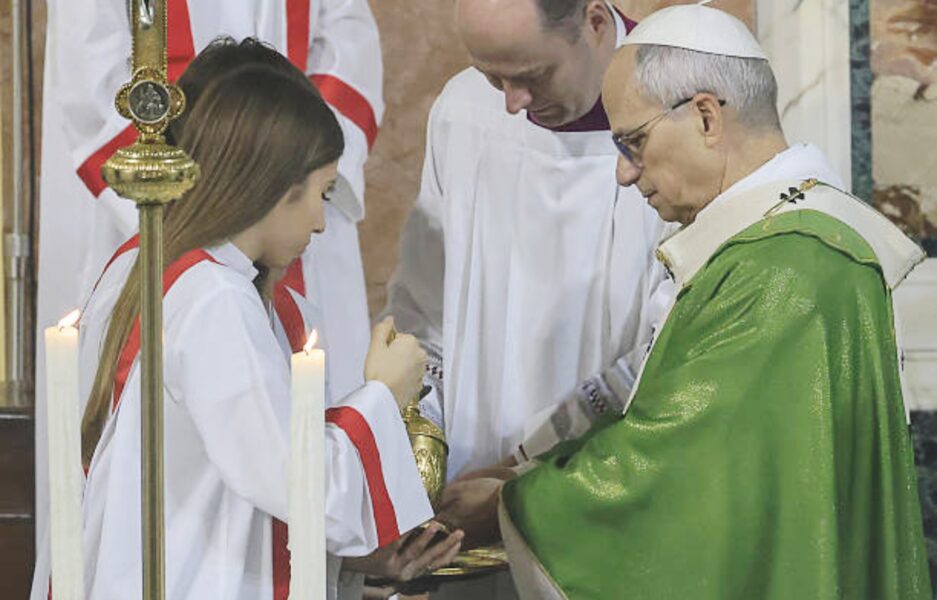
On Sunday morning, Pope Leo XIV celebrated Holy Mass in a parish on the Ostia coastline, in a sober pastoral visit, as Bishop of Rome, of an ordinary nature and with the usual diocesan dynamics. The liturgy featured direct participation from the faithful of the community and took place in a discreet atmosphere. However, one specific detail has captured attention: the altar service was partially performed by girl altar servers. The image is not unprecedented in the Church, but it is rare in celebrations presided over by the Roman Pontiff and, to date, it had not occurred during the pontificate of Leo XIV.
Since 1994, following an interpretive response published by the Congregation for Divine Worship during the pontificate of St. John Paul II, it was made clear that canon 230 §2 of the Code of Canon Law allows the diocesan bishop to authorize women and girls to perform functions of service at the altar. That clarification did not impose the practice nor make it mandatory, and it left intact the legitimacy of maintaining the tradition where it was deemed pastorally convenient. The decision always corresponds to the ordinary of the place.
It is necessary to distinguish between the altar boy and the acolyte. The altar boy—child or adolescent—provides a liturgical service without receiving an instituted ministry: he assists the priest, prepares the altar, carries the cross or the candlesticks. The acolyte, in the proper sense, receives a stable ministry conferred through a liturgical rite by the bishop. After the reform of the minor orders in 1972, the acolytate became a lay ministry, usually linked to seminarians or adult men committed to parish life.
Changes in recent years and their impact
In 2021, a significant change occurred: the motu proprio Spiritus Domini modified canon 230 §1 and expressly opened the instituted ministry of lector and acolyte to women as well. Since then, there are instituted female acolytes, not just girl altar servers. This is not an occasional service, but a stable ministry recognized by the Church. This reform does not affect in any way the doctrine on the priesthood—which the Church has affirmed definitively as reserved to men—but it does expand the framework of lay altar ministries.
In a Church in vocational crisis, the question of the altar is not secondary. In the Latin tradition, the service close to the altar was intimately linked to the ministerial priesthood. Not by a logic of task distribution, but by sacramental coherence: the priest acts in persona Christi, and the immediate surroundings of the altar had a formative dimension oriented toward that configuration. The altar boy was not simply someone who helped; he was someone who familiarized himself, from childhood, with the mystery of the Sacrifice.
Between the ages of eight and seventeen, roots are forged and major life decisions are made. The discipline of the rite, the proximity to the celebrant, all of that educates. Historically, that space has been one of the most fruitful channels for priestly vocations. Not by automatism, but by constant exposure to the center of the Church’s life: the Eucharist.
In a Western context marked by the scarcity of ordinations and the aging of the clergy, the pedagogy of the altar should acquire particular weight. The liturgy is not neutral; it transmits a concrete understanding of the priesthood and the difference between ordained ministry and lay service. One might ask whether, as it seems from the fruits, weakening the perception of that specificity can also affect vocational clarity.
The dramatic and constant crisis and the lack of adolescents and young people who want to dedicate themselves to the priesthood oblige us to think rigorously about how the altar environment is configured today and the proposal that is transmitted to new generations. What seems anecdotal or secondary could be one of the keys from which to analyze the lack of vocations.