


“You can’t put the cart before the donkey”; constitutes the content of a charming proverb typical of Spanish-speaking countries. We can apply it to an innumerable variety of everyday situations where secondary or accidental elements are given priority, bypassing the main or most predominant element.
In the present day, we see a sea of mentalities and scenarios notable for having tones of brazenness, incoherence, and irrationality where there is room to apply said proverb, specifically within the structure of the Holy Church. It is seen constantly and must be denounced with an accusing finger on the objective plane; it may be that several people do not know, but this does not suppose an exemption from responsibility for them. It manifests in various forms and in different spheres, such as merely aesthetic matters above the truths that the former must transmit; feelings/emotions prevailing over reality; each person’s subjective opinions that decapitate the cardinal binding foundations of our faith. Indicating in a precise manner, an order of elements that is inverted in a way already established by force, it is authority understood as superior to the Deposit of Faith, which leads to a severe detriment of the deepest, most profound or essential part of our faith.
The conception disseminated everywhere of having authority as a quasi-oracle of the Lord is so habitual that it does not raise any questioning among the faithful, and any type of interrogative questioning is taken as a vulgar lack of respect toward the hierarchy. “But they are the ones in charge… but they are the successors of the apostles and they cannot be wrong… they have the Holy Spirit that guides them… it is not possible that they are wrong or that they lead us astray, you have to trust…” These and another exorbitant amount of fallacies are the majority part of the very little formation instilled among the Lord’s sheep. The despotic and subversive behavior of the ecclesiastical hierarchs is contemplated as part of God’s positive will. A very simple example is the malicious action of Cardinal José Cobo against the Valley of the Fallen in Spain. This prelate has manifested his profound displeasure—for not saying the word hate— against the aforementioned place. It is impossible to determine the cardinal’s action as irreproachable for being guided by God or as a manifestation of the Holy Spirit doing God’s will through his position of authority.
In the current crisis infiltrated into the structure of the Church that has unleashed the most rudimentary elements of Catholicity, we see these inversions cited previously being used as deadly weapons against the essential part of our faith: the bimillennial doctrine. Having the badge of being part of the Ecclesia docens (teaching Church) today is assumed as a license endowed with the power to morph, change, even eliminate certain doctrinal points of our faith. From simony to modernism, it has been seen how the main objective of the enemies of Christ Jesus has been the doctrine. “Do not be deceived… if anyone walks in strange doctrine [heresy], he has no part in the passion [of Christ]” (cf. St. Ignatius of Antioch, Letter to the Philadelphians). What was dictated by the aforementioned saint leaves us seeing very clearly the need to keep the doctrine intact above all; this we can combine with the sacred words stipulated in the Athanasian Creed recited constantly in the tradition of the Church that, among other things, declares the following: “Whoever wishes to be saved must, above all, keep the Catholic faith. Whoever does not keep this faith whole and undefiled will undoubtedly perish eternally”.
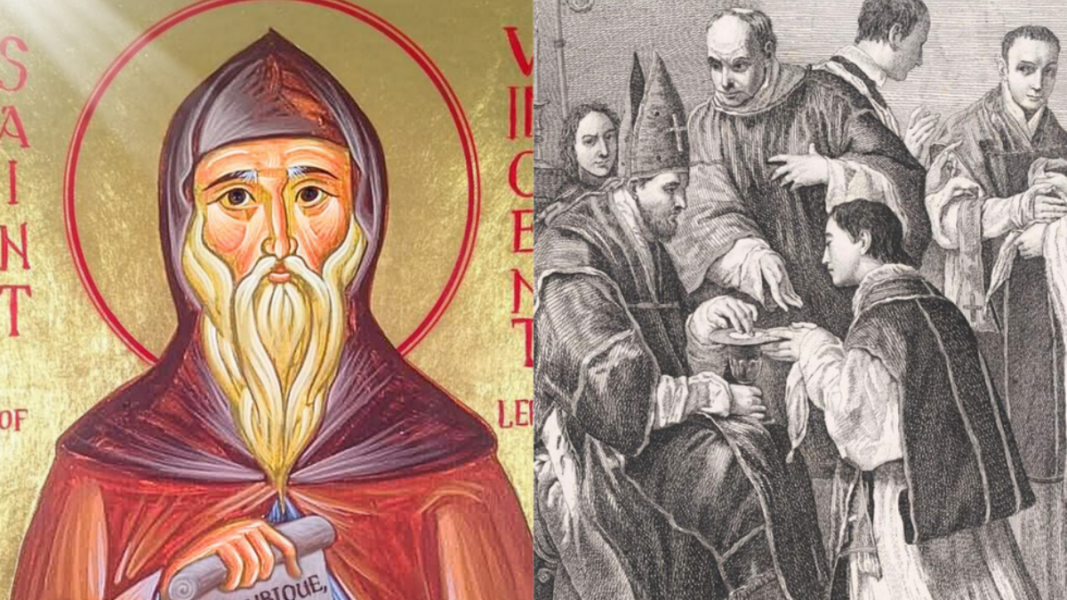
In order to counteract and heal that nefarious inversion of the order of things, we must always put doctrinal clarity in front. Below we are going to read a brief excerpt from the well-known patristic text called the Commonitory, written by St. Vincent of Lérins. Let us pay attention to the singular value of the Depositum Fidei (Deposit of Faith); it is so elevated that it is described in various ways to highlight its unmovable integrity and its normative force for each one of those who profess the Catholic faith. The saint highlights the unyielding task that bishops have to transmit the faith of always without altering it, something that today does not happen and is taken as a toy box disposed to their full discretion. Nothing nor anyone on the face of the earth has the power or authority to change or eliminate a single comma from the truths revealed by Christ Jesus and faithfully transmitted through the centuries. Receiving the entire faith is not a privilege nor a charism, but an inherent right of all the baptized who are fully empowered to demand it from their pastors. St. Vincent of Lérins is going to describe with perfect eloquence how we should handle ourselves with the tradition of the Church in order to transmit it to the future.
Let us read with the eyes of the soul the following to orient ourselves in these times when errors become more subtle, added to the subversive agenda of prelates who have preferred the pestilent world in substitution for the treasures of Christ.
***
“The Commonitory”, numeral 22, by St. Vincent of Lérins
«But it is profitable that we examine with greater diligence that phrase of the Apostle: “O Timothy, guard the deposit, avoiding profane novelties in expressions”.
This cry is the cry of someone who knows and loves. He foresaw the errors that were going to arise, and he grieved over it enormously.
Who is Timothy today if not the universal Church in general, and in a particular way the body of bishops, who, they principally, must possess a pure knowledge of the Christian religion, and moreover transmit it to others?
And what does “guard the deposit” mean? Be watchful, he says, against thieves and enemies; lest while everyone sleeps, they come stealthily to sow tares in the midst of the good grain that the Son of man has sown in his field.
But what is a deposit? The deposit is what has been entrusted to you, not found by you; you have received it, you have not devised it with your own strength. It is not the fruit of your personal ingenuity, but of doctrine; it is not reserved for private use, but belongs to a public tradition. It did not come from you, but to you it came: with respect to it you cannot behave as if you were its author, but as its simple custodian. You are not the one who initiated it, but you are its disciple; it will not correspond to you to direct it, but your duty is to follow it.
Guard the deposit, he says; that is, preserve inviolate and unstained the talent of the Catholic faith. What has been entrusted to you is what you must guard by your side and transmit. You have received gold, return gold therefore. I cannot admit that you substitute one thing for another. No, you cannot shamelessly substitute gold for lead, or try to deceive by giving bronze in place of precious metal. I want pure gold, and not something that only has its appearance.
O Timothy! O priest!, interpreter of the Scriptures, teacher, if divine grace has given you the talent through ingenuity, experience, doctrine, you must be the Bezalel of the spiritual Tabernacle. Work the precious stones of divine dogma, gather them faithfully, adorn them with wisdom, add splendor, grace, beauty to them. Let your explanations make comprehensible with greater clarity what was already believed in a dark manner. May future generations rejoice in having understood through your mediation what their fathers venerated without understanding.
But you must be attentive to teach only what you have learned; lest by seeking new ways of saying the doctrine of always, you end up saying new things as well.»
Nota: Los artículos publicados como Tribuna expresan la opinión de sus autores y no representan necesariamente la línea editorial de Infovaticana, que ofrece este espacio como foro de reflexión y diálogo.