


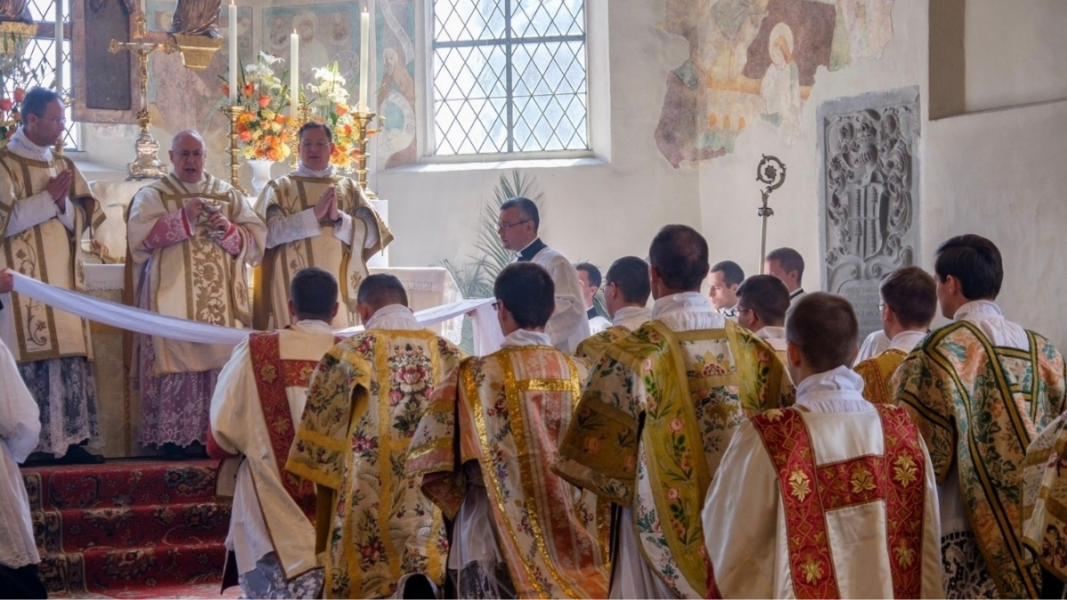
Today, February 14, 2006, at the seminary of the Priestly Fraternity of Saint Peter in Wigratzbad, in Bavaria, twelve young men (three Spaniards) have been ordained subdeacons. It is not noisy news. It will not appear in the world’s headlines. But in heaven there must have been a gentle thrill of joy, because twelve lives have taken a luminous step toward the altar.
The subdiaconate—today suppressed in the ordinary discipline after the motu proprio Ministeria quaedam of Paul VI (1972)—was not a mere practical function nor a decorative station on the path to the priesthood. It was, and remains where it is preserved, a true “ascent” to the altar, a sacred order that already introduces into the stable orbit of the major clergy, with grave and sweet obligations: perpetual celibacy and the integral recitation of the Divine Office.
Up to the subdiaconate, the seminarian had received tonsure—the sign of consecration—and the minor orders: porter, lector, exorcist, and acolyte. They were preparatory steps, necessary, beautiful; but the subdiaconate marked a threshold: it was no longer just about serving; it was about belonging in a definitive way. The subdeacon touches the chalice, prepares the altar, chants the Epistle, holds the sacred book, purifies the vessels. He does not consecrate, but he is already in the immediate circle of the Mystery. He lives in the sacred penumbra of the Holy of Holies, one step from the fire. And for that reason, the ancient Church always considered it a major order, with a stable bond to the altar and to the public prayer of the Church. The subdeacon becomes a man of the Office, a custodian of the Hours, a sentinel of choral praise. His day is no longer his own: it belongs to the Church.
In his Life of Saint Dominic of Silos, in the 13th century, Gonzalo de Berceo painted with admirable vividness the scala sancta of four sacred steps:
Such was the young man like silver as a four-grader,
the silver turned to gold when he became an epistolary,
the gold to pearl in the evangelist,
when he rose to priest he resembled the morning star.
The “[e]pistolary” is the subdeacon. Up to then, the silver of the one ascending the steps has been polished: the vigor of a divine mountaineer, the enthusiastic study of the discoverer of God, the clean purity of the sturdy youth, the attentive fidelity in the minor orders, the self-sacrificing obedience in the small things. But when he receives the solemn charge of proclaiming the Epistle—to be the voice of apostolic teaching in the assembly—the silver turns to gold. It is not yet the pearl of the deacon nor the radiant star of the presbyter; but it is already gold. Gold that does not shine for itself, but reflects a greater light. There is in that medieval metaphor a profound theology: grace does not annul nature; it purifies and elevates it. The silver does not disappear: it is transfigured. The chaste young man, formed in discipline, tested in fidelity, upon assuming the subdiaconate becomes a man of the altar, a man of irrevocable promise, a man of the breviary. Because one of the most eloquent aspects of the subdiaconate is that, from that moment, the candidate binds himself to perpetual celibacy and the daily recitation of the Divine Office. It is not a mere juridical norm: it is a theological sign. Celibacy is not sad renunciation, but eschatological anticipation. The subdeacon declares with his life that Christ suffices, that the Kingdom is real, that the altar is sufficient center. And the Divine Office—that uninterrupted current of psalms, hymns, and readings—introduces him into the very breathing of the Church. From that day, his voice intertwines with that of monks, consecrated virgins, priests, and the faithful who sanctify time. The subdeacon begins to live, in a stable way, what will be his future identity: a man ordained in sacris and segregated for the sacrum, but not separated from the world, but delivered to it from the altar.
The reform of Paul VI, by suppressing the minor orders and the subdiaconate in the ordinary Latin discipline, sought to simplify the ministerial structure and highlight the diaconate, also permanent. However, not a few have felt that with the disappearance of the subdiaconate, a precious pedagogical and ascetical nuance was also lost: that solemn moment in which the young man already commits himself definitively, when he is not yet a deacon, but already belongs juridically to the altar. For that reason, it is a motive for sincere joy that in institutes like the Priestly Fraternity of Saint Peter this sacred order is preserved according to the traditional liturgical discipline. Not as an archaeological gesture, but as a living expression of a theology of the priesthood that emphasizes continuity, gradualness, and the symbolic beauty of each step.
Twelve young men. Twelve personal stories. Twelve families that have given a son. Twelve wills that today have said, with trembling and firmness: I ascend. They ascend to the altar, but descend to the kenosis of the Servant of God. They ascend in dignity, but descend in humility. They ascend in responsibility, but descend in obedience.
The silver of tonsure and the minor orders has today been transformed into gold. Not worldly gold, but liturgical gold: the one that adorns the chalice, the one that surrounds the tabernacle, the one that burns in the monstrance. If they persevere—and the whole Church prays for it—that gold will turn into oriental pearl in the diaconate and a blazing star in the presbyterate. But already today they are, in a new way, men of the altar. And in a time when the sacred is so trivialized, when religious language is diluted and commitment is relativized, seeing young men embrace celibacy and the Divine Office as a joyful obligation is a sign of hope. Because each subdeacon is a promise of fidelity and continuity; a promise, young and enthusiastic, generous and valiant, that the altar will not be left empty.
The silver has turned to gold. A gold that reflects the light of Christ. A gold that will guard the Domus aurea: Mary, Mother priestly.
By: Msgr. Alberto José González Chaves