


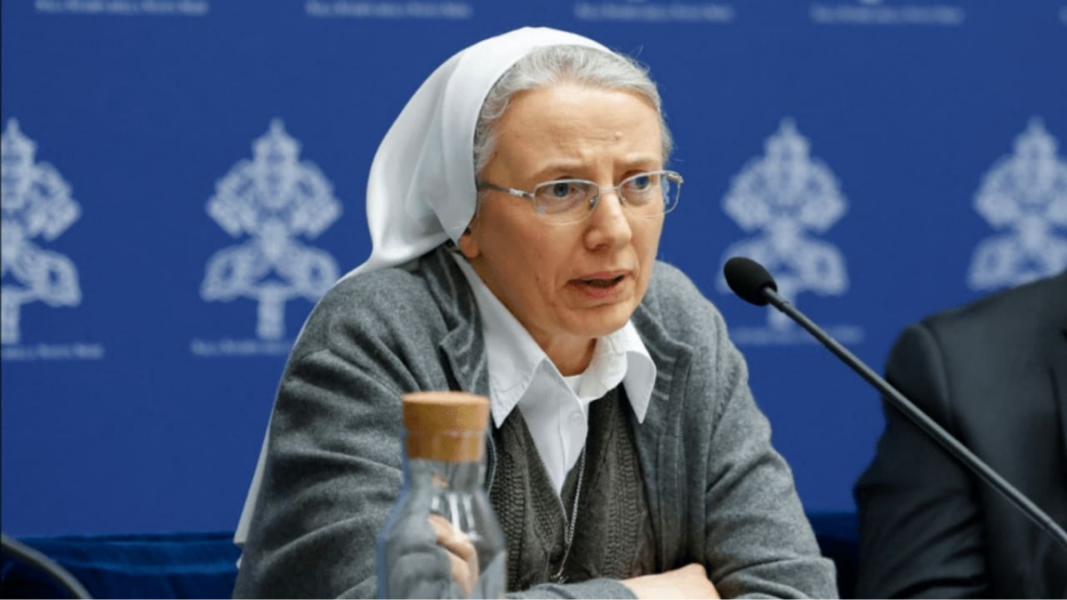
Pope Leo XIV has appointed Sister Simona Brambilla as a member of the Dicastery for Bishops, the body that studies and proposes episcopal appointments in the Latin Church. The announcement, officially communicated by the Holy See, confirms that the current prefect of the Dicastery for Institutes of Consecrated Life now adds a decisive area of influence in the governance of the Church.
The official note states that the Pontiff has appointed the religious sister—already prefect of Consecrated Life—as a member of the dicastery that advises on the election of bishops.
From Religious Life to the Heart of the Episcopate
Sister Brambilla has held the prefecture of the Dicastery for Institutes of Consecrated Life and Societies of Apostolic Life for a year, an organism in which she previously served as secretary.
Her name has been linked to theological approaches with a feminist bent, including expressions such as “God is woman,” which introduce a problematic reading of revealed language. Theological tradition has always taught that God reveals himself as Father; this is not an interchangeable category according to cultural sensitivities, but a datum transmitted in Revelation.
Read also: God is woman: the feminist theology of Sister Simona Brambilla
In the exercise of her role, Brambilla has been associated with restrictive stances in sensitive cases, such as the prolonged commissariat imposed on the Heralds of the Gospel. Under her responsibility in the dicastery, the process has been maintained without clear resolution for years, consolidating a line of firm and inflexible intervention toward that institution.
Whoever directs the dicastery charged with supervising religious life directly influences the formation, orientation, and discipline of thousands of communities. Now, in addition, she will participate in the body that intervenes in the selection of future bishops.
A Transversal Power in the Curia
The Dicastery for Bishops examines profiles, studies lists of candidates, and formulates proposals to the Pope. Although the final decision belongs to the Pontiff, its members contribute in a real way to shaping the type of shepherd considered suitable for each diocese.
Brambilla’s entry into the Dicastery for Bishops significantly increases her influence in the structure of the Curia and extends her imprint to the decisive sphere where the future episcopate is shaped. This is not a technical adjustment without greater reach. This step redefines internal balances and reinforces certain pastoral and theological lines in a key organism, making it clear which voices Leo XIV trusts to guide the course of ecclesial governance.
Members Confirmed by the Holy Father
The Holy See’s bulletin further specifies that the Pope has once again confirmed as members of the Dicastery for Bishops the following cardinals and prelates:
- Cardinal Pietro Parolin, Secretary of State.
- Cardinal Kurt Koch, Prefect of the Dicastery for Promoting the Unity of Christians.
- Cardinal João Braz de Aviz, Emeritus Prefect of the Dicastery for Institutes of Consecrated Life.
- Cardinal Sérgio da Rocha, Metropolitan Archbishop of São Salvador da Bahia (Brazil).
- Cardinal Blase Joseph Cupich, Metropolitan Archbishop of Chicago (United States).
- Cardinal Joseph William Tobin, C.SS.R., Metropolitan Archbishop of Newark (United States).
- Cardinal Juan José Omella Omella, Metropolitan Archbishop of Barcelona (Spain).
- Cardinal Anders Arborelius, O.C.D., Bishop of Stockholm (Sweden).
- Cardinal Jose F. Advincula, Metropolitan Archbishop of Manila (Philippines).
- Cardinal Augusto Paolo Lojudice, Metropolitan Archbishop of Siena-Colle di Val d’Elsa-Montalcino and Bishop of Montepulciano-Chiusi-Pienza (Italy).
- Cardinal Jean-Marc Aveline, Metropolitan Archbishop of Marseille (France).
- Cardinal Oscar Cantoni, Bishop of Como (Italy).
- Cardinal Grzegorz Ryś, Metropolitan Archbishop of Kraków (Poland).
- Cardinal José Cobo Cano, Metropolitan Archbishop of Madrid (Spain).
- Cardinal José Tolentino de Mendonça, Prefect of the Dicastery for Culture and Education.
- Cardinal Mario Grech, General Secretary of the Synod.
- Cardinal Arthur Roche, Prefect of the Dicastery for Divine Worship and the Discipline of the Sacraments.
- Cardinal Lazzaro You Heung-sik, Prefect of the Dicastery for the Clergy.
- Cardinal Claudio Gugerotti, Prefect of the Dicastery for the Eastern Churches.
- Cardinal Víctor Manuel Fernández, Prefect of the Dicastery for the Doctrine of the Faith.
- Cardinal Paul Emil Tscherrig, Apostolic Nuncio.
- Cardinal Rolandas Makrickas, Archpriest of the Papal Basilica of Saint Mary Major.
- Mons. Dražen Kutleša, Metropolitan Archbishop of Zagreb (Croatia).
- Mons. Jorge Ignacio García Cuerva, Metropolitan Archbishop of Buenos Aires (Argentina).
- Mons. Felix Genn, Emeritus Bishop of Münster (Germany).
- Mons. Paul Desmond Tighe, Secretary of the Dicastery for Culture and Education.
- Mons. José Antonio Satué Huerto, Bishop of Málaga (Spain).
- Fr. Donato Ogliari, O.S.B., Abbot of the Monastery of San Paolo fuori le Mura.
- Sister Raffaella Petrini, F.S.E., President of the Pontifical Commission for the State of Vatican City.
- María Lía Zervino, former president of the World Union of Catholic Women’s Organisations.
The set of names confirms the profile of the body charged with advising the Pope on the election of bishops. In that framework, the expansion of Sister Simona Brambilla’s scope of action consolidates her weight in a decisive instance for the future leadership of the Church.