


By Brad Miner
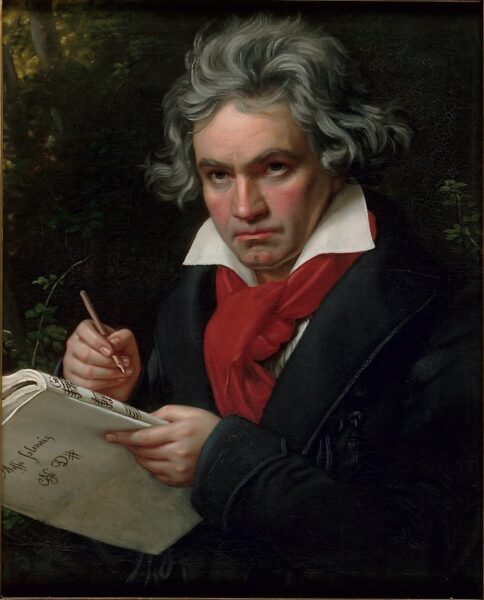
Like many figures of the Enlightenment, Ludwig van Beethoven was both religious and secular. He was more Catholic than W. A. Mozart, though I’m not sure that means he was less secular.
Secular is probably not the right word, in any case; republican is better.
Beethoven was born in 1770, so he was about 19 years old when the French Revolution broke out. He may well have agreed with William Wordsworth that «Bliss was it in that dawn to be alive, / But to be young was very heaven!». Then came the terror, and Wordsworth writes: «And finally, I lost all sense of conviction and, in sum, / abandoned moral questions in despair». (The Prelude, 1798-1799)
On June 9, 1804, Beethoven premiered his Symphony No. 3 in E-flat major, Op. 55, known as the Eroica («Heroic»), which very clearly reflected his enthusiasm for Napoleon Bonaparte’s republicanism, to whom he dedicated the work.
But the shine of that rose also wilted soon when, six months later, Napoleon crowned himself emperor, at which point Beethoven took the manuscript of the Third and, fuming, furiously crossed out the dedication.
Both Mozart and Beethoven found themselves near the end of their lives composing Masses that they would not live to see performed. Mozart’s Requiem (1791) remained unfinished (though «completed» by his student Franz Xaver Süssmayr), and the work—profoundly beautiful—remains among the composer’s most performed. Rarely at funerals, however.
Beethoven’s Missa Solemnis (finished in 1823) is among the least performed of his compositions. There is a sad irony in this, given that the composer considered it his greatest work. Along with his Choral Symphony (No. 9 in D minor, Op. 125), the Missa Solemnis occupied the last great creative period of Beethoven’s life, roughly from 1820 to 1825.
Beethoven’s judgments on music were remarkably accurate. But, as great as the Missa is, most musicologists consider the Choral to be Beethoven’s best work, followed by the Eroica, several other symphonies, and a handful of both glorious piano sonatas and string quartets. Only then do we come to his Masses, the other being the Mass in C major from 1807, written for the episcopal installation of his friend, student, and patron, Archduke Rudolph of Austria, Prince Royal of Hungary and Bohemia, Cardinal Archbishop of Olomouc, for whom he also composed the Piano Trio, Op. 97, today known as the Archduke. Beethoven, busy and distracted, presented the Mass in C to the archbishop two years after the ceremony.
About the Missa Solemnis, Beethoven wrote to his friend Andreas Streicher (September 16, 1824): «During the work on this great Mass, my main purpose was to arouse religious feelings in the singers and listeners and to inculcate them permanently».
I wrote above that neither Mozart nor Beethoven lived to see their last Mass compositions performed, but that is not entirely true in Beethoven’s case.
On May 7, 1824, Beethoven, 53 years old, entered the auditorium of Vienna’s Kärntnertor Theater, took his place on the podium, turned for a moment to acknowledge the audience, then turned to the orchestra, raised his hands, and began to lead the musicians through the 11-minute overture, Die Weihe des Hauses («The Consecration of the House»), which he had composed two years earlier for the grand reopening of another Viennese theater, the Theater in der Josefstadt. The Kärntnertor audience enjoyed the overture.
Beethoven then conducted only three parts of the Missa Solemnis: the Kyrie, the Credo, and the Agnus Dei. And the audience received the music warmly.
Then the great composer conducted the premiere of Symphony No. 9.
As the end of the nearly 90-minute masterpiece approached, Beethoven was exhausted, physically and emotionally, and was not aware that, throughout the evening, the agitated movement of his arms and his animated facial gestures had no effect at all on the members of the orchestra or the chorus. All had been instructed to look only at the Kapellmeister, Michael Umlauf, who was in their sight (but not Beethoven’s), marking the tempo for them: a necessary precaution, as it was likely that Beethoven would lag behind the score… and so it happened.
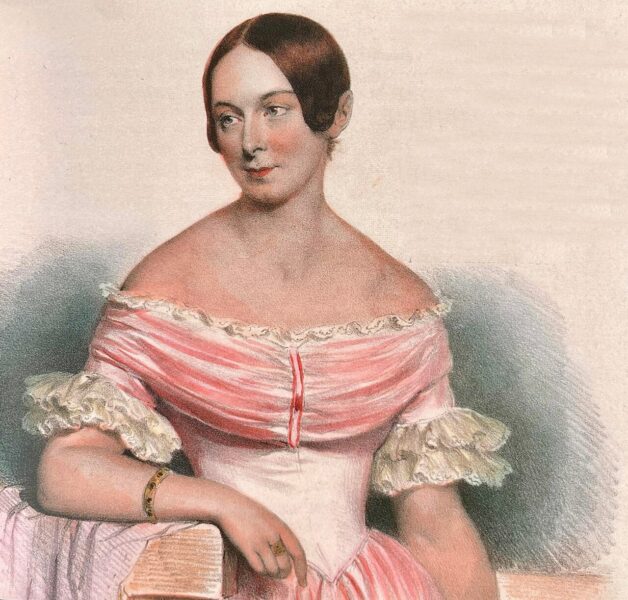
Beethoven, with his head now fallen, exhausted, was completely unaware not only of Umlauf’s efforts, but also of the thunderous applause in the theater behind him. He may still have been conducting, until the solo contralto Karoline Unger approached the podium. Gently placing her hands on Beethoven’s arm, she turned him to face the audience.
Did everyone present that night know that Beethoven was completely deaf? Perhaps. But it is said that when Unger performed her loving act of charity, it was electrifying. The applause stopped for an instant and then erupted with force, described by a witness as volcanic. The crowd, already enthused by the music, was now carried away by an almost rapt realization that Beethoven had not heard a single note of his own music that night, nor the audience’s cheers.
But now Beethoven saw them all—orchestra, chorus, and audience—with mouths agape and eyes shining with tears, as they applauded, cheered, stamped their feet, and waved hats and handkerchiefs—or struck their string instruments with their bows.
They had witnessed a genius who could not hear them, nor hear the glorious music even though he himself had composed it. So now they allowed him to see how moved they were. He too was moved. It must have been a moment they would never witness again and would never forget.
The «Choral» part of Beethoven’s Ninth derives from the poem by Friedrich Schiller, An die Freude («Ode to Joy»), and forms the basis of the symphony’s final movement. Schiller was not Catholic. Beethoven was.
Beethoven considered Georg Friedrich Händel, a Lutheran, the greatest of all composers, and The Messiah the greatest of Händel’s compositions, and this, I believe, was what he was aiming for.
I resist calling the Ninth Catholic, but it is certainly not a hymn to the Culte de la Raison. After years of fear that total deafness would deprive him of his gift, the joy of the Ninth remains as Beethoven’s prayer of thanksgiving to God, whom he knew he would soon meet.
Beethoven died on March 26, 1827. He had received Viaticum three days earlier.
[The video is of the Dresden State Orchestra and Choir performing the Sanctus: Benedictus from the Missa Solemnis, conducted by Fabio Luisi.]
About the author
Brad Miner, husband and father, is senior editor of The Catholic Thing and senior fellow of the Faith & Reason Institute. He was literary editor of National Review and had a long career in the publishing industry. His most recent book is Sons of St. Patrick, written with George J. Marlin. His successful The Compleat Gentleman is now available in a third revised edition and also as an Audible audio edition (read by Bob Souer). Mr. Miner has served as a member of the board of Aid to the Church in Need USA and also on the Selective Service System draft board in Westchester County, New York.