


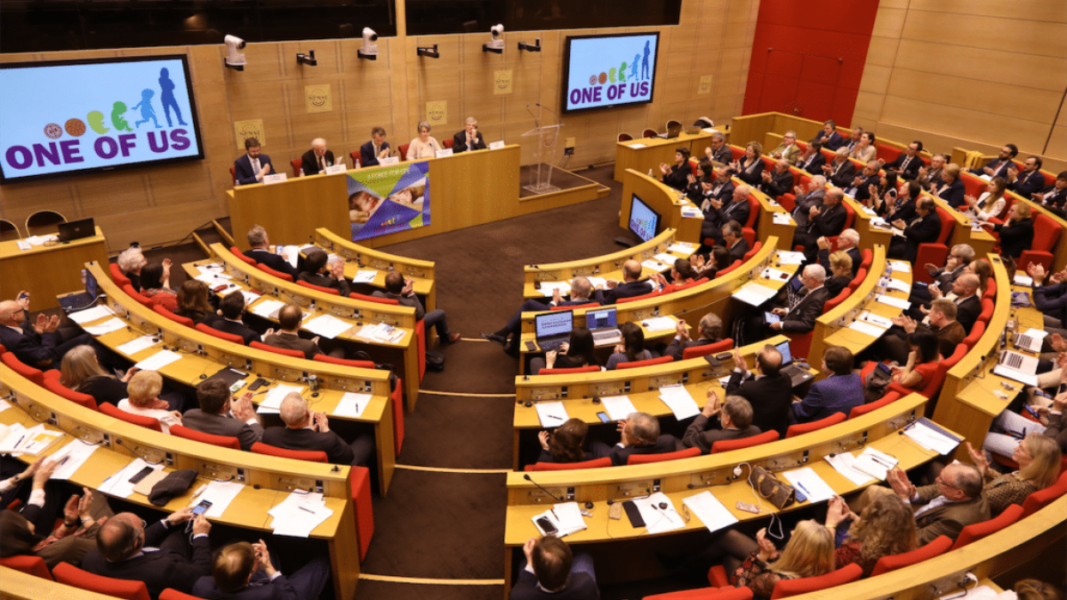
Various European pro-life organizations have launched an international campaign to halt the possibility of the European Union funding cross-border travel to access abortion in countries with more permissive legislation.
The initiative, driven by the One of Us federation, comes in the wake of the resolution adopted by the European Parliament in December 2025 in support of the European Citizens’ Initiative (ECI) “My voice, my choice,” which proposes the creation of EU-funded mechanisms to facilitate access to abortion services between Member States.
The controversy over the EU’s competencies
As explained by the promoters of the “No to abortion tourism” campaign, the proposal would allow a woman to claim funding to travel to another Union country where the regulations are broader in terms of deadlines or decriminalizing circumstances.
Pro-life organizations argue that this resolution represents an overreach of community competencies. They contend that the regulation of abortion falls within the national sphere, both in terms of public health and, in some countries, in the realm of criminal law, and that the measure would undermine the principle of subsidiarity enshrined in the European treaties.
In the letter addressed to the European Commission, the EU’s executive body, the promoters remind that the current treaties expressly exclude the harmonization of national legislation in this area.
Legal scope of the initiative
The promoters emphasize that, although the European Citizens’ Initiative “My voice, my choice” has met the formal requirements, this does not oblige the Commission to present a legislative proposal. They also recall that an ECI does not create new competencies for the Union, but merely requires the Commission to examine the proposal and issue a reasoned response.
Likewise, they point out that the resolution approved by the European Parliament has a political character and no binding legal force.
As they warn, if the proposal were to be transformed into European legislation, it could in practice lead to a widespread application of the most permissive regulations, by facilitating cross-border access funded with community funds.
The precedent of the One of Us initiative
The current campaign is framed within the previous experience of the One of Us movement, which in 2014 promoted a European Citizens’ Initiative to prevent the funding of activities involving the destruction of human embryos.
That text garnered nearly two million signatures, becoming the ECI with the greatest citizen support in the history of the European Union. However, the European Commission dismissed the request citing a lack of competence in the matter.
The new debate thus reopens the discussion on the limits of action of community institutions in bioethical issues and on the balance between national sovereignty and common policies within the European Union.