


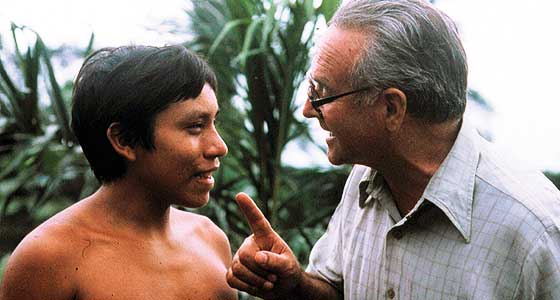
The portal Infocatólica has highlighted the deep controversy surrounding the beatification process of Mons. Alejandro Labaka, opened in May 2025 by Leo XIV. And it has done so by recalling something that for years has remained in a discreet second plane: the explicit texts, written and published by the protagonist himself, which describe situations of systematic nudity, sexualized coexistence with young people, and a conception of inculturation based on liberation theology, which did not intend to modify local customs but to idealize them and integrate into them: a failed and absurd vision that also seriously challenged the moral tradition of the Church and its missionaries.
It is important to note that in the analysis of Bishop Labaka’s autobiography, we are not dealing with rumors or hostile reconstructions. We are dealing with pages printed in the Crónica Huaorani and in other autobiographical writings by Labaka himself. His beatification process was officially opened on May 22, 2025, when Pope Leo XIV authorized the promulgation of the decrees recognizing his life as an “offering of life” and his venerability, thus marking the initial phase of the path toward beatification in the Catholic Church.
That act is not merely a formality: it implies that the Holy See recognizes that Labaka lived his missionary vocation with heroic dedication until death, and it places him in the stage of “Venerable Servant of God,” a necessary prior step before he can be declared blessed and, in the future, a saint, if the conditions are met.
Precisely for that reason, what appears there demands serious, direct reflection without euphemisms. The discussion cannot be reduced to personal sympathies or emotional judgments about his violent death. With an open beatification process, it is important to examine the texts, the concrete pastoral decisions, and their coherence with the moral doctrine of this bishop in Catholic teaching.
“Blessed Nudism”: when adaptation becomes ideology
Labaka, a missionary bishop in the Amazon, does not simply describe a cultural adaptation forced by the climate or necessity. He elevates nudism to an almost theological category:
“Blessed nudism of the Huaorani, who do not need cloths to safeguard their norms of natural morality!” (CH, 39).
And he adds:
“They lived naked and I too was often naked like them”.
It is not merely a matter of tolerating a local custom while proclaiming the Gospel. It is about assuming it as an original moral paradigm, as a return to the “Paradise before sin”:
“God has wanted to preserve in this people the way of life, the natural morality as in Paradise before sin” (CH, 57).
The issue is not the fabric, but the theology. In the Christian tradition, modesty is not a secondary cultural convention, but an anthropological expression linked to the consciousness of original sin and the dignity of the body. Presenting a specific culture as an intact preservation of prelapsarian “natural morality” implies a profound theological idealization.
Inculturation, according to the magisterium, involves assuming what is true and good in each people, but always in the light of the Gospel. When adaptation is formulated in terms of original moral superiority, the risk is no longer practical, but doctrinal.
Sexualized coexistence with young people: texts that admit no makeup
The truly grave point is not abstract nudism, but the scenes that Labaka himself narrates with unsettling frankness.
He describes repeated dynamics of excitement among young people:
“I observed the ease, or rather the almost generalized practice as something ritual, of exciting themselves among the males frequently (…) not to mention other games of homosexual aspect in their long family gatherings” (CH, 57).
And in that context, he explains that he decided to bathe and coexist naked with them:
“Starting from their reality required me to bathe with them or like them, or in the sight of young people and children, with complete naturalness; intentionally performing the full grooming of an adult male; allowing to satisfy the natural curiosity to touch and see in what they see us different…”
The situation does not end there. He himself acknowledges attempts at provocation:
“One of the adolescents wanted to excite me and I prevented it with smiling energy”.
In another passage, he recounts:
“Peigo stayed, apparently, without a hammock and approached my bed (…) I shared the bed lying down naked under the same mosquito net” (CH, 51-52).
And even more explicit:
“The young people were more playful than ever, abound in words and signs that figured the union of sexes, allowing touches on the genitals. This time they especially bothered me, until confirming with uproar that male reactions are identical between us and the Huaorani. In any case, they did not insist either with me or among themselves in a way that pollution occurred. I tried not to make any drama and made an effort to act with naturalness, laugh with them and dissuade them from the game” (CH, 146).
Deliberately placing oneself in a repeated context of sexual excitement with young people, sharing nudity and nighttime space, and describing it as a pastoral method raises a grave scandal regarding prudence, continence, and moral judgment.
In an ecclesial context especially sensitized by abuses, these texts cannot be minimized as mere cultural anecdotes.
From personal decision to pastoral method
The issue worsens when this practice is not reduced to a debatable individual option, but is presented as a missionary model.
“The missionary does not have to wait to be undressed, but will do better to take the lead in doing so to show appreciation and esteem for the Huaorani people’s culture” (CH, 144).
Nudity ceases to be a tolerated circumstance to become a programmatic gesture. Moreover, the described scenes include coexistence in mixed contexts, with the participation of religious sisters in situations where nudity is normalized as a communicative tool.
An inculturation without a purifying dimension
The theological core of the problem is even deeper. In Labaka’s texts, an inculturation appears that seems to dilute the corrective dimension of the Gospel.
He himself describes practices that he qualifies as “games of homosexual aspect” or ritualized excitement dynamics. However, no clear horizon of moral transformation or call to a gradual pedagogy of purification is apparent.
The Catholic tradition has always taught that the Gospel assumes what is true and good in cultures, but purifies what is disordered. Inculturation is not uncritical fusion, but transformative insertion.
When sexualized practices are naturalized under the category of “extraordinary sexual maturity” and any moral confrontation is avoided for fear of “creating complexes,” the mission runs the risk of becoming neutral accompaniment rather than salvific proclamation.
That shift is not minor: it affects the very concept of evangelization.
Beatification and ecclesial responsibility
Mons. Labaka died violently in 1987. That fact is tragic and no one disputes it. But beatification does not canonize dramatic circumstances; it examines heroic virtues, doctrinal orthodoxy, and integral moral coherence.
In a Church marked by the wound of abuses, is it prudent to proceed without an exhaustive examination of writings where a priest describes naked coexistence with young people who attempt to excite him and scenes of genital touching in his immediate environment? Raising these questions is not puritanism. It is ecclesial responsibility. Holiness does not fear the light. The Church must have the courage to recognize the errors of liberation theology and of missionaries who had an atrophied vision of an “inculturated” evangelization in error.
Literal quotes from Mons. Alejandro Labaka
-
-
“Blessed nudism of the Huaorani, who do not need cloths to safeguard their norms of natural morality!” (Crónica Huaorani, 39; from now on, CH).
-
“They [the Huaorani] went naked, we began to go that way too. (…) They lived naked and I too was often naked like them” (Tras el rito de las lanzas, Vida y lucha de Alejandro Labaka, CICAME, Coca, Ecuador, 2003, 199-200).
-
“God has wanted to preserve in this people the way of life, the natural morality as in Paradise before sin” (CH, 57).
-
“As I was, in underwear, I advanced to the head of the family, Inihua and Pahua, his wife; next to me was already the eldest son. With the words father, mother, sisters, family I strove to explain to them that they, from now on, constituted my parents, siblings; that we were all one family… I undressed completely and kissed the hands of my Huaorani father and mother and siblings, reaffirming that we are a true family” (CH, 37).
-
“I feared being a rejection for the Huaorani culture and customs if I showed myself too rigid (…). In those circumstances, I understood that the missionary, if he has to walk through the jungle with them, must walk like them to be able to dress when the occasion of the night’s cold arrives” (CH, 38).
-
“Missionaries must behave with complete naturalness among them; not be surprised by their nudism or certain curiosities they may have with us, and even we must undress voluntarily in some circumstances, not in a plan of exhibitionism but to not create guilt complexes in a culture of extraordinary sexual maturity” (CH, 103).
-
“Every time new missionaries join the team, the same concerns arise from our first contacts with the Amazonian culture of the ‘naked man.’ The concern, turned almost into obsession, was that the Huaorani undressed everyone. Admitting all that nudity was legal within their culture, it constituted, however, one of the greatest difficulties for the entry of missionary personnel, especially religious sisters. Very soon we realized that the missionary does not have to wait to be undressed, but will do better to take the lead in doing so to show appreciation and esteem for the Huaorani people’s culture” (CH, 144).
-
“At one point, we find that the path is lost in a deep swamp of about five hundred meters in extent. Without hesitating a moment Deta (an indigenous woman) undresses and advances naked with the water up to above the waist; upon reaching the opposite shore she encourages us smiling, while we walk cautiously, without daring to imitate her example because of our educational prejudices. After a couple of hours we return by the same path. Deta, this time, does not take off her shorts and crosses the swamp, followed by the Sisters. Shortly after we arrive: Neñene, with her child in her arms, indicates that I help her untie the knot of her shorts which, then, she hands me so that I pass it to her. Before this sign of trust and naturalness, I also undress and we cross the swamp that way” (CH, 145).
-
“This is the only occasion in which the whole group equally lived in the presence of the Creator a beautiful chapter of the Bible (Gen. 2, 25)” (CH, 113).
-
“I observed the ease, or rather the almost generalized practice as something ritual, of exciting themselves among the males frequently and whenever they do their needs; not to mention other games of homosexual aspect in their long family gatherings. Starting from their reality required me to bathe with them or like them, or in the sight of young people and children, with complete naturalness; intentionally performing the full grooming of an adult male; allowing to satisfy the natural curiosity to touch and see in what they see us different, like, the hairy parts of the body. But right there the opportunity was offered to me to give a lesson, when one of the adolescents wanted to excite me and I prevented it with smiling energy” (CH, 57).
-
“Peigo [a young Huaorani] stayed, apparently, without a hammock and approached my bed. On previous days I had rejected him, for I feared him because of his gestures and provocative homosexual attempts. This time I had another understanding of ‘accept everything, except sin’ and I shared the bed lying down naked under the same mosquito net” (CH, 51-52).
-
“We went to bed very early, as soon as it got dark. The house consists of a single room: In one corner is the stove, between the hammocks of the spouses Inihua and Pahua. On the other side are the remaining hammocks, taken from the Company workers, with their awnings and blankets, in an east-west direction. My bed they put behind, in a north-south direction, on the floor, so that we can hold hands with the young man who sleeps next to me in the hammock. I am soaked in sweat and I take off my shirt and pants” (CH, 36).
-
“My mother Pahua insisted that we all sleep in her house, despite there being almost no physical space for it (…). The young people were more playful than ever, abound in words and signs that figured the union of sexes, allowing touches on the genitals. This time they especially bothered me, until confirming with uproar that male reactions are identical between us and the Huaorani. In any case, they did not insist either with me or among themselves in a way that pollution occurred. I tried not to make any drama and made an effort to act with naturalness, laugh with them and dissuade them from the game (…). In this concrete circumstance nothing would have been so ridiculous nor produced so much hilarity as the erection achieved in Captain ‘Memo’ [that was Fr. Labaka’s nickname, in Aguarico]. When they came back to bed, I had just asked forgiveness from God in case I had become ‘an old green homosexual’” (CH, 146).
-