


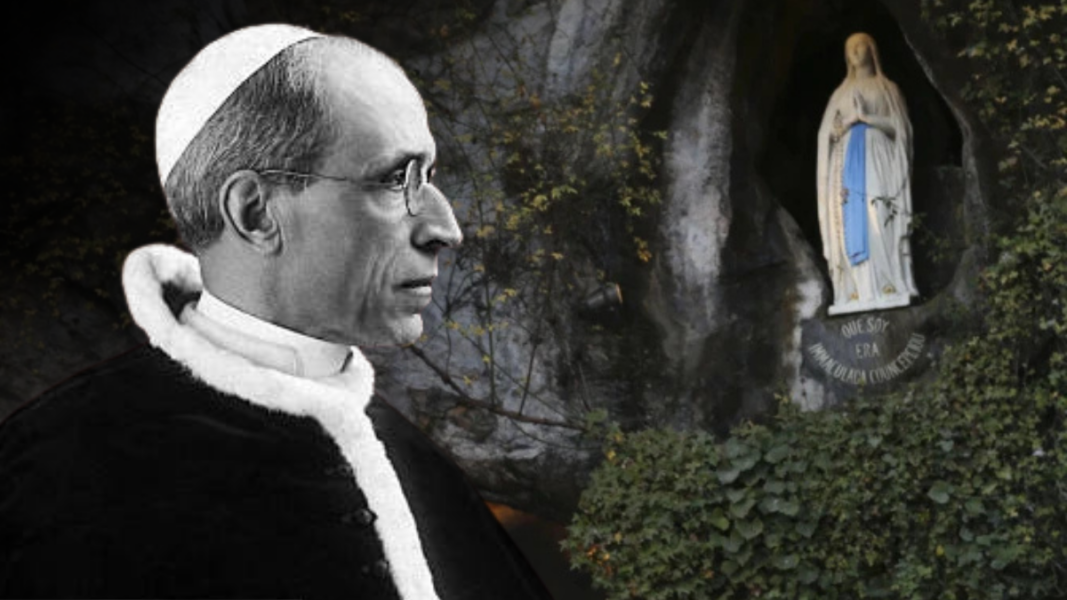
On July 2, 1957, feast of the Visitation of Our Lady, Pius XII publishes his only encyclical in French, Le pèlerinage de Lourdes, on the occasion of the centenary of the apparitions. Pastoral and exhortative in tone, it aligns with the Church’s doctrinal line on the mission of the Most Holy Virgin in the economy of salvation. The starting point is distinctly Christological: Lourdes, Marian devotion, and the figure of Mary can only be understood from Christ. As the hermeneutical key to the entire text, Pius XII writes that «everything in Mary leads us to her Son, the only Savior.» With this phrase, he dismisses any autonomous or parallel reading of Marian mediation: the Immaculate One does not occupy an independent intermediate place, but leads to Christ and constantly refers to Him.
However, this absolute reference to Christ does not empty Mary’s mission, but defines it. Pius XII describes it in very clear terms, recalling the way the Virgin manifested herself in Lourdes: «She comes to Bernadette, makes her her confidante, her collaborator, the instrument of her maternal tenderness and of the merciful omnipotence of her Son, to restore the world in Christ through a new and incomparable outpouring of the Redemption.» Mary appears as an instrument desired by God, associated with Christ’s redemptive action, not as a source of salvation, but as a subordinate collaborator in the application of its fruits.
The Pope does not limit himself to describing a past event: Lourdes is a permanent sign of this economy of grace, where the encounter between human suffering and Christ’s redemptive action is manifested in a visible way: «Never, in any place on earth, has such a procession of suffering been seen; never such a radiance of peace, serenity, and joy.» The contrast is not accidental: pain, assumed and offered, becomes a place of grace. The Pope recalls that «the Immaculate Virgin, who knows the secret paths of grace in souls and the silent work of that supernatural leaven of the world, knows how much your sufferings united to those of the Savior are worth in the eyes of God.» Mary understands the redemptive value of suffering because she is intimately associated with Christ’s sacrifice. Without using the term «co-redemption,» Pius XII expresses the reality of the concept: a real cooperation, though totally subordinate, in the work of the only Redeemer.
From this association springs Marian mediation in the order of grace, as Pius XII expresses by recalling that in Lourdes «fervent supplications have obtained from God, through Mary’s intercession, so many graces of healing and conversion.» The Virgin’s mediation is not a sentimental resource, but an effective intercession, desired by God, always oriented toward conversion and the renewal of man. This mediation is embodied in an insistent and almost urgent invitation. Pius XII reproduces the Virgin’s call with direct words: «Go to Her… go to Her… go to Her… and receive peace of heart, the strength of daily duty, the joy of sacrifice offered,» as fruits of a grace that transforms life and orients it to God.
The Pope extends this perspective to the whole Church and society: sufferings offered and united to those of Christ «can contribute in great measure to that Christian renewal of society that we implore from God through the powerful intercession of his Mother.» Marian mediation is not enclosed in the private sphere of devotion, but has an ecclesial and social dimension: Mary cooperates, from her maternal mission, in the redemptive fruitfulness of the Church in the world.
Pius XII presents the invitation of Lourdes as a call that is always current. Recalling the words addressed to Bernadette, he emphasizes that the Mother of God «without imposing herself, urges men to reform themselves and to work with all their strength for the salvation of the world.» Mary’s discretion does not diminish the exigency of her call; her mediation does not substitute personal responsibility, but awakens and sustains it.
Pius XII concludes by imploring for the Church «the most ample outpouring of graces.» The Redemption, the exclusive work of Christ, is poured out upon the world through grace; and in this design, by God’s will, Mary occupies a singular place as associated Mother, mediator, and intercessor. In Le pèlerinage de Lourdes, Pius XII shows the Virgin’s mission as inseparable from Christ, totally subordinate to Him, but truly associated with the diffusion of the fruits of the Redemption. Lourdes thus appears as a mirror of Mary’s maternal mediation in the service of the world’s only Savior.