


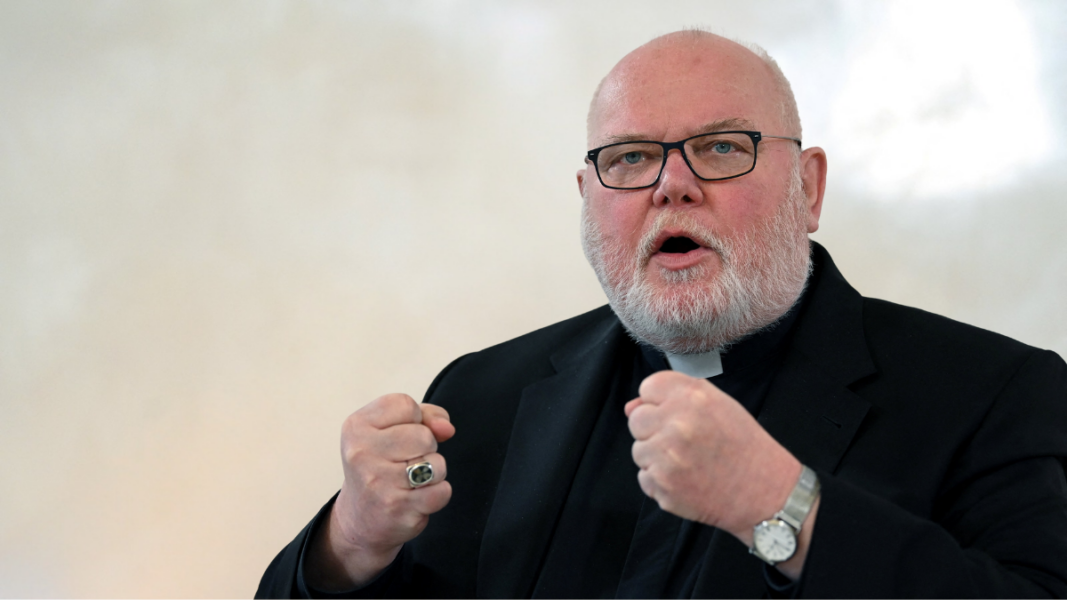
The progress of the German Synodal Way towards the creation of a permanent Synodal Conference, with monitoring functions over the implementation of its resolutions in the dioceses, has exposed internal tensions among the bishops themselves, including the explicit opposition of one of its main promoters, Cardinal Reinhard Marx, Archbishop of Munich and Freising, who openly exclaimed: “I don’t want this!”, expressing his rejection of the creation of a national body that supervises the bishops and intervenes in the life of the dioceses.
According to an analysis published by kath.net, the recent vote that introduces mechanisms of monitoring—supervision—over the diocesan bishops has highlighted a fundamental contradiction: a synodal process whose promoters claim that its resolutions are not binding, but which at the same time establishes control structures over those who do not implement them.
From Promoter of the Process to Critic of the Result
Marx was one of the main promoters of the Synodal Way from its inception in 2019, along with the then president of the Central Committee of German Catholics (ZdK). The process, conceived as a response to the abuse crisis and as a platform for structural reforms, has produced more than 150 pages of resolutions on issues such as priestly celibacy, lay preaching, and the role of women in the Church.
However, the approval of the control mechanism over the bishops seems to have marked a red line even for the cardinal. The system requires dioceses to report which resolutions they have implemented and which they have not, with each bishop having to justify himself before the new Synodal Conference.
Paradoxically, the approved structure envisages a composition in which the bishops would be in the minority compared to lay representatives linked to the ZdK, which would allow decisions to be made without the prelates having an effective veto right.
A Controversial Vote
The vote formally reached the required two-thirds majority, but through a disputed calculation: abstentions were considered as votes not cast, which allowed 21 favorable votes to suffice to achieve the qualified majority, despite Germany currently having 59 bishops. Of the 47 present, only 33 voted, which would have raised the real threshold to 22 votes if an ordinary criterion had been applied.
A Fundamental Ecclesiological Problem
The resolutions of the Synodal Way are not binding in character and, in some cases, conflict with Church doctrine. No bishop is canonically obligated to implement them. Nevertheless, the new system introduces a mechanism of public signaling that, in practice, functions as a form of political and media control.
From the Church’s point of view, this model poses a serious problem. The Holy See has repeatedly reminded that synodal bodies are strictly consultative, lack decision-making authority, and cannot exercise supervision over the bishops, whose authority derives from the apostolic order.
Finances and Lay Power
Another of the most controversial aspects is the possible attribution to the Synodal Conference of competencies in financial matters, including a role for the Central Committee of German Catholics (ZdK) in controlling the budget of the German Dioceses Association (VDD). Various canonists have pointed out that the ZdK lacks ecclesiastical legal status, making this proposal particularly problematic.
Although bishops legitimately rely on experts and consultative bodies, canon law clearly establishes that ultimate responsibility for diocesan goods lies with the bishop, whose signature is essential for the validity of economic acts.
Waiting for Rome
The statutes of the future Synodal Conference must still be approved by the German Episcopal Conference and sent subsequently to the Holy See. There is an expectation that Rome will not approve a model that introduces control or supervision functions incompatible with Catholic ecclesiology, although some German bishops trust that the text can be “canonically redirected.”
In the meantime, the paradox remains: Cardinal Marx rejects a control structure that the Synodal Way itself—of which he has been a promoter—has ended up designing. A contradiction that highlights the ecclesial viability of this process and its compatibility with the communion of the Church.