


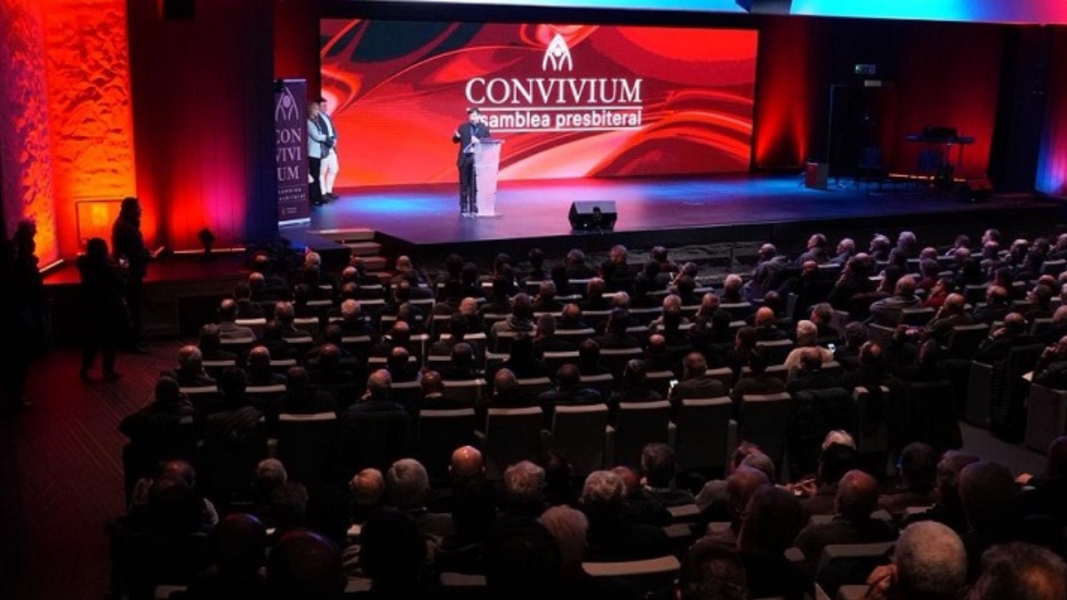
The Archdiocese of Madrid has concluded CONVIVIUM, the Presbyteral Assembly held on February 9 and 10 in the Auditorio Pablo VI. The Archbishop of Madrid, Cardinal José Cobo, closed the meeting by synthesizing the process into ten concepts that, as he explained, were present both in the pre-assemblies and in the final sessions.
The first was the call to walk together. “We are not here for an idea, but because we have been called,” he affirmed, emphasizing the vocational character of the priestly ministry.
“Convoked” to exercise pastoral care with others
The second concept was the word CONVIVIUM itself. “We are the convoked, and convoked to exercise pastoral care with others, not solitarily,” the cardinal noted, insisting on the collegial dimension of the presbyterate.
Among the highlighted keys were also the centrality of the encounter with Christ, listening—to the Spirit, to the Word, to the Church, and to the people—and humility, recalling that it is the Spirit who guides the Church and that everyone has something to contribute.
Cobo also emphasized the need to walk with the diversity of the laity, distinguishing between delegating tasks and sharing responsibility in evangelization.
Mutual care and priestly fraternity
Another of the reiterated axes was the care of priests. The concept of “caring for each other” appeared as a constant in the CONVIVIUM process, along with priestly fraternity and the hope that this fraternity be open and generative of Christian communities.
“We are men of the Eucharist, and therefore instruments to generate communities,” the cardinal affirmed.
In the final part of his intervention, Cobo insisted on the vocational urgency: “There is no future without caring for vocations, and there are no vocations if the ministry ceases to be joyful or loses the tone of fraternity.”
The Assembly concluded with a commendation to the Virgin of the Almudena and a final message from the archbishop to the presbyters: “Thank you for being priests. And now, let’s keep working.”
A speech in a synodal key
Beyond the immediate content, Cobo’s speech is clearly inscribed in the synodal style that today marks much of the ecclesial language: walking together, listening, co-responsibility, integration of diversity, and mutual care.
The insistence on “walking together” reinforces communion, but poses the challenge of not diluting the sacramental identity of the priest in a merely functional or team category. The presbyter is not only a pastoral agent; he is configured with Christ the Head to teach, sanctify, and govern.
Likewise, the distinction between delegating and sharing responsibility in evangelization is relevant. Lay co-responsibility is a reality affirmed by the Second Vatican Council, but always within the clear distinction between the common priesthood of the faithful and the ministerial priesthood.
Doctrinal clarification:
The common priesthood is received by all the baptized through Baptism and enables them to participate in the Church’s mission by offering their lives as a spiritual sacrifice and giving Christian witness in the world. The ministerial priesthood, on the other hand, is received through the sacrament of Holy Orders and configures the presbyter with Christ the Head and Shepherd, granting him the power to teach, sanctify, and govern, and to celebrate the Eucharist in persona Christi. Both proceed from the one priesthood of Christ, but are distinct in nature and not merely in degree.
May it not be just a slogan
The key will be in how these ten keys translate into concrete decisions in diocesan life. Because priestly fraternity and vocational impetus do not depend only on the internal climate, but also on the clarity of identity and pastoral coherence.
In short, CONVIVIUM leaves a clear message: to strengthen the communion of the Madrid presbyterate. The challenge will be for that communion not to be just a slogan of the synodal moment, but a reality rooted in the proper identity of the priesthood.