


By Daniel B. Gallagher
There will be much conversation about freedom during this 250th anniversary of our nation. Intellectual elites are already debating whether the Constitution envisions limits on citizens’ freedom and, if so, what those limits are. The Bill of Rights apparently sets limits on the government, while later interpretations of the First Amendment impose limits—for example—on freedom of speech, restricting obscenity, incitement to violence, and defamation.
In the face of this Semiquincentennial celebration, some have even come to question whether the very political project of liberalism presents a false conception of human freedom. If Patrick Deneen’s Why Liberalism Failed, published in 2018, did not make us uncomfortable enough with the Lockean ideas underlying the American founding, his Regime Change: Towards a Postliberal Future, published five years later, really made us squirm. «Liberalism has failed,» Deneen writes, «not because it fell short, but because it was true to itself.» In other words, liberalism «has failed because it has succeeded.»
If there is any hope for a counterargument to Deneen’s «postliberalism,» it must be based on a robust conception of the relationship between freedom and truth. Simply put, it is not entirely correct to say that the role of truth is to «limit» freedom, as if the main consequence of a moral imperative against killing, for example, were to reduce the range of permissible actions toward other human beings; or as if the immorality of sexual acts outside of marriage simply restricted what we can do with our bodies and what we can do with the bodies of others.
Recent ICE activities have sparked a vigorous debate about the Fourth Amendment, which recognizes our right «to be secure… against unreasonable searches and seizures.» The main purpose of that Amendment is to limit the power of the government, but it also implies limits on the citizen’s right to resist the actions of law enforcement. If the search is reasonable, the person being searched is obligated to comply.
These are crucial matters, but they can easily cloud our perception of a deeper relationship between freedom and truth. That is why recent Popes have reminded us that truth, properly understood, does not narrow our horizons but expands them. To say that freedom—whether political or moral—is «bound» to truth does not mean so much that the human will is intrinsically dangerous apart from truth, but rather that the human will is fundamentally ordered to an end, and that end cannot be achieved unless it is freely chosen.
The difference is subtle but critical. In moral life, it is the difference between acting only to avoid evil and acting fully to achieve the good. In political life, it is the difference between refraining from breaking the law and wholeheartedly devoting oneself to the common good.
The difference is even more important when we place the relationship between freedom and truth within the context of the Christian faith, which, in the words of Pope Benedict XVI, allows us to perceive the «grammar» written in human hearts by the divine Creator. Faith enables us to better understand that:
the norms of the natural law should not be considered as externally imposed decrees, as restrictions on human freedom. Rather, they should be welcomed as a call to faithfully carry out the divine universal plan inscribed in the nature of human beings.
The liberating power of truth becomes even more evident if we contrast a democratic republic with an authoritarian state. The real problem with Chavismo in Venezuela, for example, has not been human freedom, but truth. And Chávez’s successor, Nicolás Maduro, also learned (as Mao, Stalin, Fidel, and other socialist leaders had already done) that political prisoners can be detained, but their will cannot be deprived. Figures like Aleksandr Solzhenitsyn, Viktor Frankl, Yeonmi Park, Jimmy Lai, and so many others demonstrate this time and again.
What can be done is to replace truth with lies. A rain of propaganda can be unleashed on citizens to reorient their wills. It costs billions, but it is the only way to maintain control.
In his annual address to the diplomatic corps, Pope Leo XIV emphasized the need to combat growing attempts to weaken language’s capacity to convey truth. He did so in a eminently Augustinian way, pointing out the paradox that «the weakening of language is often invoked in the name of freedom of expression itself. Examined more closely,» he said, «the opposite occurs, for freedom of speech and expression is guaranteed precisely by the certainty of language and by the fact that every term is anchored in truth.»
The moment we forget that language is intrinsically ordered to truth is the moment we endanger the human person’s capacity to achieve the good to which their will is ordered. That is why the only hope that tyrants ultimately have to suppress human freedom is by distorting the truth.
Pope Leo argues that if we focus on seeing the truth more clearly, we will be less inclined to «short-circuit» human rights through the proliferation of falsehoods that promise freedom but do not deliver it:
The right to freedom of expression, freedom of conscience, religious freedom, and even the right to life are being restricted in the name of other supposed new rights, with the result that the very framework of human rights is losing its vitality and creating space for force and oppression. This occurs when every right becomes self-referential and, especially, when it is disconnected from reality, from nature, and from truth.
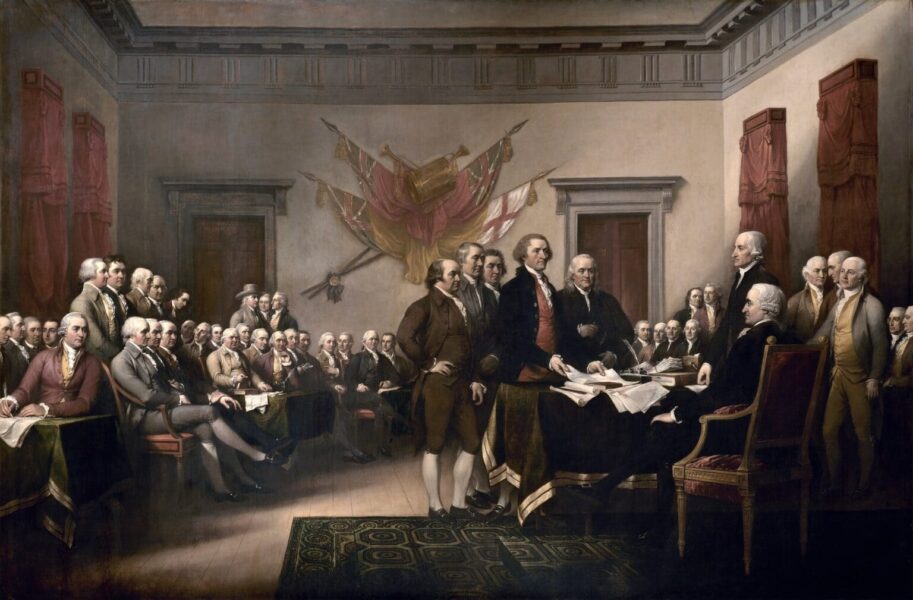
This 250th anniversary of our nation is an opportune moment to reexamine any reservations we may have about political liberalism. For if we suspect that liberalism has «failed» because it has allowed us to be too free, we should consider the possibility that it is we who have failed by losing sight of the crucial truths that our Founders considered self-evident.
About the author
Daniel B. Gallagher teaches philosophy and literature at Ralston College. Previously, he served as Latin secretary to Popes Benedict XVI and Francis.