


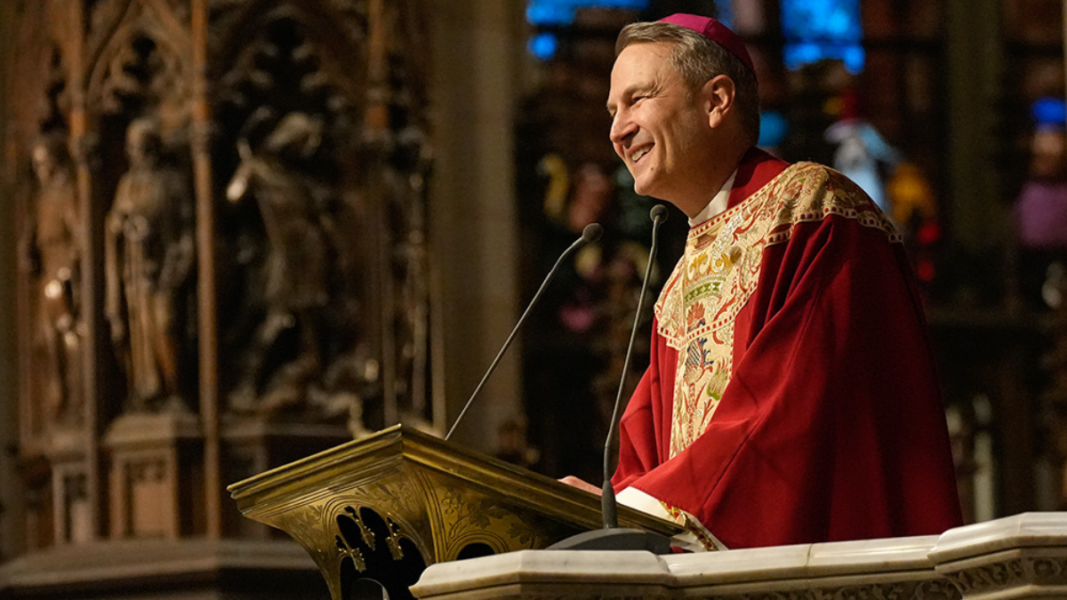
During the Installation Mass as the new Archbishop of New York, Msgr. Ronald A. Hicks included unusual cultural references in a liturgical context: he quoted popular lyrics linked to the city, including a phrase associated with the repertoire of Bad Bunny, to explain his pastoral vision of a Church that must approach its urban and multicultural environment.
In the ceremony held at St. Patrick’s Cathedral, Hicks evoked that “if you want to have fun, you just have to live a summer in New York”, a phrase taken from a popular song recently performed by Bad Bunny, to illustrate how music—and culture in general—form part of his conception of Church life in the New York metropolis.
The reference has generated attention not so much for its content itself, but for what it symbolizes: an archbishop who, from his homily at the start of his ministry, resorts to expressions from the realm of popular culture to describe the identity of the city and, by extension, the pastoral mission it demands. For Hicks—it seems—this gesture is a way to connect with the everyday experience of the faithful. However, it also dilutes the proper language of Christian preaching and even more so by choosing a cultural reference linked to irreverent lyrics such as:
«Aquí no existe el pecado
Y equivocarse es bonito
Los errore’ son placere’
Igual que to’ tus besito'»
(Ojitos bonitos, Bad bunny)
Between Tradition and Popular Culture
This type of resource raises questions about the balance between pastoral closeness and doctrinal clarity. The issue does not center on popular culture itself, but on the place it occupies within a discourse delivered in a liturgical context and in a homily of special ecclesial relevance.
The Church, called to evangelize all cultures, cannot renounce dialoguing with the contemporary world. But at the same time, Christian preaching has its own language, rooted in Sacred Scripture, tradition, and liturgy, which can hardly be replaced by passing cultural references without the risk of confusion.
Hicks’s intervention, beyond the pastoral intention that animates it, touches the limits of the use of elements from popular culture in ecclesial communication, especially when it comes to moments that mark the beginning of an episcopal ministry—which have strong symbolic value for the life of the Church—and due to the choice of a singer like Bad Bunny as an example.