


By: Mons. Alberto José González Chaves
When, on February 2, 1904, the first year of his pontificate, St. Pius X publishes the encyclical Ad diem illum laetissimum, on the occasion of the 50th anniversary of the dogmatic definition of the Immaculate Conception, he intends to show that the dogma proclaimed by Pius IX belongs to the very nucleus of the Christian mystery and that Mary occupies, by God’s design, a necessary place in the economy of salvation. The Immaculate Conception is not presented as an isolated privilege nor as a personal honor, but as a decisive key to understanding the Redemption and the life of the Church.
The Pope places Mary within God’s eternal plan, preserved from every stain of original sin from the first instant of her conception and enriched with the fullness of grace, which means not only an exceptional holiness, but a providential preparation for a unique mission: to be the Mother of the Redeemer and to be singularly associated with his saving work. Such preservation was neither passive nor merely negative: God wanted a totally holy Mother for his Son, and he wanted her that way to intimately associate her with the Redemption of the human race. Therefore, contemplating Mary at the culminating moment of Calvary, the Pope writes: “When the supreme hour of the Son arrived, Mary was beside Jesus’ Cross, and she participated so entirely in his Passion that, if it had been possible, she would have gladly endured all the torments that her Son suffered.” From this flows a decisive doctrinal consequence: “From this community of will and suffering between Christ and Mary, she deserved in the most worthy manner to become the restorer of the lost world and the dispenser of the gifts that our Savior acquired for us with his death and his blood.” Here is the doctrine of Marian co-redemption, clearly formulated. It is not a parallel redemption nor an equality with Christ, the only Mediator by nature between God and men to whom the Redemption belongs exclusively, in the proper and effective sense. But precisely because Christ wanted to associate his Mother with his sacrifice, Mary cooperates in a real, subordinate, and God-willed manner.
And from this association springs Marian mediation. St. Pius X affirms that a productive power of grace cannot be attributed to Mary, which belongs only to God; but he adds that, by her singular union with Christ and by having been associated with the work of Redemption, Mary merits for us what Christ merits in the fullest sense and acts as the supreme minister in the distribution of graces. Christ is the source; Mary is the maternal channel established by Providence: “Since divine Providence has willed that we have the God-Man through Mary, there remains for us nothing but to receive Christ from the hands of Mary.” This is not a devotional option nor a particular sensitivity, but the very order of salvation willed by God. To separate Christ from Mary is to falsify that order; to welcome them united is to fully enter into the divine plan.
In this doctrinal context, Pius X refers to Lourdes: “Scarcely had Pius IX proclaimed as a truth of the Catholic faith that Mary, from her origin, was free from the stain of sin, when in the town of Lourdes, by the work of the Virgin herself, admirable prodigies began; from which arose, with immense effort and magnificent work, the erection of temples dedicated to the Immaculate Mother; and toward which the prodigies that occur every day—obtained by the divine Mother through her intercession—are illustrious arguments to subdue the unbelief of the men of our time.” This quote is key. Lourdes does not appear as a marginal or sentimental phenomenon but as the immediate providential fruit of the dogma, a response from heaven to the solemn act of the Magisterium. Lourdes is the historical and pastoral confirmation of the Immaculate Conception, and its miracles are arguments against modern unbelief. Lourdes is the historical translation of what the saintly anti-modernist Pontiff doctrinally expounds in Ad diem illum laetissimum. Because in the French Pyrenees, along the Gave, the Mediator is seen in action; there the fruitfulness of her co-redemption becomes visible; there the Immaculate One leads to conversion, to penance, and to grace. Lourdes makes the proclaimed truth visible.
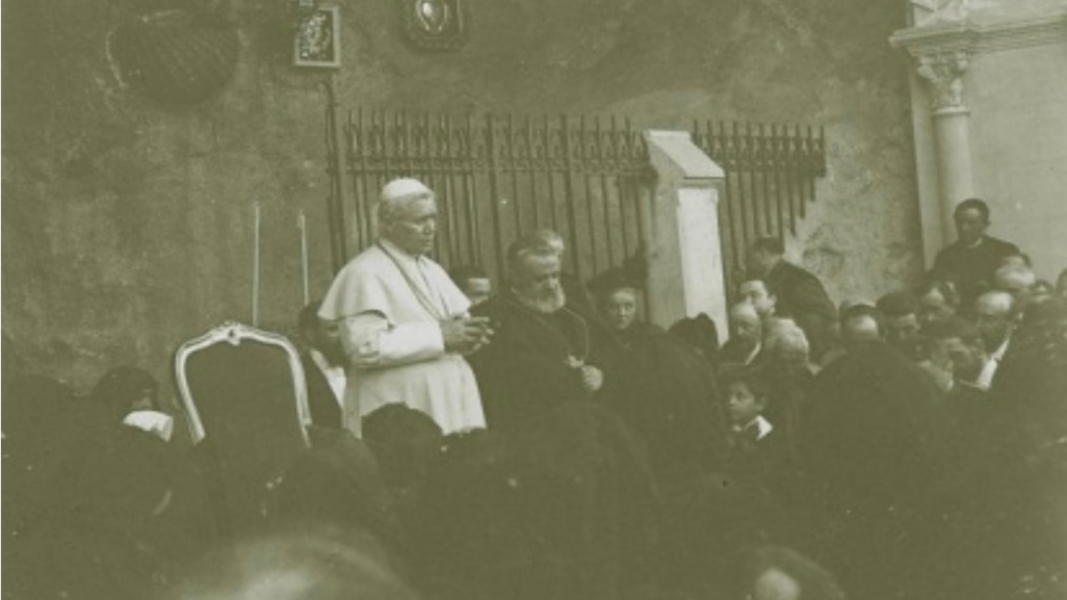
A month after signing this encyclical, on March 28, 1905, Pius X inaugurated in the Vatican Gardens “another” Lourdes: an exact replica of the Massabielle grotto, where the Virgin appeared to St. Bernadette (initially embedded in a small replica of the Lourdes basilica, which Pius XI would demolish in 1933 for aesthetic reasons: it was really an exaggeration in the gardens; in 1962, John XXIII decided to demolish the two lateral sections of stairs and restructure the cave arch). The work of architect Costantino Sneider, the grotto, with the small basilica, was built between 1902 and 1905, and donated to Leo XIII by the bishop of Tarbes and Lourdes, François-Xavier Schoepfer. We have prayed there many times, some of which (already in the years of his retirement) we surprised there, praying the rosary, Benedict XVI. Because today in that grotto the Pope continues to pray, especially in the rosary every May 31, thus reinforcing the bond between the universal Church and the Lourdes sanctuary, which, more than a geographical place, is a caress from God: his Mother, the Immaculate Mary, associated with the Redemption and mediator of grace, continues to act in history, interceding and leading souls to Christ.