


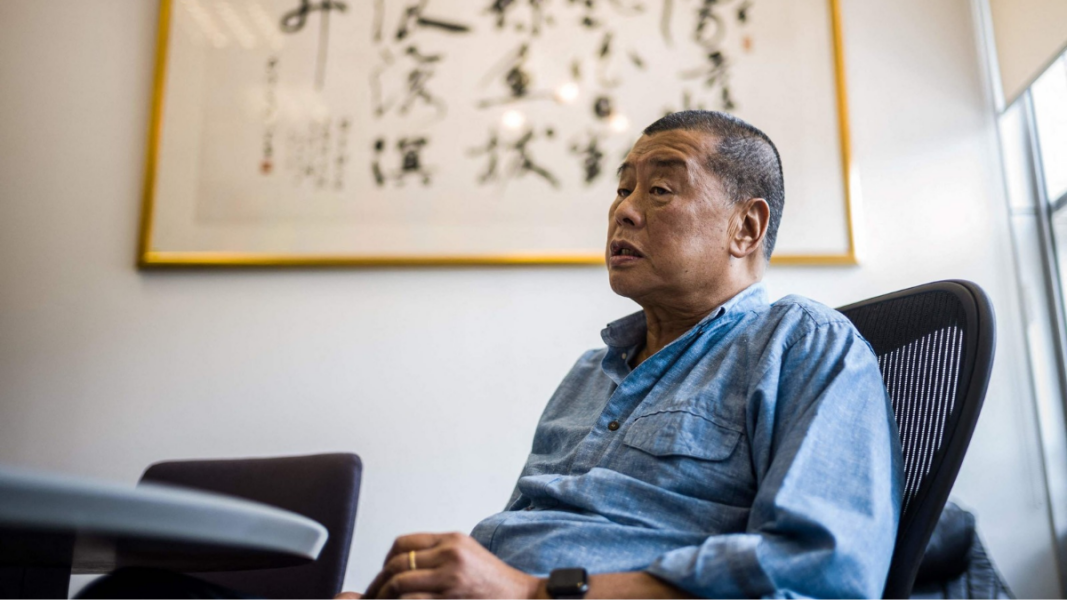
The Hong Kong businessman and publisher Jimmy Lai, known for his defense of press freedom and his Catholic faith, has been sentenced to 20 years in prison under the National Security Law imposed by Beijing in Hong Kong. The sentence, one of the most severe handed down to date under this legal framework, has been interpreted by international observers as a harsh blow to fundamental freedoms in the region.
Read also: Jimmy Lai, Catholic businessman and regime critic, is declared guilty in Hong Kong
According to The Pillar, the businessman’s daughter, Claire Lai, described her father as a “hostage,” considering that the judicial process lacks real guarantees and that the conviction responds more to political than legal criteria. Lai, founder of the newspaper Apple Daily, has been deprived of liberty for more than five years following a succession of arrests, trials, and restrictive measures.
A conviction under the National Security Law
On February 9, Jimmy Lai—78 years old—was finally declared guilty of charges related to the publication of content considered “seditious” and alleged collaborations with foreign actors, accusations formulated under the National Security Law introduced in 2020.
This legal instrument has been widely criticized for its vagueness and for allowing an expansive interpretation of offenses related to freedom of expression.
The forced closure of Apple Daily in 2021, after the freezing of its assets and the detention of several of its executives, marked a turning point in the situation of independent press in Hong Kong.
A testimony marked by faith
Converted to Catholicism in 1997, Jimmy Lai has stated on various occasions that his faith has been a decisive support during his imprisonment. International media have emphasized that, even in prison, Lai maintains an active spiritual life, centered on prayer and reading the Gospel.
His case has acquired particular significance for numerous Catholics, who see him as an example of resistance of conscience in the face of political pressure. In this sense, the conviction not only affects press freedom, but also the fundamental right to live and express faith without coercion.
International concern and ecclesial silence
Various governments and international organizations have expressed their concern over the sentence, considering it incompatible with basic standards of justice and freedom. Experts from the United Nations have also warned about the systematic use of the National Security Law to silence critical voices.
The situation also raises questions for the Church in China and Hong Kong, especially in a context marked by the delicate diplomatic balance between the Holy See and Beijing authorities.
The case of Jimmy Lai brings to the forefront the issue of religious freedom, the defense of conscience, and the price paid for not renouncing the truth.