


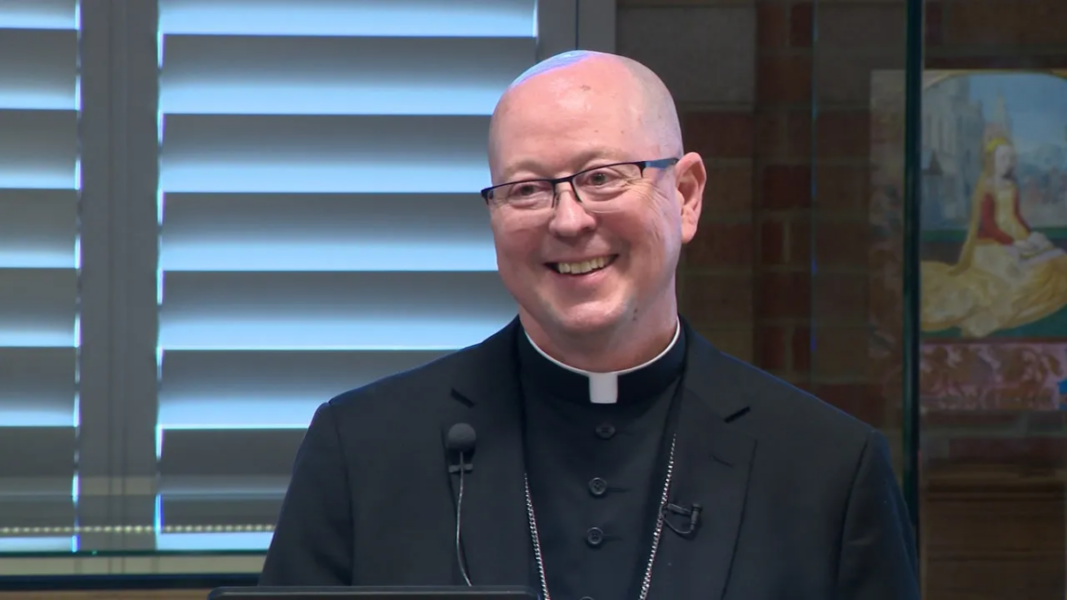
On Saturday, February 7, Catholics in Colorado in the United States woke up to the news that Archbishop Samuel Aquila of Denver has reached the mandatory age of 75 and has quickly received acceptance of his resignation. His successor is relatively new, Bishop James Golka of Colorado Springs. He was only ordained and took possession of that suburban diocese of Denver four years ago. As a priest, he came from the Diocese of Grand Island, Nebraska. His studies were completed at Creighton University, Omaha, Nebraska, where he obtained a bachelor’s degree in philosophy. Subsequently, at the Saint Paul Seminary in Saint Paul (Minnesota), he obtained a master’s degree in theology. He was ordained a presbyter on June 3, 1994, and a bishop on June 29, 2021, the day he took possession of the Colorado See.
Among his standout traits, he himself defines as a shy person who frequently needs time for himself, away from crowds. In the diocese where he developed his presbyteral ministry, he had a reputation as a mystic. Perhaps that came from having prepared for the ministry of exorcist in Chicago, under the auspices of the Léon XIII association. A curious fact that lingers in the memory of many who were present in the Cathedral of Colorado Springs for the celebration of vespers prior to his consecration was the emphasis placed on how Jesus washed his feet when he felt especially fatigued. Many of those present understood it in a literal sense.
Initially, his relationship with the priests was of a sugary flavor. He publicly assured that he would never look at any of their files unless more or less pressured to do so. He earned general applause by assuring that he would not take canonical measures even in cases of need, but that his dedication to dialogue would be his hallmark. With delicacy, it was noted that he desired a different course from the one that Bishop Michael Sheridan had forged in the preceding seventeen years, which had to be discredited. It was to be expected that the styles would be different between two notably different personalities. Bishop Sheridan was a doctor in theology and had taught dogmatic theology in the seminary of the Archdiocese of St. Louis, Missouri. His homilies were profound and full of spiritual and practical content. The same for his writings. Those of Bishop Golka, on the other hand, consisted rather of a personal anecdotal collection and appeal to feeling and emotion. It is to be supposed that there was an audience for both styles. Monsignor Sheridan took care with care that his determinations were steeped in tradition and Catholic discipline. His successor, however, sought the approval of the faithful even if it put dogma or canonical discipline at risk. An example, it is said, was dispensing a couple from the good of procreation who were attempting to marry immediately after a vasectomy.
However, the greatest contribution undoubtedly concerns discipline with the priests. Once he had taken possession, he communicated to the curia that the nuncio, who had promoted him, the now octogenarian Cardinal Christophe Pierre, had told him that there were some priests who were hurt. About five, and they threatened to leave the diocese. He offered them, according to him, the best he could: healing, because they were hurt. And perhaps some in good faith believed it. In the end, it gives the impression of having been a trick. He began a persecution without quarter—with courtesies and affectations. The targets of his harassments, without canonical respect, were and are the most traditional ones. He has given no truce to those he perceives as not absolutely submissive to him. In total, he has expelled approximately a dozen priests from the diocese. He certainly perceives that his duty is blind obedience to the Petrine primacy. He demands the same from his subjects, never better said, toward him.
It has leaked from the presbyteral council that on the agenda of one of its meetings were the initials of the name of one of those expelled from the clerical state, and he had reserved a moment in the meeting for all those present to have laudatory words for the achievement he had accomplished. In that case, there was no procedural guarantee, and he was conveniently helped from Rome with an administrative penal process.
Bishop Golka always has his time very measured, even if he is the host at a dinner or if it is an appointment. At the minute of fulfilling the time allotted for a particular matter, he concludes the meeting. His agenda is always at the top, as he likes to say. For that reason, he delegates to some—unconditionals—a good load of “authority” or power to surely enjoy a little more time. It is said that it is not uncommon for him to take many of the intentions of the faithful to his residence to pray for them. For that, he sometimes takes several days of retreat. Many of them in Nebraska. His close associates mention how tired he usually is from the weight of the apostolic responsibility he carries selflessly on his shoulders, and for that, nothing more consoling than the constant displays of affection from his closest ones or from those who know him little.
The announcement of his appointment has caused, in some, a justified uproar in the Archdiocese of Denver. It is very possible that this plundering orchestrated from Rome will continue on a larger scale. In Colorado Springs, 25% of the priests have been destroyed; another percentage of the most synodal and thuriferary ones can expect promotions in the short term, and many others will live terrified with their consciences unrested, waiting for who comes can only surpass who left. May he surpass him in holiness. Let’s see what Rome says… But Denver must have a clear picture, and if the donors call to inquire at the metropolitan curia, they are only told that they have the wrong door. ¡Excmo. James Golka ad multos annos!