


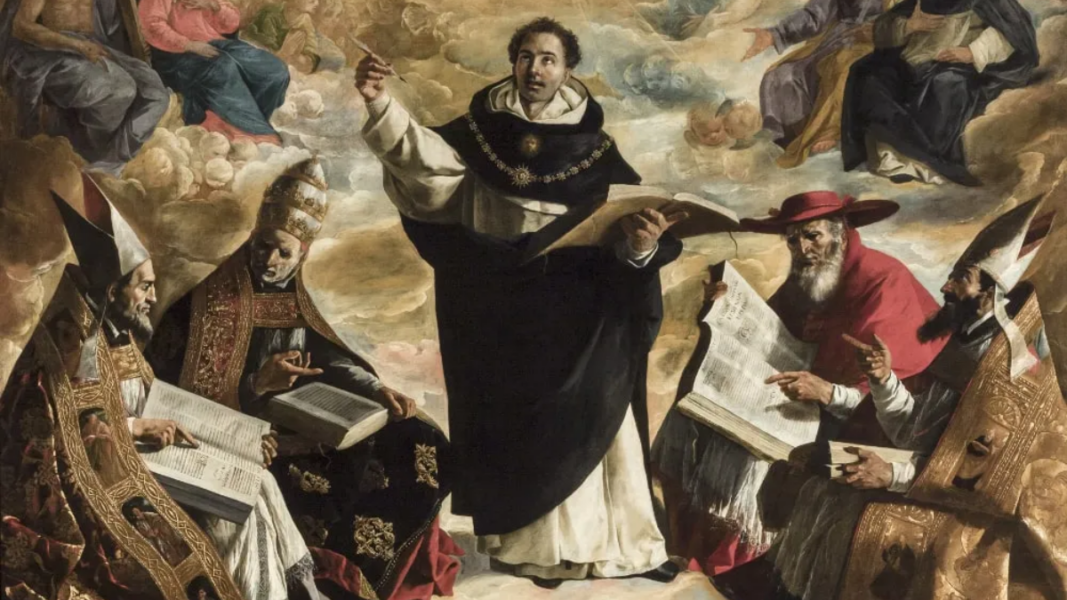
If someone asked me who my favorite saint is, without hesitation I would point ex aequo to Saint Francis of Assisi (1181/2-1226) and Saint Thomas Aquinas (1224/5-1274). Two Christian figures of very different physical complexion, personality, and spirit, who came into the world successively as if they were twins in the historical birth of Christendom. A wonderful gift from the Creator to humanity to teach us, through the first, to feel and to love, and through the second to contemplate and to think. And to do so as Christians, for both invite us with their example to develop as children of God, according to the Grace given to each one, the best of our volitional and intellectual faculties, that is, to the limit of our capacities. And although their imposing achievements continue to generate our astonishment and admiration today, from the most intimately Christian point of view, both were aware that all the glory of their works belonged to God and not to them; they were mere «unprofitable servants»; «they had nothing that they had not received before». And precisely for that reason, for their fidelity and their labors, for being «faithful in a few things», «God put them over many» (Mt. 25:17). They never doubted that «from Him, through Him, and for Him are all things. To Him be glory forever» (Rm. 11:36).
Precisely about this saintly and wise Dominican, whose anniversary we celebrated a few days ago, I would like to highlight one of the discoveries of his metaphysics, a genius that continues to fascinate me every time I reflect on it: his doctrine on the difference between being and existence; between essence and act of being; between ens and esse. Personally, it is the Thomistic thesis (even more than his classic five ways) that most rationally convinces me that God exists and that He sustains with His power everything created. Of course, I am speaking of philosophical proof, not empirical, but it is worthwhile to stretch the mind a bit to realize that, starting from material reality itself without leaving it, the explanations about why things exist and why our intelligence is capable of grasping them, understanding them, differentiating them, ordering them, and structuring them with scientific rigor are absolutely insufficient. That the ground of metaphysics is less firm than the empirical solidity of physics—something I do not deny, and hence the prestige of the latter compared to the current (and unjust) discredit of the former—does not imply that, following a logical path without errors or fallacies, joyful results cannot be achieved regarding the truth, beyond what we can measure, weigh, or count. A Thomistic principle is that all paths of truth—whether science or theology—lead to the Truth, that is, to God. Saint Thomas pilgrimaged and crowned the summit of knowledge, the maximum that man can achieve with his intelligence regarding God, the Pure Act of Being. From that summit—and as the saint also reports (Summa contra Gentiles, Book I, Chap. III)—to reach the Heaven of full knowledge of God we need faith and Revelation. And, very important: to be humble, both in the act of thinking and in the act of believing.
The first time Saint Thomas expounds this distinction between the essence and existence of things is in his little work «De ente et essentia» (1256), composed when he was about thirty years old, as a bachelor and preparing for his future chair in Paris. In this brief study, he reflects on these philosophical concepts keeping in mind Aristotle, Averroes, and above all, Avicenna. This last philosopher, Arab like the previous one, in a genial intuition, was the first to introduce into philosophical thought the powerful notion of existence as distinct from essence, although considering it a mere accident extrinsic to the being; a shortsighted vision, brilliantly overcome by the Italian saint.
Existence—and we enter the most impressive part of Thomistic metaphysics—is not an accident but a distinct principle in creatures, unlike God (in Him, essence and existence are identified). Indeed, in the things we see, touch, or perceive there is matter, there is form but also—and Saint Thomas will say—esse (existence). Matter, as a principle of potentiality; form as a principle of actuality (which gives essence to things), and esse, the very fact of existing, which is the most fundamental act of being and which—attention—is not formal, since form is linked to essence (matter + form), and esse belongs to another order, the order of existence:
«It is impossible for the proper principles of the essence of a being to cause its existence, because every created being is not the cause of its existing» (Summa Theologica I q3,a4).
Esse, act of all acts and perfection of all perfections, does not inform (as form does), it is not part of the essence but actualizes the entire essence; if (esse) were formal it would be part of the definition of the thing, whereby all essences would exist necessarily, and that is inadmissible for Saint Thomas. In the saint’s luminous phrase: the form makes something to be; esse makes it to be. Now, if esse is really distinct from essence (matter + form), and is received by it, the conclusion is imposed that there necessarily exists that being whose esse is not received, but is its essence. And in God, by definition, there is no real distinction between esse and essence; in other words, God does not have being, God is BEING; God necessarily exists. Ipsum esse subsistens.
«From which it is necessary that every such thing whose existing is distinct from its nature has its existing from another. And since everything that is through another is reduced by itself to the first cause, it is necessary that there be a thing that is the cause of the existing of all things, insofar as it itself is only existing» (De ente et essentia, 34).
To the recurring question of why there is something rather than nothing, Saint Thomas responds: things (contingent) cannot exist without the prior (and necessary) existence of God, from whom all things participate. Of course, participation not in a pantheistic sense (God as part of creatures), but in the sense of receiving in a limited way the perfections that God possesses in an unlimited way, God being the principal efficient cause of everything. Thus, only in that sense, creatures—contingent beings—participate in the donation of their being and exist.
«it is necessary that all things, except God, not be their own being but participate in being and, therefore, it is necessary that all beings, which are more or less perfect by reason of that diverse participation, have as cause a first being that is entirely perfect» (Summa Theologica I q44,a1).
On the other hand, the difference between contingent and necessary Saint Thomas will brilliantly unfold in his Third demonstrative way of the existence of God (which is, in my judgment, the most convincing of the five), and which can be formulated as follows: all and every one of the beings we contemplate are contingent—they can exist or not have existed, they appear and disappear because none has in itself the cause of its existence—but if all things carry in themselves the possibility of not existing, there was a time when nothing existed. Therefore, there must exist a necessary being, cause and origin of all contingents (Summa Theologica I, q2,a3).
Without the slightest doubt, the fertile furrow opened by the saint with this teaching of being as act and not only as concept would have deserved to have been sown by the seed of the theologians who succeeded him. Unfortunately, the brilliant Christian metaphysicians who followed (until the subjectivism of modernity arrived with Descartes) did not deepen this fruitful doctrine of the «act of being.» The Franciscan Duns Scotus in the 14th century and the Jesuit Francisco Suárez in the 16th century abandoned that existentialist metaphysics of Saint Thomas, in favor of an essentialist one. William of Ockham in the 14th century went further and reduced metaphysics to a matter of words, conceptual, not of essences. Ironically, Saint Thomas was and is avant la lettre the greatest existentialist philosopher in history (who would say that today he could be related to atheist/agnostic thinkers like Sartre or Heidegger). Thank goodness that in our time, the great French philosopher Etienne Gilson brilliantly rescued this doctrine, and in fact he will affirm that Saint Thomas was the first philosopher who truly understood metaphysics.
I think and rethink, in short, about this luminous doctrine, and what my head assures me my heart ratifies. And—above all—it proves it to me, confirms it definitively and with divine certainty, the Sacred Scripture: «Bereshit Bara Elohim» (Gn. 1:1); «quia ex nihilo fecit illa Deus et hominum genus» (2 Mac. 7:28). Only the God revealed in Judeo-Christianity is BEING, «the One Who IS» (Ex. 3:14); transcendent, eternal, omnipotent, omniscient, omnipresent, holy and pure goodness; He is uncaused cause and from nothing has given origin to everything created. By the munificence of His love.
In short, reason and revelation are two rivers that converge and flow into the infinite ocean of the true God, One and Triune. And although I navigate in the fragile little boat of my understanding, I advance with the solid—and sometimes hard—oars of Thomistic doctrine, guiding myself with the compass of the Scriptures. And—fundamental—in the sunset I always keep in mind the polar star that is the Blessed Virgin Mary. With these provisions, I have the certainty that I will arrive at the good port of Heaven. Saint Thomas is my best teacher of theology, but he is also my favorite saint (without forgetting the poverello of Assisi). For that reason alone I can conclude this article with an exclamation that springs not so much from my head as from my heart: Saint Thomas, pray for us!
Note: Articles published as Tribune express the opinion of their authors and do not necessarily represent the editorial line of Infovaticana, which offers this space as a forum for reflection and dialogue.