


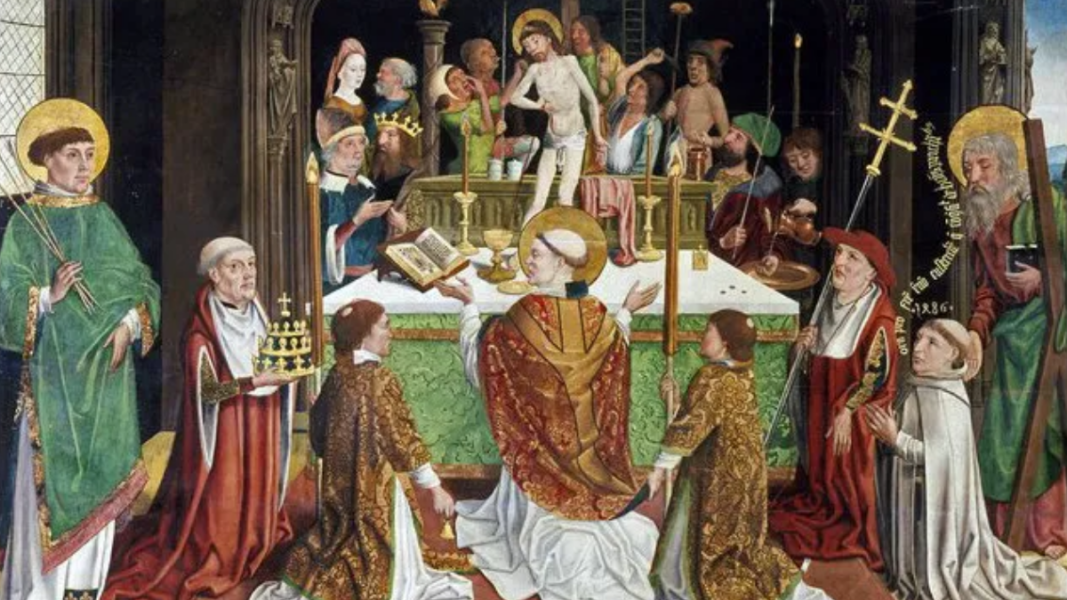
«What will I offer to the Lord for all his benefits? I will lift up the cup of salvation and offer a sacrifice of thanksgiving,» sings the psalmist. With these words, the liturgy introduces the Offertory rites, the moment in which the Church begins to express visibly what it has already confessed with faith: that the Mass is a sacrifice. After having considered in the previous chapter the theological meaning of the Offertory, this episode of Claves — FSSP focuses on the gestures and prayers through which the priest makes the offering of bread and wine, sacramentally anticipating the Sacrifice of the Cross.
The offering of the bread: host destined for sacrifice
The first gesture of the Offertory is the offering of the bread. Once the veil of the chalice has been removed, the priest takes the paten and elevates the host it contains toward the cross. In the Latin liturgy, unleavened bread is used, that is, without leaven, following the Jewish tradition prescribed by God himself for Passover. The rapidity of the departure from Egypt prevented the Hebrews from allowing the dough to ferment, and everything indicates that it was this same simple bread—flour and water—that Christ used at the Last Supper.
In some places in the early Church, leavened bread was used, a custom that is preserved in the Eastern Churches and does not affect the validity of the sacrament. However, in the West, the exclusive use of unleavened bread gradually became established, especially from the ninth century onward, due to its symbolism of purity and for its better preservation for the Eucharistic presence.
Bread and wine were not chosen at random by the Lord. Both powerfully express the mystery of the unity of the Church: just as a single loaf comes from many grains of wheat, and a single wine from many clusters, so Christians, through the Eucharist, become one body in Christ.
In the first prayer of the Offertory, the priest presents the bread as an immaculate host, indicating its destiny: to be transformed into the true Host, Christ himself, the pure and spotless victim. The prayer Suscipe, Sancte Pater is addressed to the Father and is formulated in the first person by the priest, who acknowledges his unworthiness but immediately extends the intention to the whole Church and to the salvation of souls, the ultimate end of the sacrifice. After tracing the sign of the cross with the paten, he places the host on the corporal, a gesture that already clearly manifests the sacrificial nature of the Mass.
It is no coincidence that the term “host” means in Latin victim, and more precisely a living victim destined for sacrifice. From this first moment of the Offertory, the liturgy makes it clear that what is being prepared is not a simple meal, but a sacrifice.
The veiled paten: reverence before the mystery
In the solemn Mass, after the offering of the bread, the subdeacon descends the altar steps carrying the paten wrapped in the humeral veil. This gesture, which may seem surprising, is a remnant of the ancient practice in which the paten was a large plate intended to collect the breads offered by the faithful, and which was removed from the altar during the consecration.
This gesture also has a profound symbolic meaning. The subdeacon, with the veiled paten, evokes the adoring angels, especially the cherubim, who cover their faces before the divine majesty without daring to look at it directly. Thus, the liturgy expresses reverence and sacred fear before the mystery that is about to take place.
The preparation of the chalice and the mixing of water and wine
The offering of the wine requires particular preparation. The acolytes present the cruets with the wine and water to the priest. The priest first pours the wine into the chalice in silence. Then he blesses the water and adds a single drop to the wine. This gesture, inherited from a common custom in the ancient world and very widespread in Palestine, is almost certainly the same one that Christ performed at the Last Supper.
But the essential is its triple symbolism. First, it expresses the mystery of the Incarnation: just as the water mixes inseparably with the wine, human nature has been assumed by the Word without losing its identity. The prayer that accompanies this gesture comes from an ancient Christmas formula and explains it clearly.
Second, the drop of water represents the faithful, united to Christ in the offering of his sacrifice. As St. Cyprian taught: «If only wine is offered, it is Christ without us; if only water, it is we without Christ.» That is why only the water—symbol of man—is blessed, and not the wine, which represents Christ. This gesture perfectly expresses the participation of the faithful in the sacrifice of the Mass, a doctrine rejected by the Protestant Reformation and firmly defended by the Council of Trent.
Third, the mixing of water and wine recalls the water and blood that flowed from the opened side of Christ on the Cross, a sign of the birth of the Church and of the sacraments.
The offering of the chalice and the humility of sacrifice
With eyes raised toward the cross, the priest offers the chalice of salvation, asking that this oblation rise to God as a pleasing fragrance and redound to the salvation of those present and of the whole world. By placing the chalice on the corporal and tracing the sign of the cross, he again manifests the union between the oblations and the real Victim of the sacrifice: Christ crucified.
Next, the priest bows deeply, expressing with his body what he pronounces with words: that only a contrite and humbled heart can please God. This attitude echoes David’s penitential prayer in the Miserere and the canticle of the three young men in the furnace, who proclaimed that the sacrifice pleasing to God is not primarily the external holocaust, but the humility of the heart.
Then, raising his hands and eyes to heaven, the priest invokes the Holy Spirit to bless the oblations. This invocation highlights the profoundly Trinitarian dimension of the Eucharistic sacrifice and points to a decisive moment: it no longer speaks of «our sacrifice,» but of this sacrifice, the one sacrifice of Christ, in which our offering is called to be assumed.