


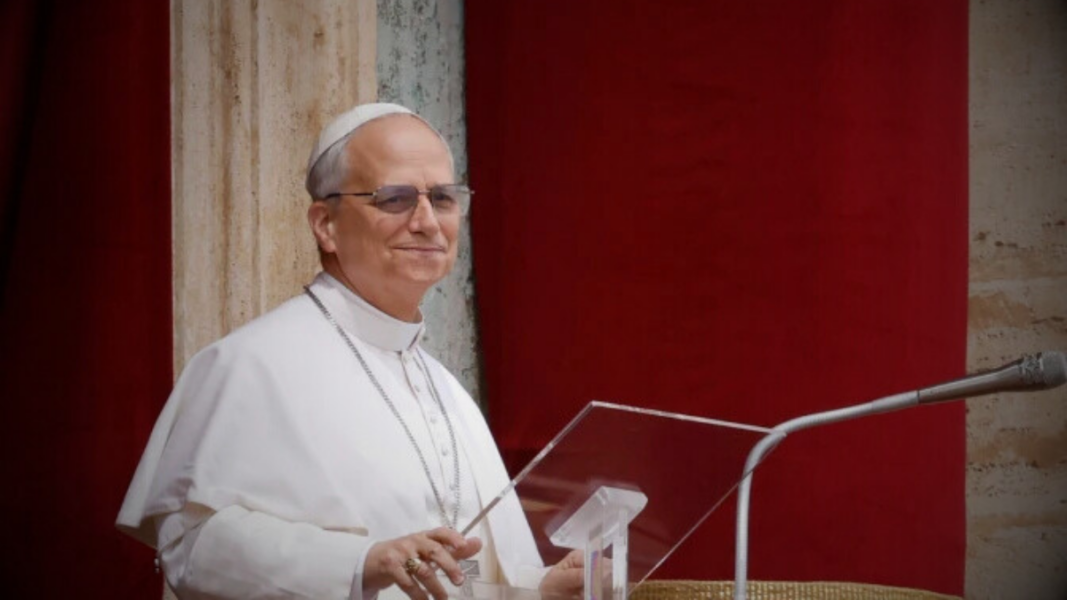
In his address prior to the Angelus prayer this Sunday, February 8, Eighth Sunday in Ordinary Time, Pope Leo XIV offered a reflection centered on Christ’s words about the “salt of the earth” and the “light of the world.” From the window of the Apostolic Palace and before the faithful gathered in Saint Peter’s Square, the Pontiff linked the Beatitudes with true Christian joy, understood not as a passing emotion, but as the fruit of a lifestyle in conformity with the Gospel: poverty of spirit, meekness, hunger for justice, mercy, and peace.
Leo XIV warned of the risk of losing that evangelical “flavor”—renouncing Christian joy and coherence—and recalled that God does not discard or abandon anyone, even when the inner wound seems deep. In the light of the prophet Isaiah, he emphasized the importance of concrete gestures of charity and justice as visible signs of a faith that transforms, in the face of the temptation of self-assertion, exhibitionism, or power. In this context, the Pope insisted that communion with Christ, especially in the Eucharist, is the source of a surrendered and silent life, capable of illuminating the world without fanfare and of making the Church a “city on a hill,” welcoming and open to all.
We now leave below the complete words of Leo XIV:
Dear brothers and sisters, happy Sunday!
After proclaiming the Beatitudes, Jesus addresses those who live them, saying that thanks to them, the earth is no longer the same and the world is no longer dark. “You are the salt of the earth. […] You are the light of the world” (Mt 5:13-14). True joy is the one that gives flavor to life and brings forth what did not exist before. This joy radiates from a lifestyle that one desires and chooses, a way of inhabiting the earth and living together. It is the life that shines in Jesus, the new flavor of his gestures and words. After encountering him, what strays from his poverty of spirit, his meekness and simplicity of heart, his hunger and thirst for justice—which impel mercy and peace as dynamics of transformation and reconciliation—seems insipid and dull.
The prophet Isaiah enumerates concrete gestures that put an end to injustice: sharing bread with the hungry, sheltering the homeless poor, covering the naked, without neglecting neighbors and family (cf. Is 58:7). “Then —the prophet continues— your light will break forth like the dawn and your wound will quickly heal” (v. 8). On one hand, the light, which cannot be hidden because it is great like the sun of every morning that dispels the darkness; on the other, a wound, which before burned and now heals.
It is painful, indeed, to lose flavor and renounce joy; however, it is possible to have this wound in the heart. It seems that Jesus warns those who listen to him not to renounce joy. The salt that has lost its flavor, he says, “is no longer good for anything except to be thrown out and trampled under people’s feet” (Mt 5:13). How many people—perhaps it has happened to us too—feel discarded, failed; as if their light had hidden itself. But Jesus announces to us a God who never discards us, a Father who guards our name and our uniqueness. Every wound, even a deep one, will heal by welcoming the word of the Beatitudes and returning us to the path of the Gospel.
Gestures of openness and attention to others are the ones that rekindle joy. Certainly, in their simplicity, they place us against the current. Jesus himself was tempted, in the desert, by other paths: to assert his identity, to exhibit it, and to have the world at his feet. But he rejects the paths in which he would have lost his true flavor, the one we find every Sunday in the breaking of the Bread: the surrendered life, the love that makes no noise.
Brothers and sisters, let us be nourished and illuminated by communion with Jesus. Without exhibitions, we will then be like a city on the top of the mountain, not only visible but also attractive and welcoming; the city of God in which everyone, in the end, desires to live and find peace. To Mary, Gate of Heaven, let us now turn our gaze and prayer, so that she may help us to be and remain disciples of her Son.