


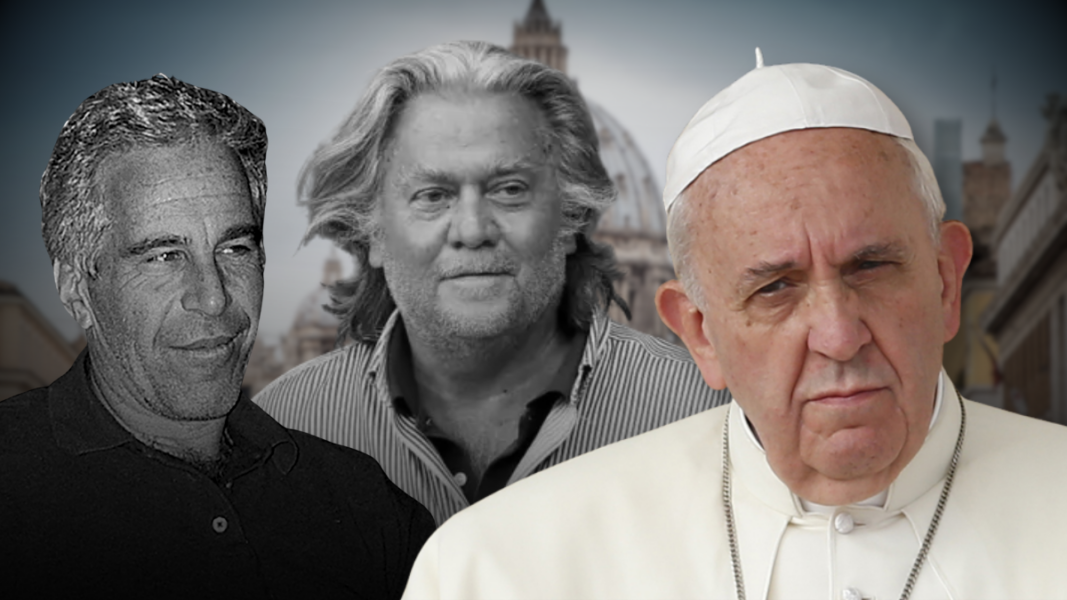
The informational outburst following the judicial declassifications linked to the Epstein case—contact lists, emails, and documents incorporated into various civil proceedings in the United States—has generated a noise that is difficult to organize rigorously. Added to this is the massive circulation of material manipulated through AI and the tendency of many major media outlets to select eye-catching fragments without reconstructing the full context. The result is an informational ecosystem in which discerning objective facts is particularly complex.
Read also: Epstein’s emails and the Vatican Bank: necessary clarifications
In that context, a series of exchanges between 2018 and 2019 between Epstein and Steve Bannon, the controversial former advisor to Donald Trump and a key figure in American conservative populism, have surfaced. Some media outlets, including El País, have rushed to present these emails as evidence of an alleged conservative ideological conspiracy against Pope Francis in which both Bannon and Jeffrey Epstein would be implicated. That simplistic framing, however, demands a broader contextualization and a less speculative reading of the available materials.
It is obvious that Jeffrey Epstein was never interested in «overthrowing» Pope Francis. His objective, consistent over decades, was above all to ingratiate himself with powerful people to compromise them, without distinction of ideology, field, or public discourse. In that framework, Steve Bannon does not appear as the mastermind of anything, but rather as one more of those who talk too much and falls seduced into Epstein’s web.
What the Epstein–Bannon emails literally say
The known messages show conversations about money, international networks of influence, and political strategies in a broad sense. In that context, Bannon uses aggressive and grandiose language, typical of his style, referring to Pope Francis as an adversary in the so-called «culture war» and using expressions like «taking down Francisco.» Beyond the bravado, there is no evidence in the texts of a concrete operational plan, nor of relevant ecclesiastical contacts, nor of real capacity to intervene in the institutional structure of the Church.
What the emails do reveal is direct interlocution and a sufficient degree of trust to speak without filters about power, funding, and personal ambitions. Deducting from there that Epstein shared or promoted a conservative Catholic agenda is, however, totally unsustainable. There is no documentary or biographical indication pointing in that direction. Epstein is a corrupter who identifies in Bannon an influential, vain, and prone-to-exaggeration figure, that is: a potentially vulnerable interlocutor for his network dedicated to compromising and controlling powerful people.
Who Jeffrey Epstein really was
Epstein was a financier with an opaque profile whose extraordinary capacity for access to Western elites was never fully explained by his known professional trajectory. For decades, he cultivated relationships with presidents, tech moguls, scientists, academics, and members of the European aristocracy. Among the documented contacts, there is a preponderance of profiles linked to the woke left, such as Bill Gates—who acknowledged meetings with Epstein after his 2008 conviction—and Bill Clinton, whose encounters and travels in Epstein’s circle are recorded in flight logs and in testimonies gathered by the U.S. press.
It is true that this network does not concentrate on a specific ideological sector. It cuts through the core of the Western political, financial, and cultural establishment, with the presence of figures associated with globalist progressivism as well as actors from other spheres of power. The pattern is consistent: Epstein did not select by ideological affinity, but by position, influence, and capacity for projection.
A strategy of transversal infiltration of power
The joint examination of open sources—judicial records, sworn statements, long-term journalistic investigations like those of the Miami Herald—reveals a coherent logic. Epstein systematically infiltrated the main spheres of contemporary power: politics, finance, science, philanthropy, and culture. He did not act as a militant or ideologue, but as a relational operator.
His objective does not seem to have been to promote a specific immediate cause, but to generate dependency, compromise reputations, and accumulate capital of influence. That transversality invalidates any partisan reading. Epstein was not an operator of specific political causes; he was something different: an agent of moral corruption obsessed with perverting the powerful in vice and evil.
The method: push to the limit and capture
A central element, widely accredited in judicial proceedings, is the nature of the environment that Epstein built. It was not just about luxury or social eccentricity. The core of his activity was the deliberate push toward extreme transgression: prostitution, systematic sexual exploitation, and the use of minors. Pedophilia was not a marginal excess, but the proven axis of his criminal activity, as acknowledged by the U.S. federal authorities themselves.
From a logic of power, this method is effective. Whoever crosses moral and legal limits of that caliber becomes trapped by fear, shame, and the permanent threat of public exposure. At that point, Epstein’s control—or that of his bosses—no longer requires direct coercion: it is sustained by forced silence and self-censorship.
An operator of higher interests?
The operational longevity of Epstein, his ability to evade investigations for years, and the institutional indulgence he enjoyed after his first conviction have fueled hypotheses about his possible relationship with broader power structures, including connections with intelligence services—a possibility for which solid indications are beginning to accumulate.
Beyond those hypotheses, what is coherent is the deeply destructive nature of his conduct. It does not respond to a classic political agenda, but to a dynamic of systematic moral degradation: destruction of innocence, normalization of crime, and reduction of people to instruments. Many will identify this logic, without the need for excessive rhetoric, with what the Christian tradition has always described as a radical form of evil.
Bannon as an illustrative case, not as an explanatory key
In this framework, Steve Bannon is not the center of the phenomenon, but an illustrative case. An influential, ambitious, and rhetorically excessive figure, who moves lightly in opaque environments. Thinking that Epstein was interested in his ideological program is inverting the real relationship. Epstein did not need to share Bannon’s ideas; it was enough for him to identify his exposure and imprudence.
An infiltration strategy
The Epstein case does not reveal a conservative Catholic conspiracy or a coherent ideological maneuver against Pope Francis. It reveals, rather, a strategy of transversal infiltration of power based on extreme moral corruption, sexual exploitation, and the accumulation of compromising material. Reducing it to a partisan reading is not only intellectually poor, but prevents understanding its true nature: a system that believes it can bargain with evil without becoming its hostage.
Reducing the Epstein case to a specific ideological conspiracy is a way of not understanding it. Epstein wanted to compromise all the powerful, without exception, because that was his true capital: the ability to degrade and capture. Some knew how to stay on the sidelines; others did not. Steve Bannon falls here not as a strategist, but as an example of imprudence and vanity. There is no epic or master plan: there is a mechanism of transversal corruption and those who, through clumsiness or arrogance, entered it on their own.