


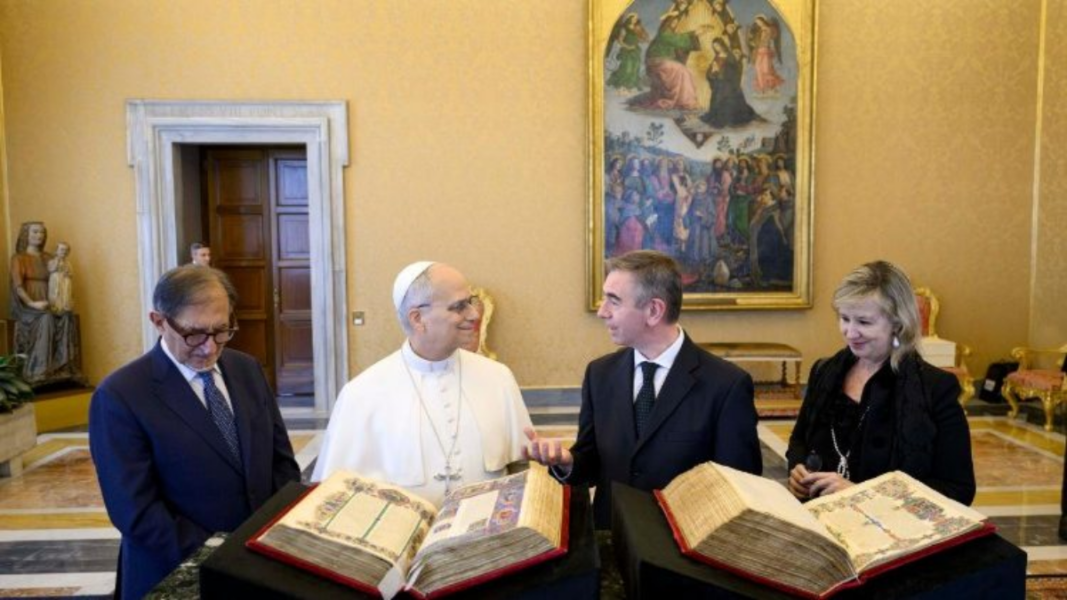
The Pope received this week in the Vatican one of the most extraordinary works of the European Christian heritage: the Bible of Borso d’Este, a 15th-century illuminated manuscript that represents, like few pieces, the synthesis between faith, culture, and art that characterized Renaissance Christendom. The institutional act, attended by Italian civil authorities, allowed highlighting not only its aesthetic value, but its profound historical and spiritual meaning.
The presentation, which AciPrensa has reported on, served to remind that this codex is not a lifeless museum relic, but an eloquent testimony of an era in which the Sacred Scripture occupied the center of public, cultural, and political life.
A Bible conceived to honor the Word of God
The Bible of Borso d’Este was made between 1455 and 1461, in the full swing of the Italian Renaissance, by the calligrapher Pietro Paolo Marone and the miniaturists Taddeo Crivelli and Franco dei Russi, considered among the best artists of their time. Each page was conceived as a work of art in itself, with richly ornamented miniatures in gold and Afghan lapis lazuli, materials reserved for works of maximum prestige.
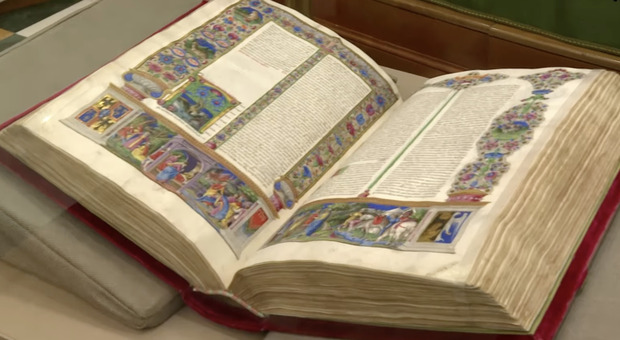
Far from being a superfluous luxury, this magnificence responded to a deeply Christian conviction: the Word of God deserves the best of human ingenuity. In a culture in which Scripture was the foundation of social and spiritual life, embellishing the Bible was a way of confessing the faith.
Borso d’Este: temporal power and visible faith
The manuscript was commissioned by Borso d’Este, duke of Ferrara, Modena, and Reggio, whose surname gives the work its name. In the context of the 15th century, commissioning a Bible of this magnitude had a double meaning: it was an affirmation of personal faith and, at the same time, a public declaration of the legitimacy and Christian order of power.
In an era in which civil authority was still understood as linked to the order willed by God, the possession and veneration of the Sacred Scripture manifested that government was not conceived apart from revealed truth.
Exile, loss, and recovery
The history of the Bible of Borso d’Este also reflects the vicissitudes of European history itself. The work remained in the hands of the Este family until 1859, when the last duke, Francis V of Austria-Este, was forced to flee to Vienna after Italian unification.
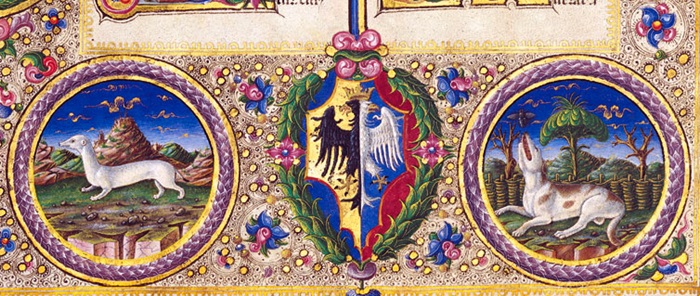
Later, the manuscript passed to the House of Habsburg and, after the dissolution of the Austro-Hungarian Empire at the end of the First World War, was sold in 1922 by Empress Zita of Bourbon-Parma. The Bible was on the verge of being lost definitively for Italy until the businessman and patron Giovanni Treccani acquired it in Paris in 1923 and donated it to the Italian State, ensuring its conservation and public custody.
An exceptional work, rarely exhibited
Due to its fragility and incalculable value, the Bible is usually kept in the Estense Library of Modena and is only shown to the public on very exceptional occasions. Each transfer requires complex security and conservation measures, with strict temperature and humidity controls.
The Italian Ministry of Culture has defined it as a work that “unites sacred value, historical relevance, precious materials, and a most refined aesthetic”, a description that reflects its unique character within the European heritage.