


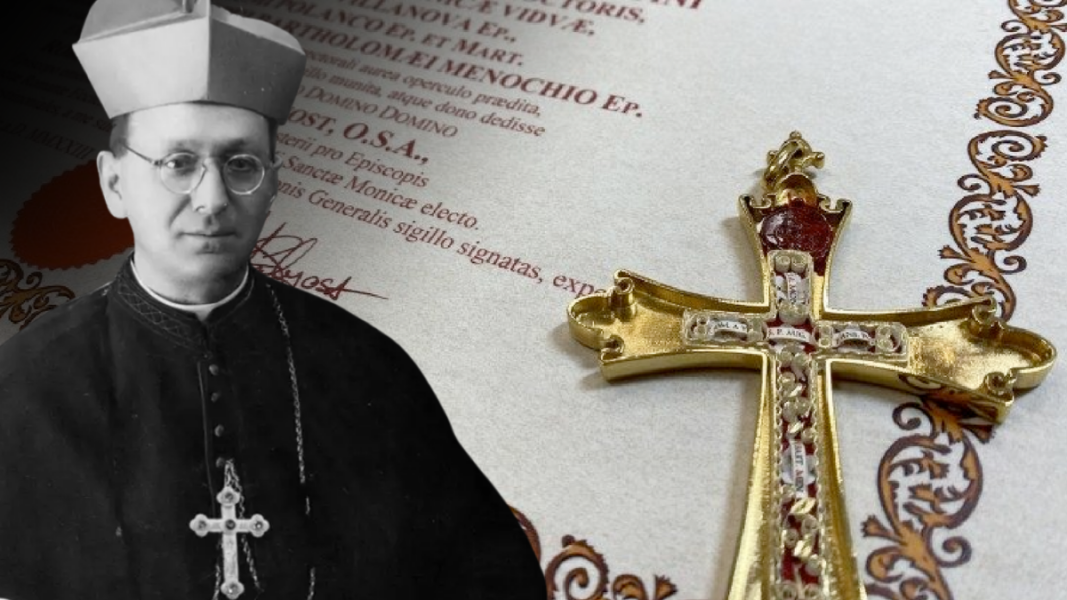
The Church commemorates this February 7th the Blessed Anselmo Polanco y Fontecha, Augustinian bishop of Teruel assassinated in the Civil War in 1939 and proclaimed a martyr by Pope John Paul II in 1995. His figure is today a symbol of pastoral fidelity in times of trial, and his memory has also acquired a universal dimension by being carried as a relic in the pectoral cross of Pope Leo XIV, who wears it in his Petrine ministry.
The Blessed Anselmo Polanco was born on April 16, 1881, in Buenavista de Valdavia, Palencia, into a simple and deeply Christian family. He entered the Order of St. Augustine from a very young age and, after years of theological and pastoral formation, was appointed bishop of Teruel and Albarracín in 1935, a few years before the outbreak of the Spanish Civil War.
A shepherd who did not abandon his flock
In a climate of open hostility against the faith and its ministers, Polanco decided to remain with his people, despite having the possibility of leaving the diocese. He did not retract or renounce his signature on a collective letter from the Spanish bishops that denounced religious persecution, which cost him being arrested in 1938 by Republican forces and suffering various privations for almost a year.
On February 7, 1939, when the war was already in its final phase, he was bound, taken out of prison, and executed by a firing squad in Pont de Molins (Gerona), along with other prisoners. He was 57 years old. His martyrdom is a testimony of fidelity to Christ and to the Church until the fullness of surrender.
His body was subsequently venerated as that of a martyr of the faith. On July 2, 1994, Pope John Paul II recognized his martyrdom, and on October 1, 1995, he was beatified along with other believers killed in that religious persecution unleashed in Spain.
His memory in Leo XIV’s cross
In the pectoral cross worn by Pope Leo XIV, along with relics of St. Augustine, St. Monica, and other Augustinian saints, there is a fragment of his relic, a tangible sign that the Spanish martyrdom is part of the living memory of the universal Church. This cross, a gift that accompanied the then Cardinal Robert Francis Prevost from before he was elected Supreme Pontiff, has been the object of attention since Leo XIV made public its use in various liturgical celebrations and when presenting himself to the world.
That gesture—carrying the name and blood of a Spanish shepherd martyred for hatred of religion in his cross—is neither accidental nor ornamental. It reminds us that the Christian faith is not a comfortable consolation but a radical surrender of life for the Gospel, and that the Spanish martyrs of the 20th century continue to be references of fidelity for today’s Church.