


By Randall Smith
Since the times of Plato, philosophers have spoken of the “transcendental” properties of being: properties that every entity possesses, such as Truth, Goodness, and Beauty. Something we can learn from this list is that truth is a good.
No one wants to be lied to. We want bread; we want the truth. We may even want the truth more than we want bread. Truth is desirable, like beauty. Truth moves us in the same way that beauty does. We are happy when we get the right answer in math or when we discover how to solve a problem. But we are also drawn to things that seem true and are not. These are illusory goods. Pursuing them is like running after a mirage of water in the desert.
Christians believe that the ultimate source of truth is God, since He is the ultimate source of all being, goodness, and beauty. We could describe this as the vertical dimension of truth: truth as it exists in the mind of God. But since, apart from the important elements we receive through divine revelation, we cannot know the mind of God, we must turn to what I will call the “horizontal” source of truth.
We acquire knowledge through the senses and by reasoning about the created world. But, contrary to the hyper-individualism of thinkers like Descartes, who imagined being able to build a body of knowledge on his own through his own deductive logic, we come to know things in communion with others. We learn by conversing with others and letting our thoughts, assumptions, and conclusions be questioned.
According to Thomas Aquinas—following an idea he found in the works of Cicero and Aristotle—human beings have an inclination proper to their nature to know the truth about the highest things and to live in society. Both are related. We reach the truth by living with others.
And we can only live successfully with others if we share a common dedication to the truth. But a common dedication to the truth means that I cannot simply rest in “my” truth. If I want the truth, I must be open to correction and resist the temptation to settle into the securities of an illusory “truth.”
Failing to do justice to the truth would be an offense not only against my neighbor but also against God, the source of all truth. In the Decalogue we are commanded not to lie, but we must also be positively committed to the fullness of the truth. It would be foolish to imagine that this devotion to God and to the truth would not demand much from us: neither patience, nor sacrifice, nor discipline. It will almost certainly demand it.
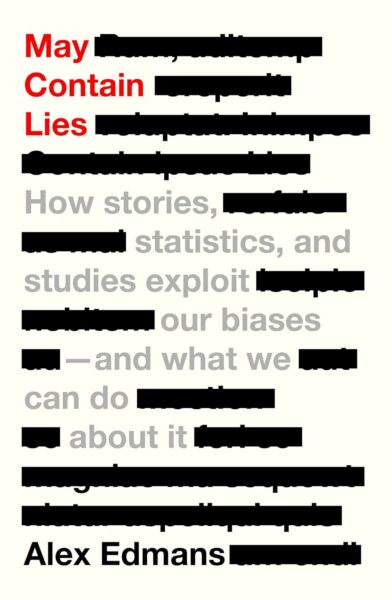
In this spirit, let me recommend a book with helpful and practical advice: May Contain Lies: How Stories, Statistics, and Studies Exploit Our Biases – And What We Can Do about It, by Alex Edmans. Edmans examines some of the biases that lead us away from the truth.
One common one is called confirmation bias. It occurs when we uncritically accept a claim if it confirms what we would like to be true, even when alternative explanations may exist. We also do the opposite: we reject claims we don’t like and invent alternative explanations to justify our initial convictions and dismiss contrary evidence. In contemporary disputes, it is common for someone who does not appreciate certain information to find a reason to ignore it, while a supporter considers it the gospel truth.
The bias not only appears in the interpretation of evidence but also in relation to the information we gather from the beginning. We only seek evidence that confirms our initial hunch and dare not explore something that might contradict it. Studies suggest that greater knowledge rarely makes people more aware of the need to consider both sides; rather, it often gives them more reasons to praise the opinions they share and ridicule those they do not.
Edmans keenly analyzes the various problems that arise when we confuse claims with facts, facts with data, data with evidence, and evidence with proof. People accept claims as facts, even if the information supporting them is unreliable or if the claim is broad and vague. (“He lied.” “They attacked.” “They didn’t care at all” about people).
Similarly, people accept a fact as data even though it is not representative, but only a hand-picked example or the result of selective “data mining.” (Repeating the details of a horrible crime committed by an immigrant does not support the claim that all or most immigrants are criminals. Surveys that say “Catholics think x” yield different results when only those who attended Mass the previous week are asked). Edmans’s book is especially solid in showing how people can use data to support almost any conclusion they prefer.
Although people know that data can be manipulated, they often accept it as solid evidence supporting their preferred conclusion, even if other interpretations are possible. An overwhelming number of successful executives use deodorant. Does using deodorant explain their success? Many successful people spent 10,000 hours practicing their craft or sport. Does that explain their excellence? Or could it be something else?
Likewise, even if the evidence can support a proof in one area, does that mean the same things will work in another? The evidence shows that strict discipline works well in the military. Will it work just as well in a family?
If we are dedicated to the truth, as our devotion to God demands, perhaps we should be more careful not to settle for any of these illusory false “half-truths” or transmit them to others in our conversations and social media posts.
Do we imagine that the truth would be easy? That it would always make us “feel good,” inflate us with pride, and feed our sense of moral superiority? What could there be in Christianity that has led us to think that? Truth in its fullness is more likely to, like God, humble us and make us recognize how small our minds and hearts have been.
About the author
Randall B. Smith is a professor of Theology at the University of St. Thomas in Houston, Texas. His most recent book is From Here to Eternity: Reflections on Death, Immortality, and the Resurrection of the Body.