


By Stephen P. White
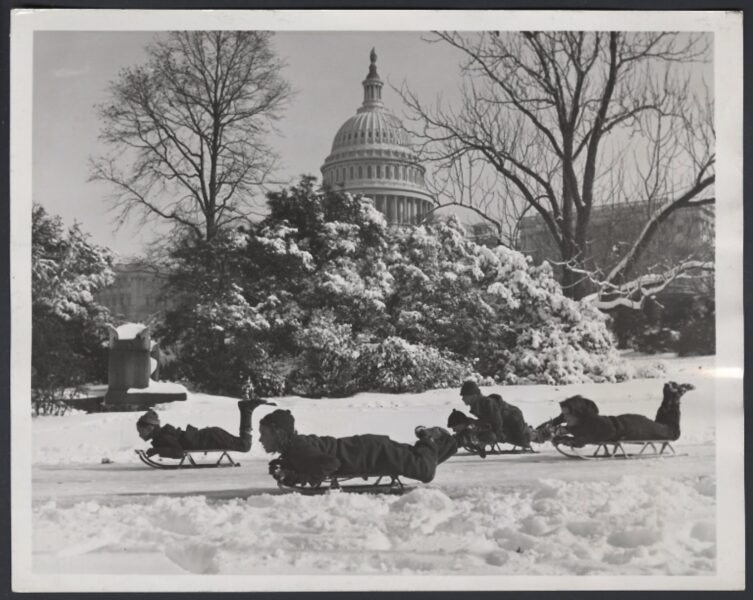
Last week it snowed here, in the country’s capital, and everything came to a standstill. This storm was unusual, not so much for the amount of snow (about thirteen centimeters where I live), but for the several inches of sleet that accumulated on top of the snow and then quickly froze into a solid mass, like cement.
The storm left much more snow farther north and much more ice to the south and west, causing massive power outages, falling trees, and the like. It even spawned a handful of tornadoes. Well over a hundred deaths have been attributed to the storm, which already has its own Wikipedia page.
Unless you live in the West or southern Florida, you probably have your own stories about this storm.
In my neighborhood, the storm was a considerable nuisance, but barely reached the level of a catastrophe. Almost two weeks later, much of my street still hasn’t been cleared. The sidewalks are mostly unshoveled and impassable. Street parking is almost impossible, except after major excavations. My kids were out of school for a full week, followed by several days of delayed starts. They’re only now returning to something like a normal schedule.
Meanwhile, the piles of snow and ice stacked everywhere show all the signs of intending to stay well into March.
But in reality, this isn’t a column about the weather, no matter how noteworthy it has been.
Scheduled holidays—like Christmas, for example—are usually filled with the usual hustle of carefully planned activities. But the unforeseen suspension of the rhythms of ordinary life we’ve had, during this past week and more, produced the opposite effect. Instead of our days being filled with pre-planned activities, these days have been a time of prolonged and delightful spontaneity.
The night before the snow started falling, Mass at the local parishes was unusually crowded, as families and neighbors who rarely attend the Saturday evening anticipated Mass showed up in droves to fulfill their Sunday obligation before the bad weather set in. One local parish even added an extra late Saturday evening Mass to accommodate everyone.
It’s one thing to see the usual faces at the usual Sunday Mass time. But seeing the entire parish packing the church as if it were Christmas Eve created a palpable sense of true solidarity. There we all were, at an unusual hour, to do the last but most important thing in preparation for the coming storm.
Neighbors, at least where I live, had an additional opportunity to help each other. Checking in before the storm, chipping each other out of the ice afterward. Friends trudged down the half-cleared street to share an impromptu happy hour while the kids sledded down the hill. Our stock of provisions (mostly snacks and hot chocolate) ran out quickly.
There’s something healthy in the way a community shows its character when the comforts and self-sufficiency of modern life are threatened (gently, but enough to notice) by the forces of nature. The need for solidarity—in the parish, among neighbors, etc.—surfaces. There’s joy in being consciously aware that my neighbor needs me and I need him, and that we’re in this together.
When reminders like this arrive without too much danger to life or physical integrity, they are a grace. The superfluous nature of so many things that fill our daily life becomes evident. Much activity, even activity around good things, stops, and suddenly we see what we must have and what we can do without.
One of the joys of having a wood-burning fireplace is that, when the weather turns really unpleasant, the simple act of staying inside, warm and sheltered, feels like an accomplishment. One is performing a feat of survival. It’s also a stimulus for gratitude for things that are otherwise taken for granted: things like a roof over one’s head, electricity, and central heating.
But there’s also a kind of thrill in having to do without all our usual comforts and conveniences (again, as long as the danger isn’t too great). I could sense my son’s disappointment when he realized the power never went out, meaning the headlamps and flashlights went unused.
One of the first things the kids did when they ran out into the freshly fallen snow was to build snow forts and tunnels. We already have a house; they wanted to see if they could build their own. One of my neighbor’s older boys built an igloo and slept in it overnight just for the fun of it. He did it once, but not twice.
I suspect there’s more to this than thrill-seeking or a boyish sense of adventure. It’s more than just play. Or perhaps play is more serious than we think. Some kinds of play allow us to test ourselves, to push our limits. For young people especially (but not only for the young), stretching in that way is an important and healthy way to gain confidence and grow.
Our way of life insulates us from contingency and precariousness. We seek, and often find, security and comfort. At least we find them often enough to come to expect them. But somehow, we know that the artifice of control and stability is, to some extent, an illusion. This realization, when it catches us by surprise, can be terrifying. But it can also be invigorating.
As Pope Benedict XVI said to a group of pilgrims from his native Germany at the beginning of his pontificate: “We were not created for an easy life, but for great things, for good.” Sometimes—often—this is a painful lesson to learn. But sometimes the heavens open and we’re offered an unexpected opportunity to learn the joy of life’s contingencies (and God’s sustaining grace), sipping from a hot cup in front of a crackling fire.
Ice and snow, bless the Lord.
About the author
Stephen P. White is executive director of The Catholic Project at The Catholic University of America and a fellow at Catholic Studies at the Ethics and Public Policy Center.