



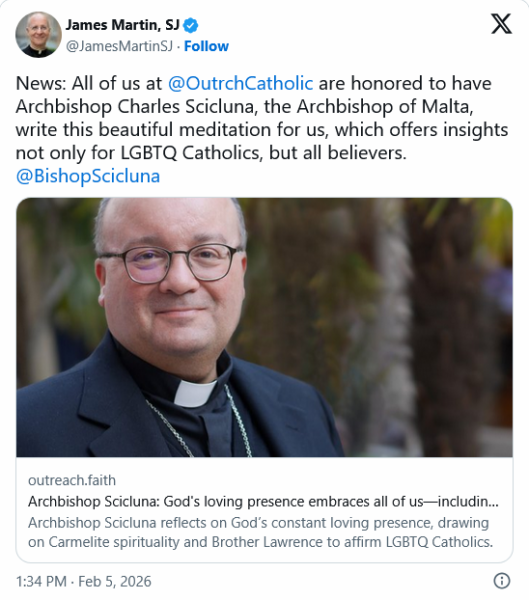
Msgr. Charles J. Scicluna, secretary of the Dicastery for the Doctrine of the Faith, has recently published a pastoral text centered on the spiritual accompaniment of people whom he identifies under the acronym LGBT. The article, which reflects on God’s loving presence in everyday life and has been widely disseminated on social media by Fr. James Martin, highlights the ambiguity with which many ecclesiastical leaders have been addressing this topic from perspectives alien to Christian anthropology and the constant teaching of the Church.
It is deeply concerning that a Secretary of the Dicastery for the Doctrine of the Faith—an institution charged with safeguarding the integrity of the revealed deposit—adopts and disseminates a flawed conceptual framework for thinking about the relationship between the person, the Church, and God. We are not faced with a mere problem of pastoral language or spiritual emphasis, but with theological presuppositions that gravely condition the understanding of the Catholic faith.
The Reduction of the Person to an Acronym
The first flawed premise is the identification of concrete persons under an ideological acronym. The Church has never defined anyone by a sociopolitical, psychological, or cultural category, but by their condition as creatures made in the image of God, called to communion with Him and to holiness.
Adopting this language is not neutral. It presupposes accepting an anthropology that fragments the person and turns an inclination into a defining trait. The Church accompanies persons, not ideological identities. When it adopts that vocabulary without nuance, it runs the risk of legitimizing a conceptual framework that does not arise from the Gospel, but from a specific cultural construction.
Displacing the Center of Spiritual Life
The second problematic premise consists in placing that identity—defined by the inclination—at the center of the relationship with God. From the Catholic faith, what structures spiritual life is not an affective orientation, but the state of grace and the free response to God’s call.
We all appear before the Lord as sinners in need of conversion. Christianity is not articulated around identities, but around the cross, conversion, and grace. When a specific inclination becomes the interpretive axis of spiritual life, the core of the Gospel is displaced and the universal call to holiness is diluted.
The False Narrative of a Distant Church
The third premise is the presumption of a structural distance between people with homosexual inclinations and the Church. This narrative, repeated ad nauseam, is simply false.
The distance is not between the Church and a specific condition, but between grace and sin. And that distance runs through all men. The struggle against concupiscence and sins of impurity is no one’s exclusive domain: it affects the single, the married, the celibate, the consecrated. We all experience the weight of a wounded nature and we are all called to combat it with the help of grace.
There is no special doctrine or differentiated morality. There is a single teaching: the universal call to chastity according to one’s state of life, the real difficulty of living it, and the certainty that God accompanies everyone in that battle.
The Silenced Doctrine and the Trap of Discourse
This is where it is worth unmasking the trap underlying this type of text. Because, taken literally, many of the statements they contain are evident truths shared by the entire Church: that God loves everyone, that no one is excluded from His mercy, that His presence accompanies every human life. All of that is elementary Catholic doctrine, truths that no faithful person disputes.
The problem is that, in this specific context, those statements do not constitute the real message, but the wrapping. What is suggested—without ever stating it explicitly—is something very different: that sin ceases to be decisive; that living objectively in contradiction with the moral law has no major spiritual relevance; that an active sexual life outside the order willed by God does not require conversion or change; that, in short, “it’s not that big a deal.”
That is the implicit conclusion that is introduced in a sly manner. The doctrine is not formally denied, but it is emptied of content. It is not affirmed that sin does not exist, but it is made irrelevant. And thus, under a language of accompaniment, presence, and consolation, a pastoral approach is transmitted that reassures man in his sin instead of calling him to conversion.
God’s love does not consist in telling us that our conduct does not matter, but in giving us the grace to come out of sin. Separating mercy and conversion is not true pastoral care: it is a spiritual deception that confuses and disarms.
An Ineludible Doctrinal Responsibility
That these approaches are disseminated in ecclesiastical circles is already a cause for serious concern. That they come from someone who holds a position of responsibility in the Dicastery for the Doctrine of the Faith is even more so. It is not a matter of denying the need for a close and patient pastoral approach, but of recalling that true mercy never opposes moral truth.
The Church’s mission is not to uncritically adapt to dominant cultural frameworks, but to judge them in the light of the Gospel. When a flawed framework is adopted, even with good intentions, the radical call of Christianity is obscured and the faithful are deprived of the integral proclamation that saves.
The Church’s doctrine is not an inhuman burden, but a luminous expression of the truth about man. Silencing it, relativizing it, or diluting it under ambiguous discourses does not liberate: it confuses. And that confusion, when it arises from instances called to safeguard the faith, cannot and must not go unnoticed.