


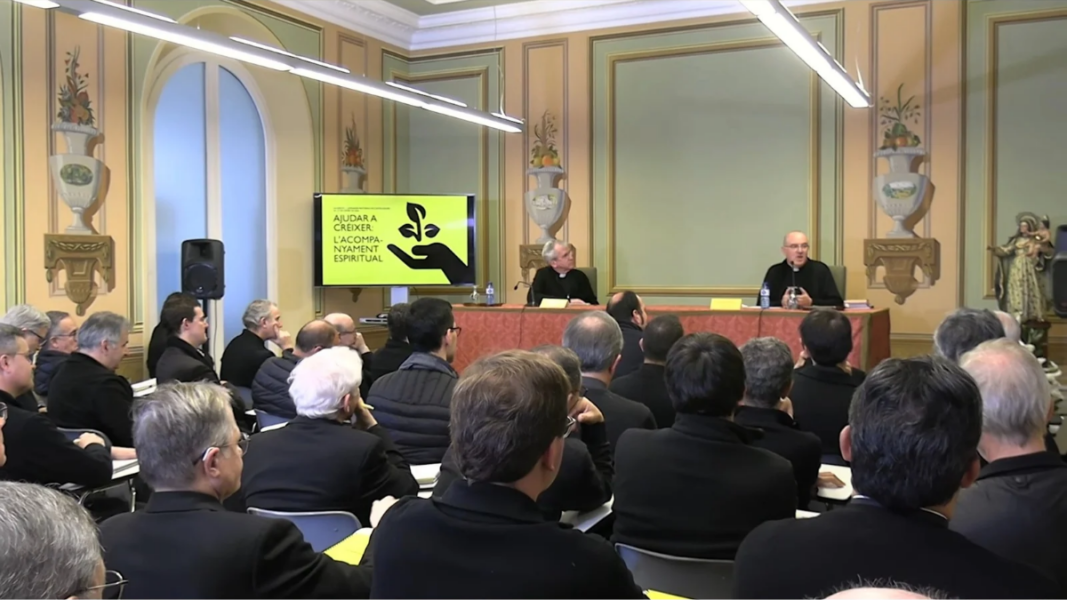
Spiritual accompaniment as a concrete path toward holiness and as a pastoral response to an increasingly secularized society was the central axis of the 61st Pastoral Issues Days of Castelldaura (Premià de Dalt, Catalonia) held at the end of January, as reported by the Archdiocese of Barcelona. The meeting brought together more than a hundred priests from various Catalan dioceses to reflect on the current challenges of the ministry.
From the beginning of the days, it was insisted that accompaniment cannot be reduced to psychological techniques or prefabricated schemes, but requires a personal relationship oriented toward interior life and following Christ.
Holiness, Freedom, and the Action of the Holy Spirit
In his initial intervention, the Bishop of Vic, Monsignor Romà Casanova, recalled that every form of Christian accompaniment has holiness as its horizon, understood as real union with Christ and fullness of love. He also emphasized that this call, recalled by the Second Vatican Council, is universal and is lived in personal freedom.
The speakers agreed in pointing out that the spiritual accompanier does not substitute the conscience nor direct from outside, but helps to discern, always respecting the dignity of the person and recognizing the Holy Spirit as the true protagonist of spiritual growth.
Accompanying in Times of Cultural Confusion
The days also addressed the current cultural context, described as marked by a loss of religious references and growing interior fragmentation. In this scenario, it was highlighted that many people are returning to approach the Church in search of meaning, which makes a pastoral approach based on closeness and listening especially necessary.
It was insisted that accompaniment requires priests trained not only doctrinally, but also in humanity and spiritual life, capable of offering credible witness.
Youth, Digital World, and Personal Relationship
A part of the sessions focused on the accompaniment of young people, especially conditioned by digital culture. Warnings were given about the difficulties posed by a life mediated by screens and virtual profiles, and the importance of generating real relationships that help build personal identity was emphasized.
In this area, it was highlighted that the first pastoral step is concrete love and closeness, rather than abstract discourses.
Priestly Fraternity as Support for the Ministry
Another of the topics addressed was priestly fraternity, presented as an essential element to sustain the life and mission of the priest. It was highlighted that accompaniment is not only a task toward the faithful, but also a need among the presbyters themselves, to avoid isolation and strengthen communion.
The days concluded by emphasizing the value of these meetings as stable spaces for formation, reflection, and mutual support in the exercise of the priestly ministry.