


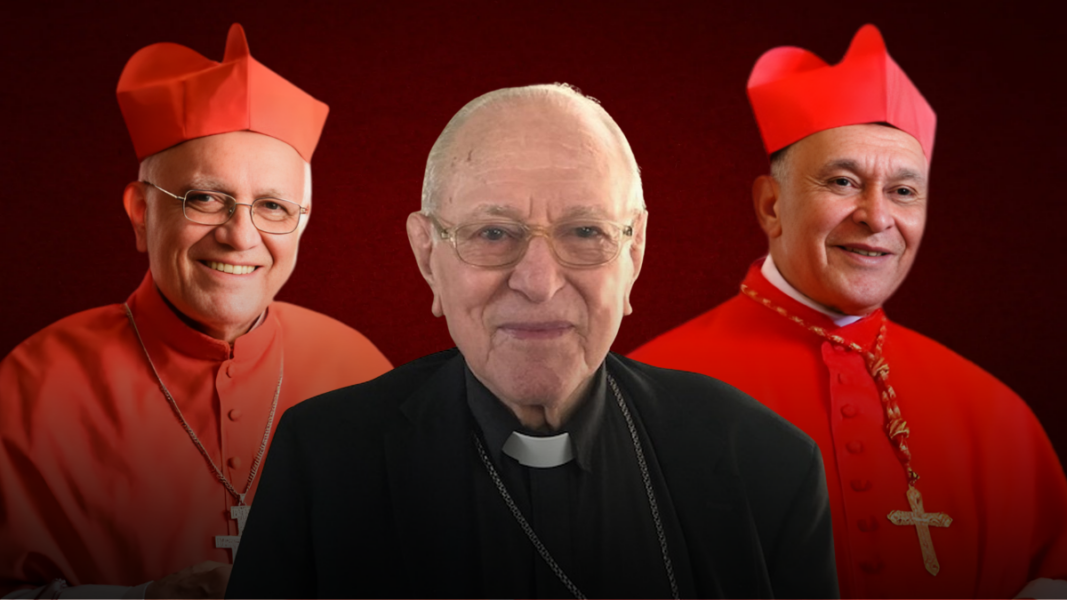
Two Venezuelan cardinals and an emeritus archbishop have publicly urged the Church in Venezuela to express a clear, unified, and firm voice in the face of the country’s current political and institutional situation, marked by uncertainty following the 2024 presidential elections and the prolonged deterioration of social conditions in a letter signed by the prelates themselves.
A letter disseminated before the episcopal assembly
The call was made public on January 31 by Cardinals Baltazar Porras and Diego Padrón, along with the emeritus Archbishop of Coro, Ovidio Pérez Morales, just a few days before the start of the plenary assembly of the Venezuelan Episcopal Conference. The temporal proximity has been interpreted by local observers as an attempt to offer discernment criteria to the bishops at a particularly delicate moment for the country.
Since early January, following the political events after the presidential elections held on July 28, 2024, the Venezuelan Episcopal Conference has maintained a prudent public profile, limiting itself to a brief initial statement and avoiding broader pronouncements on the evolution of the national situation.
Read also: Concern grows over possible religious persecution in Venezuela
A context of institutional uncertainty
In the letter, the signatories describe the current moment as a “critical hour” for Venezuela, characterized by a situation of institutional provisionality and the risk of greater social fracture. They point out that the country is awaiting a still uncertain political transition, in a context of weakening of the rule of law and restrictions on fundamental rights.
Following the 2024 elections, widely questioned by the opposition and much of the international community, the Government did not publish the results disaggregated by polling stations, while opposition sectors claim to have obtained a clear victory. Since then, arrests of political leaders, restrictions on freedom of expression, and increased pressure on media outlets and civil organizations have been reported.
Principles that the prelates consider non-negotiable
In the face of this situation, the cardinals and the emeritus archbishop recall three principles that they qualify as non-negotiable and that, in their judgment, must guide any peaceful way out of the crisis: the dignity of the human person, the validity of the Constitution, and popular sovereignty as the basis of national coexistence.
In the text, they emphasize that the recovery of the rule of law and effective constitutionality is a necessary condition to guarantee democratic pluralism, economic and political development, peaceful coexistence among citizens, and respect for human rights, in coherence with the values of a predominantly believing people with a Christian tradition.
Three specific requests to the authorities
The letter articulates these reflections in three concrete proposals that the signatories consider priorities.
First, they demand the immediate, total, and integral release of all political prisoners, specifying that this must include not only release from prison but also the suppression of any subsequent precautionary measures that could prolong situations of control or repression.
Second, they call for an end to the communicational hegemony exercised by the State and the full restoration of freedom of communication. In the text, the prelates explicitly link this right to the right to life and to the dignity of the person.
Third, they call for respect for the majority will of the Venezuelan people expressed in the July 2024 presidential elections and emphasize the urgency of initiating a political transition that does not prolong the current situation of uncertainty.
The mission of the Church in national life
The signatories recall that the Church, despite the limitations inherent in the human condition, is by God’s will a sign and instrument of communion among all Venezuelans. From this conviction, they express their desire that the Church actively contribute to national reunification and to the moral and material reconstruction of the country.
The text insists that this commitment corresponds not only to the pastors but also to the lay faithful, each from their own competencies and responsibilities, and underscores the moral and spiritual dimension of the current crisis.