


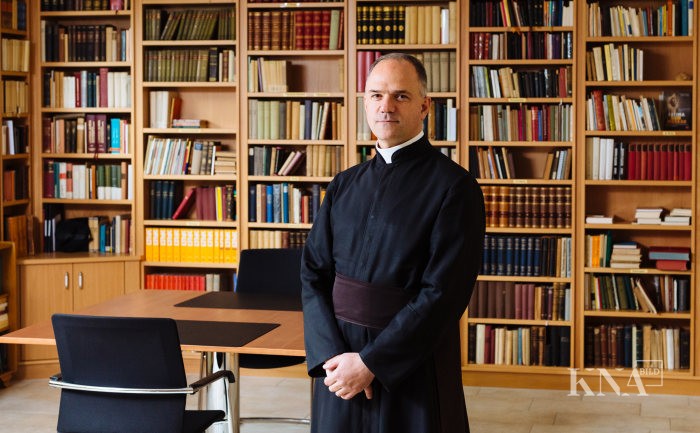
The Superior General of the Priestly Fraternity of Saint Pius X has granted his first interview following the public announcement of the decision to proceed with new episcopal consecrations without pontifical mandate, scheduled for next July 1. In the interview, published by FSSPX Actualidad and dated February 2, 2026, Davide Pagliarani justifies this determination on the canonical principle of salus animarum as the supreme law, in the context of what he considers an objective and prolonged state of spiritual necessity in the Church, aggravated by the doctrinal and pastoral continuity of the pontificate following Francis and by the absence of a satisfactory response from Rome to the approaches made by the Fraternity.
Source: FSSPX Actualidad
FSSPX.Actualidad: Reverend Superior General, you have just publicly announced your intention to proceed with new episcopal consecrations within the Priestly Fraternity of Saint Pius X on July 1. Why announce it precisely today, February 2?
Don Davide Pagliarani: The feast of the Purification of the Most Holy Virgin holds particular importance in the Fraternity. On this day, candidates for the priesthood receive the cassock. The Presentation of Our Lord in the Temple, which we celebrate today, reminds them that the key to their formation and preparation for the Orders lies in the gift of themselves, which passes through the hands of Mary. It is a Marian feast of utmost importance; when Simeon announces to Our Lady a sword of sorrow, he clearly indicates her role as Co-Redemptrix alongside her divine Son. Our Lady accompanies the future priest in the same way in his formation and throughout his life: it is She who continually forms Our Lord in his soul.
FSSPX.Actualidad: There have been persistent rumors about this announcement in recent months, especially following the death of Msgr. Tissier de Mallerais in October 2024. Why have you waited until now?
Don Davide Pagliarani: Just as Msgr. Lefebvre did in his time, the Fraternity has always sought not to anticipate Providence, but to follow it, allowing itself to be guided by its indications. A decision of such importance cannot be taken lightly or with precipitation.
Specifically, as it is a matter that obviously concerns the supreme authority of the Church, it was first necessary to undertake the appropriate approaches to the Holy See—as we have done—awaiting, for a reasonable period, a response. We could not take the decision without having concretely manifested our recognition of the authority of the Holy Father.
FSSPX.Actualidad: In your homily, you said that you had written to the Pope. Could you tell us more about it?
Don Davide Pagliarani: Last summer I wrote to the Holy Father to request an audience. Having received no response, I wrote a new letter a few months later; a simple and filial letter, without hiding any details about our needs. I mentioned our doctrinal divergences but also our sincere desire to serve the Catholic Church tirelessly, for we are servants of the Church despite the lack of canonical recognition.
A response to this second letter was sent to us from Rome a few days ago, signed by Cardinal Fernández. Unfortunately, this response dismisses our proposition outright, without offering us an alternative solution.
This proposal, given the absolutely exceptional circumstances in which the Fraternity finds itself, consists, in short, in the Holy See accepting to let us continue provisionally in our exceptional situation, for the good of the souls who come to us. Likewise, we reiterate to the Pope our promise to dedicate all our energies to the safeguarding of Tradition and to making our faithful true children of the Church. It seems to me that such a proposal is, at once, realistic and reasonable, and that it could, in principle, receive the Holy Father’s approval.
FSSPX.Actualidad: But then, if you still have not received that permission, why do you consider that you must proceed with the episcopal consecrations anyway?
Don Davide Pagliarani: It is a question of an extraordinary means, proportionate to a need that is at once real and extraordinary. Certainly, the mere existence of a need for the good of souls does not imply, in itself, that any initiative in its favor is automatically justified. In our case, after a long period of waiting, observation, and prayer, it seems to us that we can affirm today that the objective state of grave necessity in which souls, the Fraternity, and the Church find themselves demands this decision.
With the legacy left to us by Pope Francis, the underlying reasons that already justified the consecrations of 1988 retain all their validity and reveal themselves today, in many respects, even more pertinent. Vatican II remains and is today more than ever the compass that guides the men of the Church, and it is unlikely that they will change course in the near future. The major orientations that are already taking shape for the new pontificate, particularly following the last consistory, fully confirm this: in them, an explicit determination is perceived to maintain Francis’s line as an irreversible path for the entire Church.
“We reiterate to the Pope our promise to dedicate all our energies to the safeguarding of Tradition and to making our faithful true children of the Church”
It is sad to note it, but it is a fact: in an average parish, the faithful no longer find the necessary resources to ensure their eternal salvation. In particular, with regard to the integral preaching of Catholic truth and morals, as well as the administration of the Sacraments as the Church has always conceived them. This is the summary of the state of necessity. In this critical context, our bishops are aging, and with the continuous growth of the apostolate, they can no longer keep up to respond to the needs of the faithful around the world.
FSSPX.Actualidad: In what sense do you consider that last month’s consistory confirms the direction taken by Pope Francis?
Don Davide Pagliarani: Cardinal Fernández, in the name of Pope Leo, invited the Church to return to Francis’s fundamental intuition, expressed in Evangelii gaudium, his key encyclical: in a simplified way, it is a matter of reducing the proclamation of the Gospel to its primitive essential expression, in very concise and forceful formulas—the “kerygma”—with a view to an “experience,” an immediate encounter with Christ, setting aside everything else, however valuable; specifically, the whole set of elements of Tradition, considered as accessories and secondary. This method of the new evangelization is the one that has produced the doctrinal vacuum characteristic of Francis’s pontificate, which a significant part of the Church has experienced so intensely.
Certainly, in this perspective, one must always be concerned with offering new and adequate responses to the questions that arise; but this task must be carried out through synodal reform, and not by rediscovering the classic and always valid responses provided by the Tradition of the Church. In this way, in the supposed “breath of the Spirit” of this synodal reform, Francis has been able to impose on the entire Church catastrophic decisions, such as the authorization of Communion for divorced and remarried persons or the blessing of same-sex couples.
In summary: through the “kerygma,” the proclamation of the Gospel is isolated from the entire corpus of traditional doctrine and morals; and through synodality, traditional responses are replaced by arbitrary decisions, easily absurd and doctrinally unjustifiable. Cardinal Zen himself considers this method manipulative and attributing it to the Holy Spirit blasphemous. It is to be feared; unfortunately, that he is right.
FSSPX.Actualidad: You speak of service to the Church but, in practice, the Fraternity may give the impression of challenging the Church, especially if they contemplate new episcopal consecrations. How would you explain it to the Pope?
Don Davide Pagliarani: We serve the Church, first of all, by serving souls. This is an objective fact, independent of any other consideration. The Church exists fundamentally for souls: its purpose is the sanctification of souls and their salvation. All the fine speeches, the various debates, and the great themes on which one discusses or could discuss are meaningless if they do not have as their goal the salvation of souls. It is worth remembering this, because today there is a danger that the Church will concern itself with everything and nothing. Ecological concerns, for example, or the defense of the rights of minorities, women, or migrants, run the risk of losing sight of the Church’s essential mission. If the Priestly Fraternity of Saint Pius X fights to preserve Tradition, with all that it implies, it is solely because these treasures are absolutely indispensable for the salvation of souls, and because it pursues nothing else beyond the good of souls and that of the priesthood ordered to their sanctification.
“In an average parish, the faithful no longer find the necessary resources to ensure their eternal salvation. This is the summary of the state of necessity”
By acting in this way, we place at the service of the Church that which we preserve. We offer the Church not a museum of old and dusty things, but Tradition in its fullness and fruitfulness: Tradition that sanctifies souls, that transforms them, that arouses vocations and authentically Catholic families. In other words: it is for the Pope himself, as such, that we preserve this treasure, until the day when its value is understood again and a Pope wishes to make use of it for the good of the entire Church. Because it belongs to the latter.
FSSPX.Actualidad: You speak of the good of souls, but the Fraternity has no mission over souls. On the contrary, it was canonically suppressed more than fifty years ago. On what basis can a mission of the Fraternity with regard to souls be justified?
Don Davide Pagliarani: It is simply a question of charity. We do not want to attribute to ourselves a mission that we do not have. But, at the same time, we cannot refuse to respond to the spiritual anguish of souls who increasingly find themselves perplexed, disoriented, and lost. They ask for help. And after having sought for a long time, they find, in a perfectly natural way, in the riches of the Church’s Tradition, lived integrally, with very deep joy, the light and consolation. With regard to these souls, we have a true responsibility, even though we have no canonical mission: if someone sees a person in danger on the street, they are obliged to help them according to their possibilities, even if they are neither a firefighter nor a policeman.
The number of souls who have come to us has not ceased to grow over the years and has even increased considerably during the last decade. To ignore their needs and abandon them would mean betraying them and, with it, betraying the Church itself, for, once again, the Church exists for souls and not to feed vain and futile discourses.
This charity is a duty that takes precedence over all others. The Church’s own law provides for it. In the spirit of Church law, the juridical expression of this charity, the good of souls comes before everything. It truly represents the law of laws, to which all others are subordinate and before which no ecclesiastical law prevails. The axiom “suprema lex, salus animarum”—the supreme law is the salvation of souls—is a classic maxim of canonical tradition, explicitly taken up, moreover, in the last canon of the 1983 Code; in the current state of necessity, from this fundamental principle ultimately depends all the legitimacy of our apostolate and our mission with regard to the souls who come to us. It is, on our part, a role of subsidiarity, in the name of this same charity.
FSSPX.Actualidad: Are you aware that contemplating new episcopal consecrations could place the faithful who resort to the Fraternity before a dilemma: either the choice of integral Tradition with all that it implies, or full communion with the Church’s hierarchy?
Don Davide Pagliarani: This dilemma is in reality only apparent. It is evident that a Catholic must preserve both the integrity of Tradition and communion with the hierarchy. He cannot choose between these two goods, for both are necessary.
However, it is too often forgotten that communion is essentially founded on the Catholic faith, with all that it implies: starting with a true sacramental life and the exercise of a government that preaches that same faith and fosters its practice, using its authority not arbitrarily, but truly for the spiritual good of the souls entrusted to its care.
It is precisely to guarantee these foundations, these necessary conditions for the very existence of communion in the Church, that the Fraternity cannot accept what opposes that communion and denatures it, even when it paradoxically comes from those who exercise authority in the Church.
FSSPX.Actualidad: Could you give us a concrete example of what the Fraternity cannot accept?
Don Davide Pagliarani: The first example that comes to mind dates back to 2019, when Pope Francis, on the occasion of his visit to the Arabian Peninsula, signed with an imam the well-known Abu Dhabi Declaration. In it, he affirmed, together with the Muslim leader, that the plurality of religions had been willed as such by divine Wisdom.
It is evident that a communion founded on the acceptance of such an affirmation, or that included it, would simply not be Catholic, for it would imply a sin against the first commandment and the denial of the first article of the Creed. I consider that such an affirmation is more than a simple error. It is simply inconceivable. It cannot be the foundation of a Catholic communion, but rather the cause of its dissolution. I think that a Catholic should prefer martyrdom rather than accept such an affirmation.
FSSPX.Actualidad: Around the world, awareness of the errors long denounced by the Fraternity is progressing, especially on the internet. Would it not be advisable to let this movement develop with confidence in Providence, rather than intervening through a strong public gesture like the consecrations?
Don Davide Pagliarani: This movement is certainly positive, and it cannot but rejoice us. It undoubtedly illustrates the plausibility of what the Fraternity defends and it is appropriate to encourage this diffusion of the truth by all existing means. That said, it is a movement that has its limits, for the battle of faith is not limited to, nor exhausted in, discussions and positions whose stage is the web or social networks.
The sanctification of a soul certainly depends on an authentic profession of faith, but this must lead to a truly Christian life. On Sundays, souls do not need to consult an internet platform. What they need is a priest who confesses them and instructs them, who celebrates Holy Mass for them, who truly sanctifies them and leads them to God. Souls need priests. And to have priests, bishops are needed. Not “influencers.” In other words, we must return to the real world, that is, to the reality of souls and their concrete objective needs. Episcopal consecrations have no other purpose: to guarantee, for the faithful committed to Tradition, the administration of the sacrament of confirmation, of holy orders, and everything that derives from them.
FSSPX.Actualidad: Despite your good intentions, do you not think that the Fraternity could end up, in some way, taking itself for the Church, or considering itself indispensable?
Don Davide Pagliarani: By no means does the Fraternity intend to substitute itself for the Church or assume its mission; on the contrary, it retains a deep awareness of existing only to serve it, relying exclusively on what the Church itself has always preached, believed, and practiced everywhere.
The Fraternity is likewise deeply aware that it is not it that saves the Church, for only Our Lord, who never ceases to watch over it, can guard and save His Spouse.
The Fraternity is, simply, in circumstances it has not chosen, a privileged means to remain faithful to the Church. Attentive to the mission of its Mother, which for twenty centuries has fed its children with doctrine and sacraments, the Fraternity filialially consecrates itself to the preservation and defense of integral Tradition, taking the means of an unequaled freedom to remain faithful to this legacy. In the words of Msgr. Lefebvre, the Fraternity is nothing more than a work “of the Catholic Church, which continues to transmit the doctrine”; its role is that of a “postman who carries a letter.” And its greatest desire is to see all Catholic pastors join it in the fulfillment of this duty.
FSSPX.Actualidad: Let us return to the Pope. Do you find it plausible to think that the Holy Father might accept, or at least tolerate, the Fraternity consecrating bishops without a pontifical mandate?
Don Davide Pagliarani: A Pope is first of all a father. As such, he is capable of discerning a right intention, a sincere will to serve the Church, and above all, a true case of conscience in an exceptional situation. These elements are objective, and all who know the Fraternity can recognize them, even without necessarily sharing its positions.
FSSPX.Actualidad: This is understandable, in theory. But do you think that, concretely, Rome might tolerate such a decision on the part of the Fraternity?
Don Davide Pagliarani: The future remains in the hands of the Holy Father and, evidently, of Providence. However, it must be recognized that the Holy See is sometimes capable of showing a certain pragmatism, even surprising flexibility, when it is convinced of acting for the good of souls.
Let us take the very current case of relations with the Chinese government. Despite a true schism of the Chinese Patriotic Church; despite uninterrupted persecution of the underground Church, faithful to Rome; despite agreements regularly renewed and then violated by the Chinese government, in 2023, Pope Francis approved a posteriori the appointment of the Bishop of Shanghai by the Chinese authorities. More recently, Pope Leo XIV ended up also accepting a posteriori the appointment of the Bishop of Xinxiang, designated in the same way during the vacancy of the Apostolic See, when the bishop faithful to Rome, imprisoned several times, was still in office. In both cases, these are evidently prelates sympathetic to the government, imposed unilaterally by Beijing with the aim of controlling the Catholic Church in China. It should be emphasized that these are not simple auxiliary bishops, but residential bishops, that is, ordinary pastors of their respective diocese (or prefecture), with jurisdiction over local priests and faithful. In Rome, it is perfectly known for what purpose these pastors have been chosen and imposed unilaterally.
“The Priestly Fraternity of Saint Pius X pursues nothing else beyond the good of souls and that of the priesthood ordered to their sanctification”
The case of the Fraternity is very different: it is not at all a question of collaborating with a communist or anti-Christian power, but solely of safeguarding the rights of Christ the King and the Tradition of the Church, at a time of crisis and generalized confusion in which these are gravely compromised. The intentions and purposes are evidently not the same. The Pope knows this. Moreover, the Holy Father knows perfectly well that the Fraternity does not intend in any way to confer jurisdiction on its bishops, which would amount to creating a parallel Church.
Frankly, I do not see how the Pope could fear a greater danger to souls from the Fraternity than from the government of Beijing.
FSSPX.Actualidad: Do you think that, with regard to the traditional Mass, the need of souls is today as grave as in 1988? After the vicissitudes through which the rite of St. Pius V has passed—its liberalization by Benedict XVI in 2007 and the restrictions imposed by Francis in 2021—, where are we heading with the new Pope?
Don Davide Pagliarani: As far as I know, Pope Leo XIV has maintained a certain discretion on this subject, which arouses great expectation in the conservative world. However, very recently a text by Cardinal Roche on the liturgy has been made public, initially intended for the cardinals who participated in last month’s consistory. And there is no reason to doubt that this text corresponds, in its broad outlines, to the orientation desired by the Pope. It is a very clear text and, above all, logical and coherent. Unfortunately, it is based on a false premise.
Specifically, this text, in perfect continuity with Traditionis custodes, condemns the liturgical project of Pope Benedict XVI. According to the latter, the ancient rite and the new one would be two approximately equivalent forms, which would in any case express the same faith and the same ecclesiology, and which could therefore mutually enrich each other. Concerned for the unity of the Church, Benedict XVI wanted to promote the coexistence of both rites and published Summorum Pontificum in 2007. For many, this providentially meant a rediscovery of the Mass of all ages; but in the long run, it also gave rise to a movement of questioning of the new rite, which seemed problematic and which Traditionis custodes, in 2021, sought to curb.
Faithful to Francis, Cardinal Roche in turn promotes the unity of the Church, but according to an idea and through solutions diametrically opposed to those of Benedict XVI: although the affirmation of continuity from one rite to the other through the reform is maintained, their coexistence is firmly opposed. He sees in it a source of division, a threat to unity, which must be overcome by returning to an authentic liturgical communion: “The primordial good of the unity of the Church is not achieved by freezing the division, but by all of us rediscovering ourselves in sharing that which cannot but be shared.” In the Church, “there should be only one rite,” in full harmony with the true sense of Tradition.
This is a just and coherent principle, for the Church, having one faith and one ecclesiology, can have only one liturgy capable of expressing them adequately… But it is a principle misapplied, since, in coherence with the post-conciliar new ecclesiology, Cardinal Roche conceives Tradition as something evolutionary, and the new rite as its only living expression for our time; the value of the Tridentine rite can only be considered as outdated and its use, at most, a “concession,” “in no case a promotion.”
Thus, there is “division” and current incompatibility between the two rites: this is what now appears with greater clarity. But let us not deceive ourselves: the only liturgy that adequately expresses, in an immutable and non-evolutionary way, the traditional conception of the Church, of Christian life, and of the Catholic priesthood is the one of always. On this point, the opposition of the Holy See seems more than ever irrevocable.
FSSPX.Actualidad: Cardinal Roche nevertheless acknowledges that there are still certain problems in the application of the liturgical reform. Do you think this could lead to an awareness of the limits of that reform?
Don Davide Pagliarani: It is interesting to note that, after sixty years, a real difficulty in the application of the liturgical reform is still admitted, “whose richness would need to be discovered”: it is a refrain that is heard whenever this subject is addressed and that Cardinal Roche’s text does not avoid. But instead of sincerely questioning the intrinsic deficiencies of the new Mass and, therefore, the general failure of this reform; instead of recognizing the fact that churches are emptying and vocations are decreasing; instead of asking why the Tridentine rite continues to attract so many souls… Cardinal Roche only sees as a solution an urgent prior formation of the faithful and seminarians.
Unwittingly, he thus enters a vicious circle, for it is the liturgy itself that is called to form souls. For nearly two thousand years, souls—often illiterate—have been edified and sanctified by the liturgy itself, without any prior formation. Not recognizing the intrinsic incapacity of the Novus Ordo to edify souls, demanding even better formation, seems to me the sign of irremediable blindness. Thus, one arrives at striking paradoxes: the reform was sought to favor the participation of the faithful; now, these have abandoned the Church en masse because this insipid liturgy has not known how to nourish them; and it turns out that this has nothing to do with the reform itself!
FSSPX.Actualidad: Today, in numerous countries, groups unrelated to the Fraternity still benefit from the use of the 1962 Missal. That possibility hardly existed in 1988. Would this not be a good alternative, for the moment, that would make new episcopal consecrations premature?
Don Davide Pagliarani: The question we must ask ourselves is the following: do these possibilities correspond to what the Church and souls need? Do they sufficiently respond to the need of souls?
It is undeniable that wherever the traditional Mass is celebrated, the true rite of the Church radiates, with that profound sense of the sacred that is not found in the new rite. But one cannot abstract from the framework in which these celebrations take place. Regardless of the good will of some or others, the framework seems clear, especially since Traditionis custodes, confirmed by Cardinal Roche: it is that of a Church in which the only official, “normal” rite is that of Paul VI. The celebration of the rite of always is therefore carried out under a regime of exception: those who adhere to this rite receive, by gratuitous benevolence, dispensations that allow them to celebrate it, but these are inscribed in a logic that is that of the new ecclesiology and presuppose, therefore, that the new liturgy remains the criterion of the piety of the faithful and the authentic expression of the life of the Church.
FSSPX.Actualidad: Why do you say that one cannot abstract from this framework of exception? Is not good still being done, despite everything? What concrete consequences would have to be regretted?
Don Davide Pagliarani: From this situation derive at least three harmful consequences. The most immediate is that of a profound structural fragility. The priests and faithful who enjoy certain privileges that allow them to use the Tridentine liturgy live in the anguish of tomorrow: a privilege is not a right. As long as the authority tolerates them, they can devote themselves to their religious practices without being disturbed. But as soon as the authority formulates certain demands, imposes conditions, or suddenly revokes, for one reason or another, the authorizations granted, priests and faithful find themselves in a situation of conflict, without any means of defending themselves to effectively guarantee the traditional aids that souls have a right to expect. How to permanently avoid such cases of conscience, when between two irreconcilable conceptions of the life of the Church, embodied in two incompatible liturgies, one enjoys full right of citizenship while the other is only tolerated?
In the second place—and this is undoubtedly more serious—the very reason for these groups’ attachment to the Tridentine liturgy is no longer understood, which gravely compromises the public rights of the Church’s Tradition and, with it, the good of souls. Indeed, if the Mass of always can accept that the modern Mass be celebrated throughout the Church, and if it claims for itself no more than a particular privilege linked to a preference or a proper charism, how then to understand that this Mass of always opposes the new Mass in an irreducible way, remains the only true liturgy of the entire Church, and that no one can prevent its celebration? How to know that the Mass of Paul VI cannot be recognized, because it constitutes a considerable departure from the Catholic theology of Holy Mass, and that no one can be obliged to celebrate it? And how are souls effectively kept away from this poisoned liturgy to quench their thirst at the pure sources of Catholic liturgy?
“The Fraternity is, simply, in circumstances it has not chosen, a privileged means to remain faithful to the Church”.
Finally, a more distant consequence that derives from the two previous ones: the need not to compromise, through behavior considered disruptive, a fragile stability, reduces many pastors to forced silence when they should raise their voice against such or such scandalous teaching that corrupts the faith or morals. The necessary denunciation of the errors that are demolishing the Church, demanded by the good of souls threatened by this poisoned food, is thus paralyzed. One or another is enlightened privately, when one still manages to discern the harmfulness of such or such error, but it is only a timid murmur, in which the truth barely manages to express itself with the required freedom… Especially when it comes to combating tacitly admitted principles. Once again, it is the souls who are no longer given light and who are deprived of the bread of doctrine of which they nevertheless remain hungry. Over time, this progressively modifies mentalities and gradually leads to the general and unconscious acceptance of the various reforms that affect the life of the Church. With regard to these souls as well, the Fraternity feels the responsibility to enlighten them and not abandon them.
It is not a question of casting reproaches or judging anyone, but of opening one’s eyes and noting the facts. Now, we are obliged to recognize that, to the extent that the use of traditional liturgy continues to be conditioned by the at least implicit acceptance of conciliar reforms, the groups that benefit from it cannot constitute an adequate response to the deep needs experienced by the Church and souls. On the contrary, to take up an idea already expressed, it is necessary to be able to offer today’s Catholics a truth without concessions, served without conditions, with the means to live it integrally, for the salvation of souls and the service of the entire Church.
FSSPX.Actualidad: On the other hand, do you not think that Rome might show itself more generous in the future with regard to the traditional Mass?
Don Davide Pagliarani: It is not impossible that Rome might adopt a more open attitude in the future, as already happened in 1988, in analogous circumstances, when the ancient Missal was granted to certain groups to try to draw the faithful away from the Fraternity. If this were to happen again, it would be very political and very undoctinal: the Tridentine Missal is destined exclusively to adore the divine majesty and to nourish the faith; it cannot be instrumentalized as a tool for pastoral adjustment or a variable for appeasement.
That said, a greater or lesser benevolence would change nothing in the harmfulness of the framework described above and, therefore, would not substantially modify the situation.
Moreover, the scenario is actually more complex: in Rome, Pope Francis and Cardinal Roche have clearly noted that expanding the use of the Missal of St. Pius V inevitably triggers questioning of the liturgical reform and the Council, in proportions that are bothersome and, above all, uncontrollable. It is therefore difficult to foresee what will happen, but the danger of being locked into logics more political than doctrinal is real.
FSSPX.Actualidad: Is there something you would like to say particularly to the faithful and members of the Fraternity?
Don Davide Pagliarani: I would like to tell them that the present moment is, first of all, a time of prayer, of preparation of hearts, souls, and also intelligences, with a view to disposing ourselves to the grace that these consecrations represent for the entire Church. All this in recollection, in peace, and in confidence in Providence, which has never abandoned the Fraternity and will not abandon it now.
FSSPX.Actualidad: Are you still hoping to meet with the Pope?
Don Davide Pagliarani: Yes, of course. It seems to me extremely important to be able to meet with the Holy Father, and there are many things I would be delighted to convey to him that I have not been able to put in writing. Unfortunately, the response received from Cardinal Fernández does not provide for an audience with the Pope. On the other hand, it evokes the threat of new sanctions.
FSSPX.Actualidad: What will the Fraternity do if the Holy See decides to condemn it?
Don Davide Pagliarani: First of all, let us remember that, in the present circumstances, any eventual canonical penalties would have no real effect.
However, if they were to be pronounced, the Fraternity would certainly accept, without bitterness, this new suffering as it has known how to accept past sufferings, and would offer it sincerely for the good of the Church itself. The Fraternity works for the Church, and there is no doubt that if such a situation were to arise, it could only be temporary, for the Church is divine and Our Lord does not abandon it.
The Fraternity will continue, in short, to work as best it can, with fidelity to Catholic Tradition and humbly serving the Church, responding to the needs of souls. And it will continue to pray filially for the Pope, as it has always done, hoping to one day be freed from those eventual unjust sanctions, as already happened in 2009. We are convinced that one day the Roman authorities will gratefully recognize that these episcopal consecrations will have providentially contributed to maintaining the faith, for the greater glory of God and the salvation of souls.
Interview granted in Flavigny-sur-Ozerain on February 2, 2026
on the feast of the Purification of the Most Holy Virgin
Interview “Suprema lex”
(Source : MG – FSSPX.Actualités)