


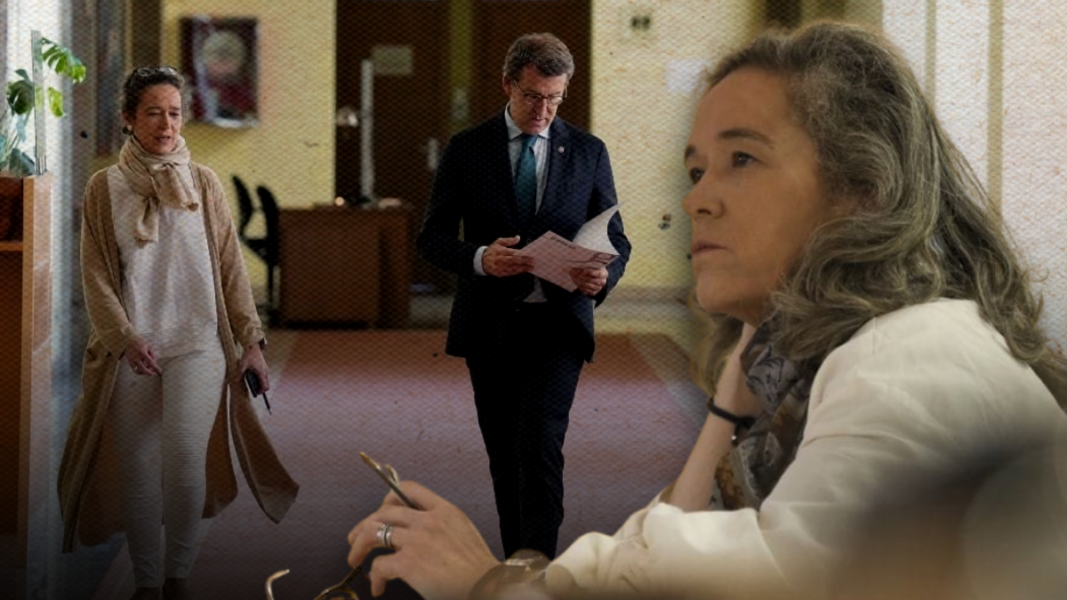
For years, María del Mar Sánchez Sierra has been one of the most influential—and least visible—figures in the Partido Popular. Member of Opus Dei with a commitment to celibacy, her power does not come from the media spotlight or parliamentary prominence, but from something much more effective: continuity, personal trust, and internal control. Sánchez Sierra has accompanied Alberto Núñez Feijóo for decades, first in Galicia and then in his landing in national politics. Today, she is one of the key people in the party’s real structure.
That power is not abstract. Sánchez Sierra is in charge of relations with the media, a decisive area for any contemporary political leadership. From that position, she manages access, sets limits, and decides who speaks and when. In the PP, she is known—and greatly feared—precisely for that: for her ability to close ranks around Feijóo and for the toughness with which she neutralizes anyone who tries to overshadow him. She is not a visible spokesperson; she is the one who controls the circuit. And in politics, whoever controls the circuit calls the shots.
Various sources agree in pointing out that Mar Sánchez Sierra is a celibate member of Opus Dei, a membership that, without being public or institutional, is relevant to understanding certain power dynamics. Opus Dei does not act as a political party, and its members enjoy freedom, which makes it possible for them to be present in various decision-making centers, both in administration and in large organizations. Not through directives, but through reliable, disciplined people trained for the long term.
In this context, the figure of Sánchez Sierra takes on a dimension that goes beyond the organic. It is not just about a veteran leader, but about a woman with enormous influence over the PP’s leadership, precisely because of her prolonged and stable relationship with Feijóo. Experience shows that, in politics, whoever remains when others pass calls the shots. And whoever remains, moreover, controlling communication and internal balances, calls the shots doubly.
The presence of Opus Dei members in very diverse ideological spaces is not new. Just remember the case of Rafa Larreina, a numerary of Opus Dei who went on to play a relevant role in Sortu, a formation located at the ideological antipodes of the Partido Popular. The common denominator is not the political program, but internal discipline, intellectual formation, and management capacity that the Work has known how to cultivate.
This fact is especially striking if one observes Feijóo’s political trajectory in Galicia. Under his presidency, the region was a pioneer in the approval of LGTB legislation, ahead of other autonomies and consolidating a normative framework widely celebrated by progressivism. This fact dismantles simplistic readings that automatically associate Opus Dei with a confessional or reactionary political agenda. Reality is more complex: personal freedom in politics, internal coherence in organization, and effectiveness in management. Opus Dei members habitually work in environments hostile to Christian identity, as professional freedom is a hallmark of the still prelature.
The asset declaration submitted by Sánchez Sierra upon taking office as a deputy reinforces that image of a consolidated and structural profile. The document reflects a very extensive real estate patrimony, with apartments, commercial premises, offices, industrial warehouses, urban and rustic estates distributed between Galicia, Madrid, and Castilla y León, as well as corporate participations and high-value financial assets. No debts or encumbrances are recorded, which points to a solidly established economic position for years.
There is nothing illegal about it. But there is a relevant fact: Mar Sánchez Sierra is not an emerging or circumstantial figure, but someone who has long belonged to the country’s administrative, economic, and political elites. And from that position, she exerts a discreet but decisive influence, reinforced by the internal fear awakened by her ability to protect the leader and settle political scores without exposing herself.
In a Partido Popular in the process of ideological redefinition, and with questioned leadership, the consolidation of profiles like that of Mar Sánchez feeds those who attribute to Opus Dei the search for an effective presence in decision-making centers, not through acronyms or declarations, but through specific people, loyal, trained, and with real power.
And there are people in Génova who are not happy about it.