


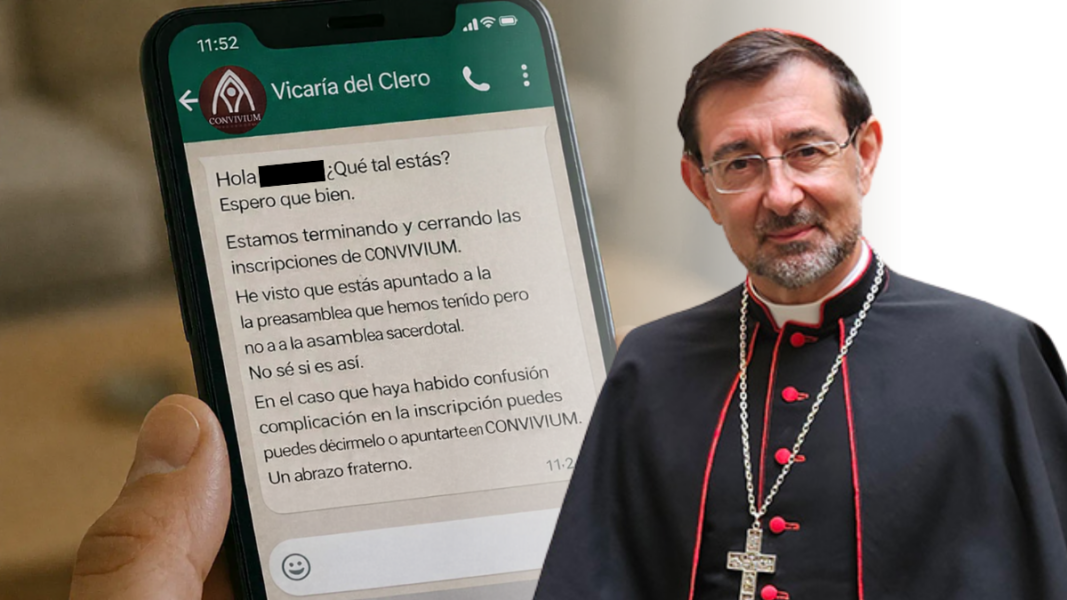
Messages have reached the Infovaticana newsroom that were sent to priests in the Diocese of Madrid who have not registered for the Convivium. These are not general calls or impersonal reminders, but individualized communications that demonstrate specific tracking of who is and who is not participating. Under an amiable and apparently pastoral language, these messages introduce an element of pressure that is hardly compatible with the freedom officially proclaimed around this event.
Read also: «Convivium»: Cobo will hold the first Presbyteral Assembly in Madrid
Several priests report having received WhatsApps in recent days signed by Juan Carlos Merino, in which they are addressed by name for not appearing registered for the Convivium priestly assembly, despite having attended the pre-assembly. The message, presented as a simple administrative check, is perceived by recipients as a personal and direct nudge inviting them to “correct” the absence and complete the registration.
Yes, there is pressure. Gentle, but pressure nonetheless.
It is not an explicit order, nor a threat, nor formal coercion. Precisely for that reason, it is more effective. It presents itself as personal concern, as pastoral care, as a simple administrative clarification. But the subtext is clear: we have seen that you have not registered, we know where you have been, we expect you to be here too. In a hierarchical context, that is not neutral.
The key lies in the asymmetry. It is not written by an equal: it is written by Juan Carlos Merino, from a position that represents structure and authority. In diocesan life, that type of message does not circulate in a vacuum: it arrives backed by a system that influences assignments, tasks, informal evaluations, and internal climate. When someone like that points out a specific absence and links it to an event promoted from above, the implicit message is that not going is an anomaly that must be justified.
Moreover, the rhetorical device is classic: it offers an “innocent” way out—confusion, technical problem—to prevent the recipient from being able to say openly “I don’t want to go.” It presupposes that non-registration cannot be a free and reasoned decision. That already says a lot about the concept of freedom being handled.
Is this “great freedom”? No. It is soft control, pastoralized, wrapped in fraternal language. It does not compel, but it points out. It does not command, but it monitors. And in clerical organizations, where the cost of being singled out is usually paid in the medium term, that type of message functions as a mechanism of alignment.
Another matter is whether it is legitimate or prudent. But if the question is whether there is pressure, the answer is yes. Low-intensity institutional pressure, designed precisely to be deniable if someone denounces it.
All this is aggravated if one considers the controversy already uncovered around the Convivium itself, after the revelation of the introduction of doctrinally problematic proposals, internally labeled as “peculiar” to avoid calling them by name. The presence of heretical or gravely ambiguous approaches has sown reasonable doubts about an event to the greater glory of a controversial and questioned cardinal, and this type of pressure does not dispel those doubts: it reinforces them.
Related links:
The Archdiocese of Madrid incorporates heretical proposals in the official documents of CONVIVIUM