


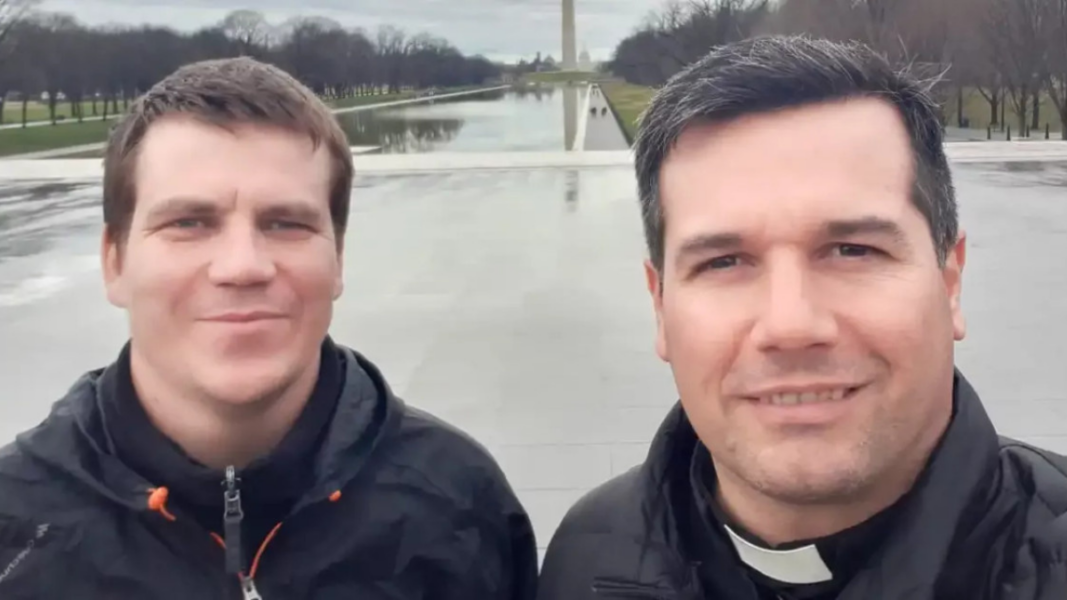
Ten years ago, in the heart of the Tibetan Plateau, a missionary adventure began that humanly seemed destined to last only a few months. The Order of Saint Elias was born in February 2016, driven by Father Federico Highton, along with Father Javier Olivera Ravasi, with the conviction to proclaim Christ where He is not known and with a radical trust in God’s Providence. A decade later, that work still stands, marked by material precariousness, missionary intensity, and an openly countercultural vision of religious life.
The foundation of the Order took place on February 3, 2016, with diocesan approval from the Bishop of Darjeeling, whose jurisdiction covers territories of extreme pastoral difficulty such as northern India, Bhutan, and areas of the Tibetan Plateau. From its beginnings, Saint Elias was conceived as a community oriented toward ad gentes missions, ready to go to the geographical, cultural, and spiritual margins, without relying on solid structures or human securities.
Provisionality, Risk, and Trust in Providence
The Order was born with a clear awareness of provisionality and risk. As its members recall today—sharing the memory through their blog and X—in those early moments, it was sincerely thought that the experience would last only a short time. However, these ten years have been marked by what they describe as a “constant happiness and joy,” even amid tribulations, shortages, and the inevitable contradictions of a mission pushed to the limit.
That original spirit was captured in a particularly eloquent way in a text written by Father Federico Highton in May 2016, from the Far East, under the title The Order We Long For. It is a programmatic writing that does not seek to describe a viable congregation according to human criteria, but rather an Order willing to live in permanent evangelical tension: poor, uncomfortable, without supports, without recognitions, and prepared even to disappear rather than betray the Truth.
Parresia, Poverty, and Rejection of Accommodation
In that text, the founder explicitly rejects a comfortable, diplomatic religious life integrated into the logics of civil or ecclesiastical power, and proposes an Order marked by parrhesia, radical poverty, readiness for martyrdom, and contempt for any form of internal careerism. The constant reference to Saint Elias—uncomfortable, solitary, and ardent prophet—is not casual, but key to understanding the identity of the Order and its vocation as a sign of contradiction.
Ten Years Later: An Ideal That Remains
Ten years later, that ideal remains the point of reference for the Order of Saint Elias. Not as a closed project or a consolidated work, but as a radical bet on a form of religious life that assumes risk, fragility, and exposure as constitutive parts of its fidelity to the Gospel.
Below, we share the text The Order We Long For, written by Father Federico Highton in the origins of the mission and republished by Father Olivera on X:
No. We do not want a congregation engaged in existing, but rather an Order (we use the expression in the broad sense) that seems engaged in not being allowed to exist any longer. We do not want a congregation desirous of recognitions, thirsty for members or to be mentioned, nor expert in taking measures to look good before Christ’s enemies, but an Order that rejoices in looking bad and having problems because of having preached the Truth.
We do not want a congregation desirous of receiving favors, but an Order that pays no tribute to any Pilate and in which the slightest flattering word is never heard, no matter who the ruler of the moment may be.
We do not want a congregation that accumulates savings or is skilled at fundraising, but to live on alms, forgetful of the vile metal, where silver is touched with disgust, happy to live abandoned to the Omnipotent Providence of God.
We do not want an institute of respectable monsignors but phalanxes of parrhesiastic Apostles to whom nothing matters—not “what people will say,” nor jail, nor hunger, nor death, nor any unjust sanction, from whatever seat it comes, as long as it is for preaching the Truth.
We want an Order that only expects favors from God, not from the magnates of the world and not even from the ecclesiastical world.
We want an Order prodigal in “most pauper means”—faith, prayer, and penance—and lacking in material riches so that it is evident that all apostolic conquests obtained were Feats of the Most High and not human maneuvers.
We long for a Crucified Order, a fully idealistic Order (in the sense of the youthful and highest Ideals it embraces), an Order that, except for a miracle (or several), seems unviable or humanly impossible to exist, an Order that during its period of existence—whether very long or ephemeral—shines for having dared to attempt quixotic apostolic feats, an Order that knows nothing of human prudences, mental restrictions, or arrangements with magnates—civil or ecclesiastical.
An Order that would prefer a thousand times to be closed rather than one of its members abstain from saying a phrase that his conscience asks him to say; an Order where not only martyrial missions are undertaken but the Order itself is martyrial by living disposed (and exposed) to be closed “giving life for friends”; an Order that chooses to live a year of lion rather than a thousand of chicken.
An Order all facing Eternity, an Order that is not a refuge nor a field hospital, but a combat squadron; an Order whose backs are guarded by the Angels of Paradise and not by “high-placed contacts,” an Order that is a precursor of the Precursor of the Parousia (who is Saint Elias), an Order alien to all propaganda, an Order that discomforts all who want a “Christianity” accommodated to our times, an Order in which every dream of missionary feats is welcome and blessed, an Order to which it matters nothing to look good with anyone but only with God.
An Order that has no other reason for being than to be a mere support for Catholic Epic, an Order whose rule makes it practically impossible for Pharisaism to take hold in it, an Order to which it matters nothing to have a ridiculous number of religious, an Order that annoys traitors and the lukewarm, an Order hated by Hell, feared by the ministers of iniquity, an Order that lives the Gospel literally, an Order of dear friends, an Order that knows how to mock the modern world, an Order that is truly a sign of contradiction, an Order that has disdain for proselytism in its own favor, an Order where no one feels coerced to enter or not to leave.
An Order that unsettles the faint-hearted, that seeks to totally short-circuit the New World Order, an Order that prefers the most resounding failure rather than negotiate a principle, an Order where it is impossible “to make a career,” an Order that strives to convert the most remote pagan peoples, an Order longing for a thousand martyrdoms, an Order that has nothing diplomatic about it, an Order that has no interest in seeing fruits but only in giving the most heroic testimony of faith in Christ Crucified, an Order that, even if granted only a few days of life on the face of the Church, leaves in the Mystical Body an indelible example of the most epic Catholic Quixotism.
An Order that if one day it were closed, is remembered as a Religious Order in which life was lived big, tremendously…
A dream Order, an Order that only wanted to dare extraordinary feats for God, a parrhesiastic Order, an Order free with the freedom of the children of God, an Order that measured or calculated nothing, an Order all of the Virgin, an Order in which God delighted…
That is the Order we want. May God grant it to us!
Long live God!
Father Federico
Missionary in the Far East
Tibetan Plateau, 13/5/16,
Feast of Our Lady of Fatima