


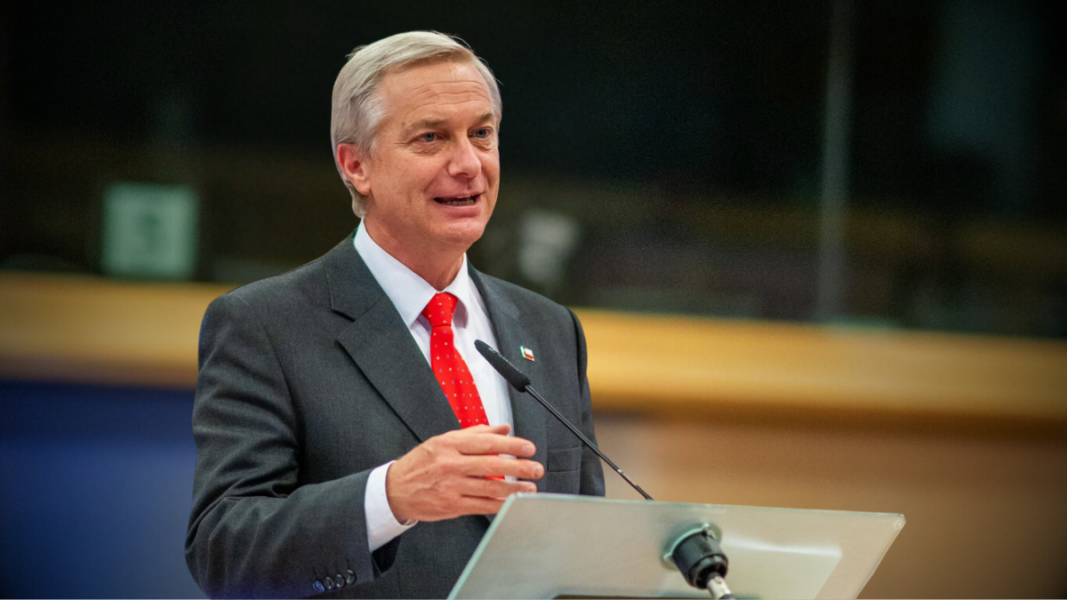
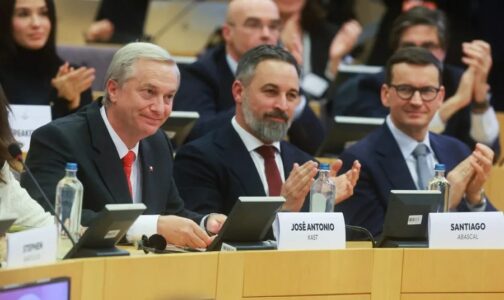
The president-elect of Chile, José Antonio Kast—a Catholic, pro-life, pro-family, and member of the Schoenstatt movement—spoke this Tuesday, February 3, in Brussels during the meeting of the Patriots group in the European Parliament with a speech in which he addressed centrally the challenges of migration and security, emphasizing the need to address both issues from respect for the dignity of the person and the responsibility of States in protecting the common good.
Read also: José Antonio Kast: Chile elects a Catholic, pro-life, and pro-family president
Forced migrations and the moral responsibility of States
In his intervention, Kast denounced forced migrations caused by ideological regimes that destroy the minimum conditions of freedom and force millions of people to abandon their homeland—a reality that the Church’s Social Doctrine identifies as a grave structural injustice. In this context, he warned against “pseudo-democracies” that, under a formal appearance of legitimacy, deny fundamental rights such as free voting and use poverty as an instrument of political control.
“That seven million or more Venezuelans have left their homeland is not by their own will, it is because a dictatorship was established there based on democracy but which later denied the most essential right of freedom, which is the vote of the people, and sought to perpetuate itself,” he affirmed.
The Chilean leader insisted that the response to the migration crisis cannot be reduced to merely administrative management or disorderly reception, but requires policies that combat the root causes of migration, promote integral development in the countries of origin, and at the same time guarantee security and social cohesion in the host countries.
Security as a condition for human dignity
On security matters, Kast linked the rise of organized crime and illegal immigration to the State’s renunciation of its protective function, emphasizing that the lack of order and law ends up affecting the poorest and most vulnerable. Security thus appears not as an end in itself, but as a necessary condition to safeguard life, freedom, and the dignity of people.
The speech also underscored the centrality of work and full employment as an authentic response to poverty and exclusion, implicitly recalling that Christian charity cannot be detached from social justice or from political structures that allow people to live with dignity in their own land.
Contrast with the episcopal response in Spain to illegal immigration
The approach presented by José Antonio Kast in Brussels contrasts with the recent statements by several Spanish bishops regarding illegal immigration and the regularization policies promoted by the Sánchez Government.
The president of the Spanish Episcopal Conference, Archbishop Luis Argüello, has publicly expressed his positive assessment of the extraordinary regularization of migrants promoted by the Executive, stating that this measure represents a recognition of the dignity of migrant persons and an opportunity to favor their social integration.
Read also: Argüello applauds the Government while the faithful people are scandalized
In the same vein, the Archbishop of Toledo, Francisco Cerro Chaves, has backed the government initiative by assuring that it is based “on the Gospel and on the Church’s Social Doctrine,” defending that regularization constitutes an act of justice toward those who already live and work in the country.
Other episcopal voices, such as that of the Archbishop of Tarragona, Joan Planellas, have likewise insisted on the need for a generous and welcoming response on the part of institutions, emphasizing Christian hospitality and the defense of human rights.
Unity, sovereignty, and cooperation between nations
From this perspective, the intervention of the president-elect of Chile was presented as a call to combine reception and solidarity with political responsibility, the defense of sovereignty, and the protection of the national community—principles that the Church’s Social Doctrine recognizes as complementary and not contradictory—.
Below, we leave the full speech delivered by José Antonio Kast in the European Parliament.
Full transcription of the speech:
Good afternoon, thank you very much for the opportunity to share with you, thank you Kinga, I remembered the first time I was here in the European Parliament and I arrived a bit late if I’m not mistaken and Kinga with that same smile, with that same skill told me, don’t worry, everything will be fine. Something that we later used in the campaign. Every time someone told us that something was a problem, I would say, don’t worry, everything will be fine.
So thank you for receiving us, thank you also to Santiago and his team, I see a large part of Santiago’s team here present, because they made a decision some time ago to found the Madrid Forum. And the Madrid Forum has been a great platform for many of us from our distant nations to have a space to literally speak to the entire world.
So we appreciate the concern for our nations and I want to tell you that this concern has been successful and just as you say, we have had differences in the Free Trade Agreement with Argentina, Javier Milei was also able to participate in Madrid Forum issues and other nations as well.
We have no concerns on agricultural issues, so we won’t have problems with you, we have concerns on mining issues, where we do have an advantage and no competition. But I want to tell you that this victory is a victory for all.
It is not a victory for one person, not a victory for a political party, like the Republican Party in Chile, but rather it is the victory of common sense, the victory of those people who have fought for years to recover freedom of expression, to recover the freedom to undertake, to recover the right of parents to be the first educators of their children, to recover freedom of worship, which curiously is threatened by those who say they defend freedom and who defend an ideology.
We defend common sense, we defend the freedom of people and it is something that we want, with our humble contribution from Chile, to help extend.
In South America, you know, we have been conquering spaces for freedom, both in Argentina and in Ecuador, in Bolivia an impressive change occurred and what we need is support, support from those who have already lived development so that in our nations stability starts with the quality of life of people.
There are many compatriots of ours and people who live in South America who do not have potable water, who do not have education, who do not have access to basic services, which would seem unimaginable for South America, but there is still a lot of poverty and as long as we do not think about poverty there will always be a possibility that radical left ideology will insert itself.
Because those people dream of something that is a lie, they tell them we from the State are going to give you everything and what they achieve with that is power over people.
To the extent that there is growth, that there is investment, there will be full employment and full employment dignifies people.
We have threats, yes, just like you have in Europe, like illegal immigration. They have taken care to create the conditions for forced migrations to occur.
That seven million or more Venezuelans have left their homeland is not by their own will, it is because a dictatorship was established there based on democracy but which later denied the most essential right of freedom, which is the vote of the people, and sought to perpetuate itself.
That is why we must always be attentive so that this pseudo-democracy is installed in our nations and takes hold of the person.
Because they trade with the person material goods to obtain their support in ballot boxes that are not free.
Therefore, to tell you that it is a victory for all and that is why we all have to take care of it. Even though we are very far away, we need your collaboration.
We need your countries to invest in our countries and you also need our collaboration.
Because just as common sense has been recovered in South America, it is also possible for common sense to be maintained in Europe.
We need to maintain certain freedoms.
Today we see that there are friendly countries that are going to have elections and it is very important that in the countries where elections are going to be held, people vote informed but based on common sense and have clear what a country can come to when democracy is lost.
Democracy can be lost in a ballot box with people who are not aware of where they can be led.
I have had the opportunity to visit Hungary where we have learned a lot about how to limit irregular immigration, how to enhance quality education, how to enhance family unity, to safeguard freedom of worship and freedom of expression.
That is why I also want to thank Viktor Orbán for receiving us, for having worked so that we can have that freedom.
I also thank Giorgia Meloni, I know that her party is part of another coalition but she also allowed us to learn how organized crime is combated through her penitentiary system of article 41 bis.
The same has been done by other countries in South America that have defeated gang terrorism like in El Salvador the president Bukele who received us as they have done in the Dominican Republic to face the crisis that is being experienced in Haiti.
Haiti is experiencing a permanent crisis and many international organizations say we are collaborating but they have only deepened poverty and misery in Haiti.
They have not managed to rescue that nation from the permanent violation of the rights of the citizenship.
We have many challenges.
In Chile we call the challenges emergencies because there was an emergency in the security issue.
There is an emergency in the security issue both because of illegal immigration and organized crime that we have to combat and we need collaboration.
We have an emergency due to lack of employment.
Everything that can be done in investment will translate into full employment which is the best public policy to address poverty, misery, and recover the dignity of people.
And we also have a social emergency.
An emergency in education issues.
An emergency in housing issues.
An emergency in health issues.
And we need collaboration.
And how do we achieve victory? Not only by talking about common sense but also about unity.
There are moments when one shows the differences but once one overcomes a stage, in this case the first electoral round, we always call for unity.
To the people who were on the same path as us, some further ahead, others further behind, we called them to unity because the challenge we have is very great.
The adversaries we have are enormous and have many more resources than one imagines everywhere.
Therefore, when one has to make the final decisions, one has to make them, at least what gave us success, in unity.
That is the call I also make to you with the differences that may exist, to always seek unity in the essential.
One can have differences in the accessory but in the essential one should never deviate and take care of the essential values that have been the principles, the bases of freedom.
So once again thank you very much for the reception, for the example you have given us in many public policies and we move forward because this is just beginning.
Thank you very much.