


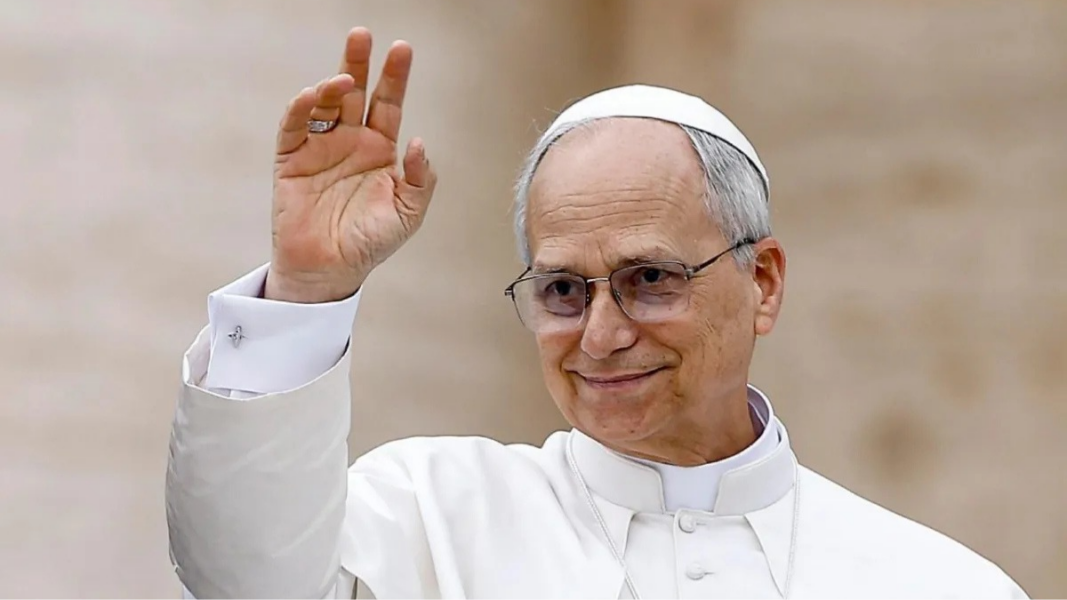
The message from Leo XIV on the occasion of the International Day of Human Fraternity raises a question that is not one of style or sensitivity, but of theological nature and the function of the papacy. It is not a matter of whether the text is kind, well-intentioned, or politically opportune, but of whether it is a discourse that only a Pope can deliver or, on the contrary, one that any generic moral authority in the international order could sign without difficulty.
The text is carefully constructed to offend no one. Too carefully. It speaks of fraternity, peace, bridges rather than walls, concrete commitment, solidarity in the face of indifference. All of that is true on a general human level. The problem is that the specifically Christian level is absent. It is not that it is deformed or poorly expressed: it is simply not there.
Christ does not appear. Not as a proper name, not as a salvific reference, not as the ultimate criterion. God is mentioned, but as an abstract foundation of a universal fraternity that is prior and autonomous. Not as the God who bursts into history, judges, saves, redeems, and divides. Fraternity does not arise from filial adoption in Christ or incorporation into the Mystical Body, but from a shared human condition that is presented as sufficient in itself. That is not heresy. It is something more subtle: Christological irrelevance.
From that point of view, the discourse is impeccably compatible with contemporary moral humanism, including that of Masonic origin. Not because it contains esoteric symbols or hidden slogans, but because it shares exactly the same conceptual ground: universal fraternity, ethics of minimums, God as a non-confessional moral principle, overcoming religious differences in favor of a common morality. Nothing in the text would require correction by a Mason; nothing would oblige the introduction of a specifically Christian reference to make it acceptable in a secular international forum.
This leads to the uncomfortable question: does a Pope have to speak this way? No, if we understand the papacy as a merely representative or diplomatic office. Yes, if we understand it, as the Church has always understood it, as a ministry of public confession of the faith. The Pope is not the president of a spiritual NGO or the moderator of a global ethical consensus. He is the principal witness that peace is not a product of human fraternity, but a consequence—always fragile—of the truth about man revealed in Christ.
When a Pope speaks as any other moral authority might speak, he is not expanding the reach of the Christian message; he is diluting it. He is not building bridges; he is renouncing to say what is on the other side. And that is not pastoral prudence. It is a choice: the choice to sacrifice Christian specificity so as not to discomfort the world.
The question, therefore, is not whether the discourse is “nice” or “well-intentioned.” The question is whether it is necessary. And the answer, honestly, is no. The world already has enough discourses on generic fraternity. Only the Church can—and must—speak of Christ as the ultimate criterion of true fraternity. If the Pope does not do so, no one else will.
We leave below the full speech:
Dear brothers and sisters,
With great joy and a heart full of hope, I address you for the first time on the occasion of the World Day of Human Fraternity and the seventh anniversary of the signing of the Document on Human Fraternity by Pope Francis and the Grand Imam Ahmad Al-Tayyeb. On this occasion, we celebrate the most precious and universal aspect of our humanity: our fraternity, that unbreakable bond that unites every human being, created in the image of God.
Today, the need for this fraternity is not a distant ideal, but an inescapable urgency. We cannot ignore the fact that too many of our brothers and sisters are currently suffering the horrors of violence and war. We must remember that “the first victim of every war is the innate vocation of the human family to fraternity” (Francis, Encyclical Letter Fratelli Tutti, October 3, 2020, 26). In a time when the dream of building peace together is often dismissed as an “outdated utopia” (ibid., 30), we must proclaim with conviction that human fraternity is a lived reality, stronger than all conflicts, differences, and tensions. It is a potentiality that must become reality through a daily and concrete commitment to respect, sharing, and compassion.
In this sense, as I recently emphasized to the members of the Zayed Prize Committee, “words are not enough” (December 11, 2025). Our deepest convictions require constant cultivation through tangible efforts. Indeed, “remaining in the realm of ideas and theories, without giving them expression through frequent and concrete acts of charity, will end up weakening and fading even our most cherished hopes and aspirations” (Apostolic Exhortation Dilexi Te, October 4, 2025, 119). As brothers and sisters, we are all called to go beyond the periphery and to converge in a greater sense of mutual belonging (cf. Fratelli Tutti, 95).
Through the Zayed Prize for Human Fraternity, we pay tribute today to those who have translated these values into “authentic testimonies of human kindness and charity” (Address to the members of the Zayed Prize Committee for Human Fraternity 2026, December 11, 2025). Our laureates—His Excellency Ilham Aliyev, President of the Republic of Azerbaijan; His Excellency Nikol Pashinyan, Prime Minister of the Republic of Armenia; Mrs. Zarqa Yaftali and the Palestinian organization Taawon—are sowers of hope in a world that too often raises walls instead of building bridges. By choosing the demanding path of solidarity over the easy path of indifference, they have demonstrated that even the most entrenched divisions can be healed through concrete actions. Their work bears witness to the conviction that the light of fraternity can prevail over the darkness of fratricide.
Finally, I express my gratitude to His Highness Sheikh Mohammed bin Zayed Al Nahyan, President of the United Arab Emirates, for his firm support of this initiative, as well as to the Zayed Committee for its vision and moral conviction. Let us continue working together so that the dynamic of fraternal love becomes the common path for all, and so that the “other” is no longer seen as a stranger or a threat, but recognized as a brother or sister.
May God, our Father of all, bless each one of you, and may He bless all humanity.
Leo XIV