


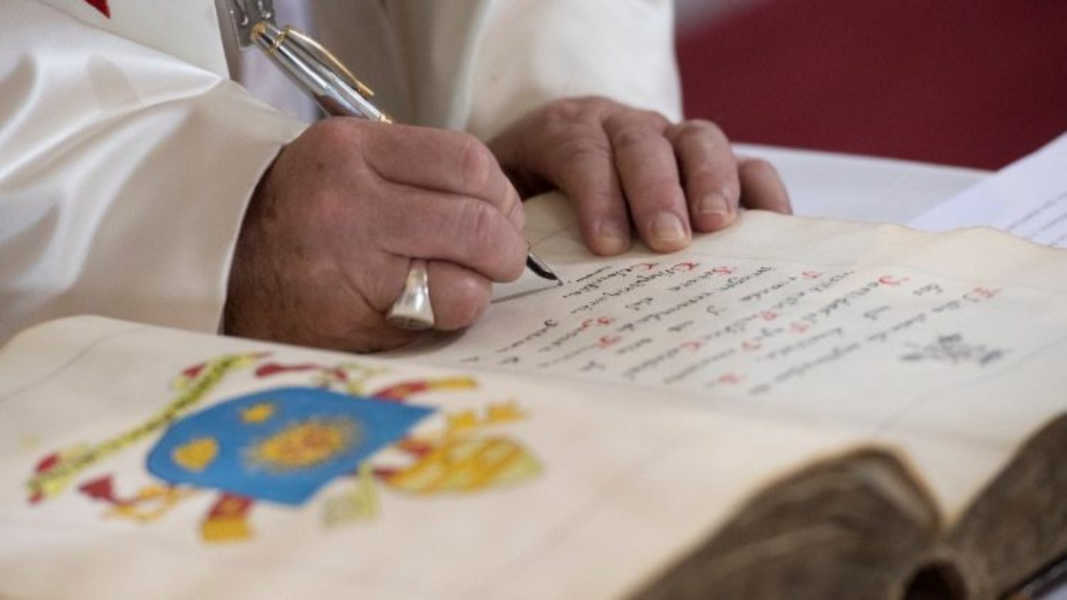
The motu proprio Traditionis Custodes, promulgated in 2021 to restrict the use of the Traditional Latin Mass, has not only reopened the liturgical debate in the Church but has also generated a deeper crisis related to episcopal authority and the trust of the faithful. This is analyzed by the Catholic media outlet Catholic Unscripted in a recent article dedicated to the practical consequences of the document.
What has occurred in several dioceses—especially in the United States—shows that the problem is not limited to the regulation of a specific liturgical form, but affects the way authority is exercised in the Church and the perception of pastoral justice among the faithful.
A document that goes beyond the Traditional Mass
Traditionis Custodes, signed by Pope Francis on July 16, 2021, established new norms for the celebration of the liturgy according to the pre-1970 missal, effectively repealing the broader framework granted by Benedict XVI’s Summorum Pontificum. The document entrusts diocesan bishops with the responsibility of authorizing these celebrations with the stated aim of safeguarding the unity of the Church.
However, the application of the motu proprio in some places has gone far beyond the legal text. In the Diocese of Charlotte (United States), for example, the restrictions were not limited to the Traditional Mass, but also affected liturgical practices such as the use of kneelers, kneeling for Communion, or the ad orientem orientation of the celebration, measures that do not appear explicitly in the pontifical document.
From liturgy to episcopal authority
This type of decision has highlighted a broader issue: to what extent a bishop can prohibit liturgical practices that the universal norms of the Church have not suppressed. The situation has led priests and faithful to raise formal doubts about the limits of episcopal authority and the coherence between liturgical law and its pastoral application.
This tension has eroded the trust of many faithful, who perceive a break with the principle of continuity defended during the pontificate of Benedict XVI, when the Traditional Mass was presented as a legitimate richness within the life of the Church and not as a problem to be eradicated.
Unity sought, division perceived
The stated intention of Traditionis Custodes was to promote liturgical and ecclesial unity. However, in practice, its uneven application has produced the opposite effect in no few places, generating divisions among communities, priests, and faithful who until now had coexisted peacefully.
The debate, moreover, is not limited to traditionalist sectors. For many observers, the case brings to the table a fundamental issue: if pastoral decisions are perceived as arbitrary or disproportionate, authority runs the risk of being weakened, even when acting within a legal framework.
An open controversy
Four years after its promulgation, Traditionis Custodes remains a subject of controversy. The true challenge is not only how to regulate the traditional liturgy, but how to exercise authority in the Church in a way that preserves unity without sacrificing the trust of the faithful or the continuity of the liturgical tradition.