


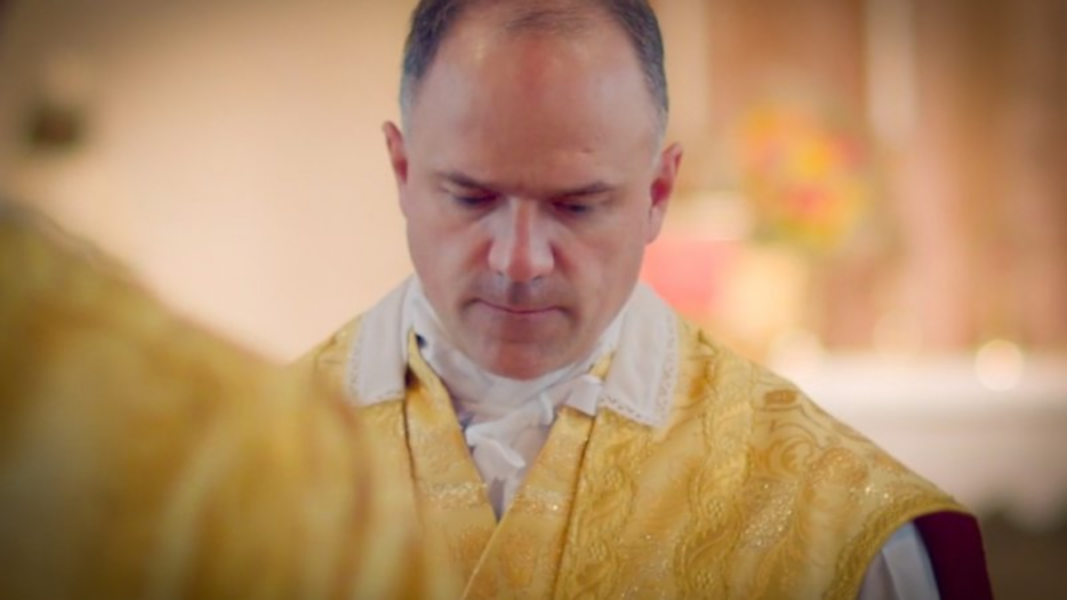
We reproduce the homily delivered by Father Davide Pagliarini, Superior General of the Society of Saint Pius X, on the occasion of the blessing of the cassocks of twenty-two new seminarians on the feast of the Presentation of the Lord. In it, he develops a theological and pastoral exposition of great doctrinal density that culminates in an announcement of ecclesial scope. Starting from the mystery of the Redemption, the singular role of the Virgin Mary as co-redemptrix, and the impossibility of remaining indifferent before Christ, the text leads to an explicit justification of the Society’s decision to proceed with new episcopal consecrations, not as a gesture of rupture, but as an act of responsibility assumed before God, the Church, and souls, invoking the supreme principle of canon law: the salvation of souls as the law of laws.
«Reverend fathers, seminarians, sisters, dear faithful:
It is a great joy for me to bless today the cassocks of twenty-two new seminarians, on this holy day when Our Lord Jesus Christ, for the first time, went to the Temple to present Himself before the altar, manifesting outwardly the offering of Himself and of His life. «Here I am to do Your will»; «this is the purpose of My Incarnation, and today I manifest Myself.» As much as possible, these perfect dispositions of Our Lord must be the dispositions of a young man who wants to give his life to Our Lord Jesus Christ, to one day ascend to the altar.
What a beautiful example! This is the model to follow throughout our entire life. All of this takes place in unity: the unity of Our Lady and of Our Lord Jesus Christ. Our Lady, the Immaculate One, the perpetual Virgin, accepted the rite of purification according to the law of Moses. Never has any creature been—or will ever be—as pure as the Most Holy Virgin Mary. And yet, out of humility, she accepted this rite. Two turtledoves were offered, one for the holocaust and the other for the remission of sins, and she is purified. It was the offering of the poor.
And Our Lord Himself was redeemed because, as the firstborn, He belonged to God, and He was redeemed by the payment of the small sum of five shekels or five coins. He, who was the true Redeemer, He who was in Himself the price of our redemption, accepted to be redeemed for a few simple coins. What humility! He was not strictly obliged to go to Jerusalem for this rite. Jews who lived far away could fulfill it by delegation. However, the Holy Family wanted to fulfill the law themselves, out of obedience.
What a magnificent example! Our Lord already presents Himself to us as obedient, obedient unto death. We know the perfection of His interior dispositions. He was already disposed to give everything for our redemption, to fulfill His duty of obedience to the Father and to carry out His will. In this context of an already perfect immolation, we have a prelude to His Passion and His Cross.
Our Lord cannot leave us indifferent.
It is in this scene that Simeon appears, a scene so common and so simple in appearance, but, in the eyes of God, so unique, because the Redemption had already begun. This elderly man spoke, and his words were divided into two contrasting parts. First, the joy of seeing Our Lord Jesus Christ and of taking Him in his arms. A joy proportionate to the desire he had nurtured up to that day. «At last I have seen the Savior, the salvation of Israel. Yes, I have seen Him.»
In Heaven, we will do nothing else but contemplate what Simeon contemplated in his arms during those brief moments: this salvation, this Savior, prepared by divine Providence from the beginning of time. The Incarnation of Christ was in God’s plan, so to speak, for all peoples—ante faciem omnium populorum, lumen ad revelationem gentium. He is the only Savior given and offered to all peoples and all races, without distinction. What immense joy! What joy in the eyes and words of this elderly man! At last the light has come that teaches the truth! The only path of salvation!
However, Simeon’s joy and light were abruptly interrupted by the announcement he made to Our Lady and to Saint Joseph. He turned to them, blessed them, and said something in a very different tone, though evidently related to the previous. What was he going to tell them? He announced to them that the redemption of the human race through this Child would take place through suffering, through the cross and the Passion. This Child will be a sign of contradiction. This is a very beautiful definition of Our Lord. He is a sign of contradiction.
What does this mean in more current language? It means that Our Lord will not hide the truth, but will affirm it. He is a sign of contradiction. He will manifest it with His words and confirm it with His miracles. He will proclaim and affirm clearly that He is the only path of salvation, that there is no other. Why does He say this? Because He cannot deceive souls. He did not come into the world to deceive them. He came to save them. He came to manifest the truth and, for that reason, He will be persecuted. And those who follow Him will also be a sign of contradiction. Therefore, one must choose. We cannot remain indifferent before Our Lord Jesus Christ. We cannot remain indifferent before the work of the Redemption. Those who remain indifferent have already made their choice. Those who remain indifferent have rejected Our Lord Jesus Christ.
Simeon said it very clearly. What did he say in his prophecy? He said that all these elements of Our Lord’s redemptive work would take place so that the thoughts of many hearts might be revealed. What does this mean? In what sense will the thoughts of men’s hearts be revealed? In the sense that no one can truly remain indifferent before Our Lord Jesus Christ. One must choose. He is a sign of contradiction. Our Lord Himself will say one day: «He who is not with Me is against Me; and he who does not gather with Me scatters.»
And this revelation of the mystery of the Redemption, which will be accomplished through the sufferings of Our Lord, will be accompanied by another suffering. This mystery of the Redemption was first revealed through the suffering of Our Lord. But God wanted Our Lady to be associated with this work, and that her role alongside Our Lord be revealed at the same time as His role was revealed before men. Simeon, addressing the Virgin, said to her: «A sword of sorrow will pierce your soul.» What a sublime mystery is contained in these words! And yet, it is a mystery that we can penetrate, and that is extremely dear to the Holy Mother Church. It is the mystery of co-redemption, the mystery of Our Lady’s association with the work of Our Lord Jesus Christ.
The place of Our Lady in the Redemption.
Now we understand why the angel asked for Our Lady’s consent, her fiat. She truly understood that becoming the Mother of God meant becoming the mother of a suffering God, a redeeming God, a suffering Messiah, as announced in the Old Testament. Understanding this, she said: «Yes, I accept. If it is God’s will, I accept.» God became man with a very precise purpose, and Our Lady understood it. She accepted it above all. But why? Why, in His divine wisdom, did God want to associate Our Lady so closely with the Passion of Our Lord Jesus Christ?
Because Our Lord came to save souls. But He will ask each soul for its collaboration, its adherence to the faith, and its participation in suffering. However, to Our Lady, despite having been preserved from original sin from before her conception, to her, who was in some way the most perfect and unique redeemed one, never touched by sin, God also asked for her cooperation in the work of the Redemption, in a manner proportionate to her holiness. What a mystery! This is a profoundly Catholic vision of the Most Holy Virgin Mary. Yes, God wants the cooperation of His creatures, and He has made Our Lady the prototype of this cooperation.
None of this exists in Protestantism, which destroys all forms of cooperation. For them, only God saves the predestined. This is Luther’s theology. And consequently, what do Protestants seek, if this cooperation is not necessary? Logically, they reject religious life, mortification, and the Holy Sacrifice of the Mass, because the Holy Mass, according to them, is a human effort or a cooperation in a work that would be purely divine. They reject the veneration of the saints, because we would not need intercessors or mediators. And above all, they reject the veneration of Our Lady. This is terrible, because it destroys the work of the Redemption as God wanted it. But for them, it is logical.
It must also be said that, on another level and in another way, modernism has done the same. Without denying these truths, it has deformed them. Behind the shield of a poorly understood false Christocentrism, that is, the unfounded fear of taking centrality away from Our Lord, modernism also reduces all human cooperation. Human efforts, mortifications, and even religious life are no longer understood. The Holy Sacrifice of the Mass is understood in a completely different way, as is the role of Our Lady. She is relegated to the background, denying her role in the Redemption, which is so central. This is also terrible.
When one has a beautiful painting, what does one do to make it stand out? One seeks a frame worthy of that painting. This is exactly what God Himself did with the Most Holy Virgin Mary. This magnificent painting of the Redemption is framed by Our Lady herself, by her co-redemption. What divine wisdom! And yet, today we are told that, to better appreciate this painting and not lose its beauty, the frame should be removed.
Our Lady accompanies Our Lord in suffering.
[Three times the Most Holy Virgin Mary accompanied Our Lord to Jerusalem. The first was for the Presentation in the Temple and the Purification of Our Lady, which we celebrate today. There were also two other occasions, and the three episodes are linked to each other. They are situated on the same axis and have a common denominator.
Today, Jesus, presented in the Temple, offered the Father His human life. At twelve years old, again accompanied by the Most Holy Virgin Mary, Jesus manifested His divine wisdom and offered it to the Father. The third time was on Calvary, once again accompanied by Our Lady, when Jesus offered the Father His own life and His own blood.
What do these three so different episodes have in common? Why is the Most Holy Virgin always present? She accompanied Our Lord three times in pain and suffering. The first time, today, February 2, Simeon announced: «A sword will pierce your heart.» At twelve years old, she accompanied Him again to the Temple and suffered the terrible pain of losing the Child Jesus. It was the most unimaginable trial for Mary. The third time was when she accompanied Him again in pain, in the suffering of Calvary.
Why each time she accompanied Him did she have to do so in pain? Because she is co-redemptrix. Because she systematically participated in the Passion of Our Lord Jesus Christ. She prepared the Passion alongside Him. The Passion of Our Lord is also hers. This is evident.
What then is the consequence of this truth, which is in the Gospel and has not been invented? That just as Mary was present throughout the life of Our Lord and followed Him in His Passion and in everything that prepared it and was linked to it, so today Mary continues, logically, to be the associate of Our Lord and continues to dispense the graces that are the fruit of His Passion, to which she was associated from Simeon’s prophecy, making it also her own passion.
What a profound mystery this sword contains!
On the day of Judgment, Our Lord will ask: «What have you done with My Mother?»
I would like to go even further. How could Our Lady offer her Son, and such a Son? We can understand that she offered herself to God, her existence and her virginity, but to offer such a Son? How could she do it? This Son, virginally conceived and virginally born, of whom she was the only human progenitor: the human nature of Our Lord came entirely from Our Lady. It is her immaculate flesh and her immaculate blood that formed the humanity of Our Lord Jesus Christ, and it is logical that she adore this perfect Son. How could she offer Him? How could she say «yes»? Not only «I say yes and I stay in Nazareth,» but «I say yes from the bottom of my heart and I go with Him.» How could she do it? How to explain it?
The answer is very simple. She did it out of love for us. This is not a fairy tale. It is the Gospel. Shall we then renounce this doctrine? Shall we forget this sword that pierced the heart of Our Lady? Shall we forget its meaning? Shall we forget what Our Lady did at the foot of the cross? Shall we forget her role as co-redemptrix? That is impossible. It is part of our faith! It is the heart of our faith! It is something we appreciate in a special way. We know that on the day of Judgment Our Lord Jesus Christ will show us His wounds and ask us: «What have you done with My wounds? What have you done with My Passion? Have you taken refuge in My side or have you preferred the world? What have you done with My blood shed on the cross? What have you done with the Most Holy Eucharist? What have you done with My grace?»
And then He will ask us one last question: «What have you done with My Mother? I had nothing left. I was stripped of everything and abandoned by all. I had not a drop of blood left in My body. The only thing I had left was My Mother, and not just any mother, but a Mother whom I Myself had prepared, an immaculate Mother, full of grace, the Mother of God. I had prepared her for Myself, for My Incarnation, for My coming into the world. She accompanied Me from the Presentation in the Temple to the cross. She never abandoned Me. The only thing I had left was My Mother, and I gave her to you so that she might continue to mold My image in your soul. I gave you My Mother. What have you done with her? In Me, she gave birth to you in the manger without pain, surrounded by heavenly songs. She also gave birth to you at the foot of the cross. What have you done with her? Have you celebrated her greatness? Have you honored her and truly treated her as Mother?»
There is no way to evade this question. This is what Our Lord will ask us. Can we then renounce this doctrine so beautiful and so profound, which shows us so abundantly the charity of Our Lord? Are we afraid that, by treating Our Lady as she deserves, as co-redemptrix, we will move away from the mystery of the Redemption, in which she herself is totally immersed? A true Catholic cannot be afraid of that. It is impossible. And moreover, are we allowed to deceive souls in this way? That is unacceptable. Are we allowed to turn souls away from Our Lady, when her role is not only to lead them to Our Lord Jesus Christ, but also to mold His image in them? That is impossible.
Episcopal consecrations out of fidelity to the Church and to souls.
We believe that the time has come to think about the future of the Society of Saint Pius X, about the future of all the souls we cannot forget or abandon, and above all about the good we can do to the Holy Mother Church. This raises a question that we have been asking ourselves for a long time and to which we may now have to respond. Should we continue waiting before considering the consecration of bishops? We have waited, prayed, and observed the evolution of the Church, and also sought advice. We have written to the Holy Father to present to him, with all simplicity, the situation of the Society, explaining these needs and at the same time reaffirming our sole reason for being: the good of souls.
We wrote to the Holy Father telling him that our only intention is to make all the souls who come to us true children of the Roman Catholic Church. We will never have any other intention. The good of souls corresponds to the good of the Church. The Catholic Church does not exist in the clouds: it exists in souls. It is souls that constitute the Church. If we love the Church, we love souls. We want their salvation and we want to do everything possible to offer them the means to achieve it. That is why we have supplicated the Holy Father to understand the so singular situation in which the Society finds itself and to allow it to take the necessary means to continue this work in such an exceptional situation.
Unfortunately, these reasons do not seem to interest Rome nor to be convincing at the moment. We deeply regret this. What are we going to do then? Are we going to abandon souls? Are we going to tell them that in reality there is no longer a state of necessity in the Church that justifies our apostolate and our existence? That everything is more or less fine? That would be a betrayal of souls and, therefore, of the Church. We cannot do it.
That is why we think that July 1, 2026, could be a suitable date, the feast of the Most Precious Blood of Our Lord Jesus Christ, the feast of the Redemption. It is the only thing that interests us. What we value most is the Precious Blood of Our Lord, which flows on the wood of the cross. Our Lady, at the foot of the cross, was the first to adore this Precious Blood, which we continue to adore at the foot of the altar. It is the only thing we want to give to souls… Souls have a right to it; it is not a privilege, it is their right. We cannot abandon them.
In the coming days, we intend to give you more information and greater detail. It is important to understand the reasons. It is important to understand what is at stake. This is crucial. But at the same time, we must understand all this in prayer. It is not enough to prepare only the mind. I would dare to say that it is not even enough to adopt a purely apologetic approach. We must prepare hearts, our hearts, because it is a grace, and we must cling to that grace. We must give thanks to God and prepare ourselves. Yes, consecrations: once again, there will be episcopal consecrations. But they will not be to challenge the Church; far from it. They will be consecrations out of fidelity to the Catholic Church and to souls.
Furthermore, I would like to add one last consideration. I fully assume the responsibility for this decision. I assume it, first of all, before God. I assume it before the Most Holy Virgin Mary and before Pope Saint Pius X. I assume it before the Holy Father. Sincerely, I would like to meet with the Pope before July 1. I would like to explain everything to him, so that he can understand our real and profound intentions, and our attachment to the Catholic Church, so that he knows and understands it. I also accept this responsibility before the holy Catholic Church and before the Society, before all the members of the Society and— I repeat it once more—before all the souls who in one way or another turn to us, and who ask us for help now or in the future. All those souls and all those vocations that divine Providence has sent us and continues to send us. Before them I assume this responsibility, each one in particular, because each soul has infinite value.
And in the Catholic Church we must never forget that the law of laws, the supreme law that prevails over all others, is the salvation of souls. It is not verbiage, it is not the synod, it is not ecumenism, it is not liturgical experiments, nor new ideas, nor a new evangelization: it is the salvation of souls. This is the law of laws, and we all have the duty, each in his place, to observe this law and to consecrate ourselves totally to defending it. Why? Because Our Lady and Our Lord Jesus Christ taught us during their life on this earth that they had no other intention or goal than the salvation of souls. Therefore, in one way or another, and according to our talents and circumstances, each of us must do everything he can, contributing his share to save his own soul and that of others.
Amen.»