



By the Reverend Jerry J. Pokorsky
Reverence and contempt for the rule of law exert a reciprocal and formative influence on both ecclesiastical and secular leadership. When religious leaders manifest an implicit contempt for the legal order, they weaken respect for the rule of law among civil authorities; when secular leaders disregard the rule of law—particularly by distorting the meaning of words—they erode moral seriousness within the Church. Authentic cultural renewal, therefore, depends on restoring reverence for truth in language and for the rule of law, both in personal conscience and in public governance.
The teachings of the Catholic Church are grounded in the Deposit of Faith handed down by the Apostles. This Deposit is preserved and transmitted through Sacred Tradition, Sacred Scripture, and the Magisterium. Priests, bishops, and Popes, by the grace of Holy Orders, serve as authorized guardians of this faith. They are custodians, not authors. The laity, in turn, receive the faith through the Church.
The clergy teaches the principles of faith and morals. The laity then applies those principles to the concrete circumstances of their lives through a prudential judgment proper to them. The faithful act as moral agents as free members of the Mystical Body of Christ. Christian moral life begins with the question: «What does God teach, through the Church?» It continues with a second, equally demanding question: «With God’s grace and through my encounter with the sacraments, how must I live accordingly?»
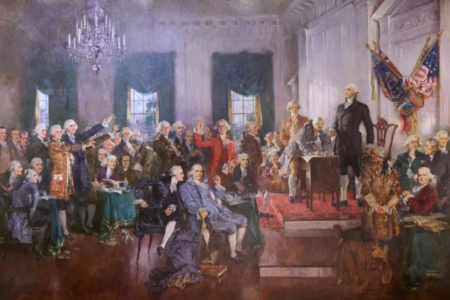
There is a parallel structure in the framework of the United States government. The Declaration of Independence, followed by the Constitution and its amendments, forms the philosophical and legal foundation of American law. Congress has the responsibility to enact laws consistent with the Constitution. The president executes those laws within constitutional limits. The Supreme Court resolves conflicts regarding the constitutionality of laws and government actions. Like the Church’s Deposit of Faith, the Constitution is something that is received and interpreted, not something that each generation reinvents anew.
Ideally, a legislator approaches proposed laws with disciplined moral and constitutional reasoning. First, a prudent legislator must ask whether a proposed law or spending plan is constitutional. If not, it must be rejected, regardless of its popularity. If it is, the next question is whether it promotes the policies preferred by the voters. If it does, the legislator should vote in favor; if not, they should oppose it.
However, a legislator may vote in favor of a constitutional law that does not immediately serve the interests of their voters. This may support a broader political vision that ultimately benefits both the nation and those voters. Legislators may rightly invoke conscience and the demands of natural law (God’s law written in our hearts), as well as legitimate political demands, as a guide.
In practice, the American political system has drifted away from its constitutional moorings. Legislators rarely oppose measures on the grounds that they exceed constitutional limits. This erosion is most visible in the powers of war: although the Constitution assigns to Congress the authority to declare war, the United States has not resorted to that authority since World War II, engaging in major conflicts—from Korea and Vietnam to the Middle East—without formal constitutional debate.
Similarly, politicians often do not oppose large public spending programs on constitutional grounds. These patterns suggest a significant breakdown of the rule of law, replaced by the politics of power. The politics of power is increasingly rooted in financial influence rather than constitutional principle. Empirical studies consistently show that candidates who spend significantly more than their opponents win congressional elections at a remarkably higher rate.
Meanwhile, a significant portion of the electorate increasingly expects its leaders to dispense government benefits unlinked to corresponding civic responsibility. The immense federal debt stands as concrete testimony to both political illegality and a popular entitlement mentality.
A similar distortion can be observed within the Church. Under political pressures, some ordained Church leaders risk forgetting that they are witnesses to the truth and begin to act as owners of the truth, especially on moral issues.
Often, the clergy sees itself as a formulator of religious policies rather than a proclaimer of permanent truths. Statements from episcopal conferences, including those on immigration, resemble public policy analyses more than proclamations of universal Christian moral principles. In doing so, they invade the proper domain of the laity, whose vocation includes issuing prudential political judgments.
Catholic clergy can aid cultural and ecclesial recovery by explicitly invoking the traditional precepts of Catholic morality, grouped around the Ten Commandments. Intellectual discipline requires recognizing a fundamental distinction: the Church teaches the principles of faith and morals. The laity, on the other hand, have the primary responsibility to prudently apply those truths in the personal and political spheres.
The clergy should also recognize the limits of the powers of episcopal conferences, which lack canonical magisterial authority. Undisciplined political statements undermine binding authoritative pronouncements. Above all, the clergy should content itself with serving as witnesses—not as owners—of the Church’s faith and morals. A renewed reverence for moral law within the Church would serve as leaven in the culture.
Such a renewed Christian witness could gradually reconfigure American political life. The authority of just laws ultimately flows from God, and all citizens are morally bound to respect them. Imbued with reverence for just laws, Catholic citizens would begin to demand that their representatives remain faithful to the Constitution despite political pressures.
In summary:
- Both in the Church and in the United States, the necessary mechanisms exist for a just rule of law with a common vocabulary.
- The Deposit of Faith and the United States Constitution are correlative, with God’s government as supreme.
- Failure to honor the rule of law is corrosive to the soul of both institutions.
- Unjust laws are not laws.
- An institution is corrupt when the rule of law yields to the politics of power («politics») and the cult of personality (law emanates from the person).
- Restoring the rule of law requires a firm purpose to return to the rule of just laws.
- The restoration of reverence for civil laws, if it occurs, will take generations.
- The restoration of reverence for the Church’s moral law, if it occurs, will come with good and repeated confessions.
Properly respected law—both moral and civil—constitutes the indispensable foundation of a virtuous and genuinely free society.
About the author
Father Jerry J. Pokorsky is a priest of the Diocese of Arlington. He is the pastor of St. Catherine of Siena Parish in Great Falls, Virginia.