


By James Patrick Reid
More majestic than the thunders of mighty waters,
more glorious than the waves of the sea,
the Lord on high is glorious.
Your decrees are very trustworthy (Psalm 92/93,4)
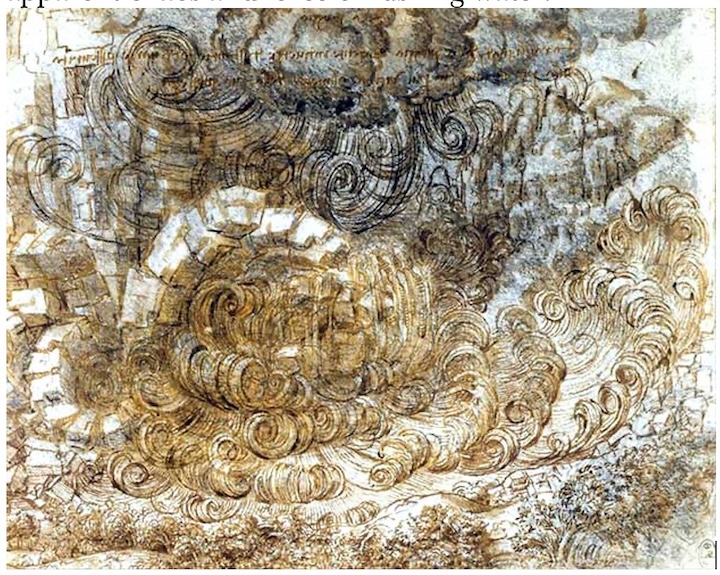
Destructive floods can tempt one to question the Lord’s governance over Creation or the reliability of his decrees. But water holds a lesson for us, a lesson that did not escape Leonardo da Vinci, whose drawings and notes explore the potential of moving water for good or for evil. Leonardo discovered order within the apparent chaos and the force of impetuous water.
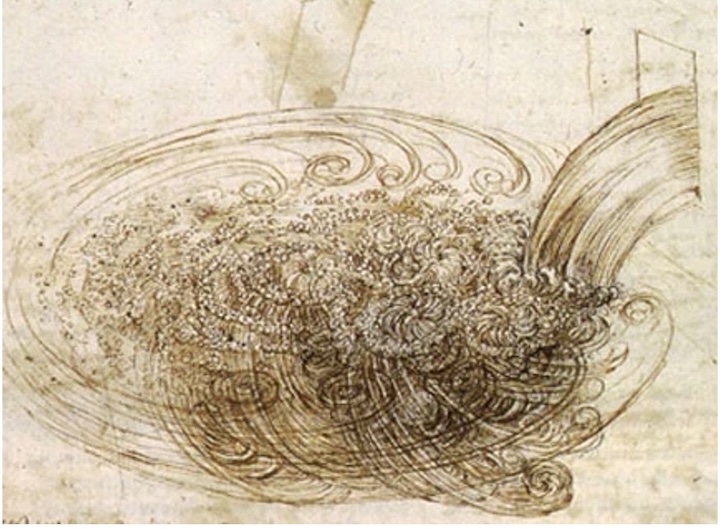
The association of water with chaos dates back to the dawn of Creation: «The earth was formless and empty, and darkness covered the face of the deep» (Genesis 1:2). In biblical imagery, the deep waters are the stronghold of demons. Water represents all matter insofar as it is formless and chaotic, prone to rebellion, waiting to be formed and made luminous. At the beginning, the Spirit of God moved over the waters to bring order out of chaos, but then man’s sin stirred up the dark depths of rebellion once more.
In the end, the Lord will banish this abyss of darkness from the earth; the sea will exist no more (Revelation 21:1). Meanwhile, in his Passion and Resurrection, the paschal mystery in which we are baptized, the Lord divides the sea with his power; he breaks the heads of the dragons in the waters (Psalm 74:13).
Christ sanctifies the waters with his descent into the Jordan, an anticipation of his death by which he conquers the devil. The enlightened water becomes an instrument of salvation; and, as the Eastern Church sings on the feast of the Lord’s Baptism, «today the mystical waters irrigate all creation».
In Christ’s victory, the dark and formless abysses are filled with light, and the transformation of all creation is revealed: «Behold, I make all things new». Man’s redemption begins with the purification and redemption of matter, in the blessing of the water in which he is baptized, when the Lord «works salvation in the midst of the earth» (Psalm 74:12).
The work of artists imitates the Lord’s formative and transformative work. An artist plunges his hands into raw matter to transform it, drawing from it a higher and more luminous form. Form, in nature and in art, always results from movement and expresses movement.
Hence, the key to good drawing is gesture, the movement of a form, and the choreography of fully coordinated movements in any composite form or set of forms. Let us observe, for example, this landscape drawn by Thomas Gainsborough (in the Metropolitan Museum of Art).
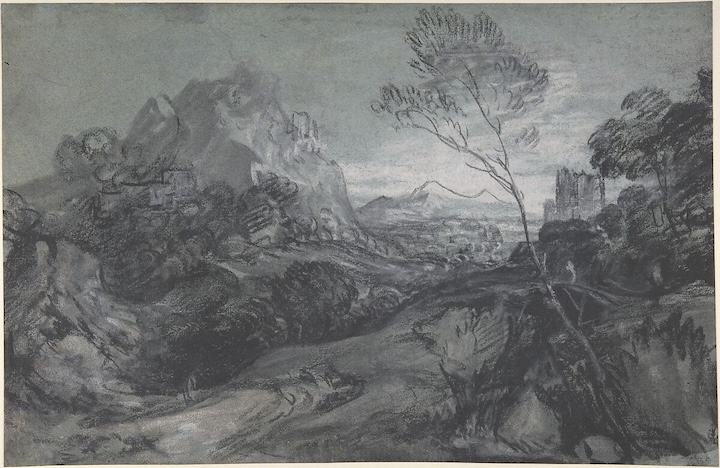
The artist feels the movements of hills and valleys as undulating waves, descending from the right, receding and rising to the left. The impulse to the right of the mountain is repeated and amplified in the luminous form of the sky and balanced by the tree leaning to the left.
Or consider this watercolor by John Sell Cotman (in the British Museum).
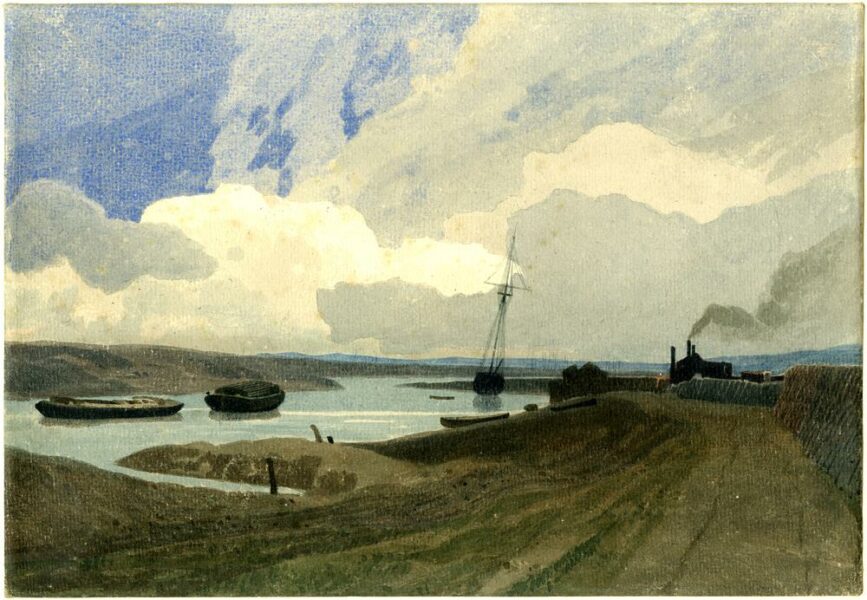
The foreground advances and recedes toward the factory, whose rising smoke rhymes with the shapes of the clouds drifting across the sky to the left, until they meet nearly vertical clouds situated within a triangular area of blue sky that leads us toward the pair of clouds, one gray and the other bright and warm, that enter from the left to balance and interlace with the large gray cloud pushing from the right.
The luminous cloud is reinforced by the bright and reflective river below, which extends downward and forward toward us, to the left, in balanced tension with the backward movement of the land to the right. The tall mast of the ship, dragged by the powerful sweep of that land to the right, leans in its direction, threatening to unbalance the entire scene.
The luminous cloud, however, clings to it to prevent it from leaning further. (Note that all layers of space interact within the pictorial plane, just as the near and the far, the past and the present, interact in consciousness.) The balanced tensions manifest a thorough organization of powerful forces.
In each of these works of art (as in thousands of other masterpieces), the artist sees nature in a state of commotion, but providentially organized in the totality of its varied movements. The matter of this world, like a tumultuous sea, yields to the ordering power of the logos. It is thus elevated to a higher level of energy.
This reformation of sensory data into a work of art magnifies the creative, saving, and governing work of the providence of the divine Logos, and refers to the redemptive Incarnation and the Passion by which we are saved from the dark disorder of sin.
All things cooperate for the good, for beauty, in this transfiguring vision.
Art worthy of the name does not copy appearances; like all science, it penetrates appearances and apparent randomness to find and reveal invisible laws and relationships. There is the book of nature, there is the book of art, and there is the book of Scripture. None of them can be understood without long effort and attention.
The world is not perfect like an image; evil and disorder abound, and will increase in the last days, when peoples will suffer «distress and perplexity because of the roaring of the sea and the waves… And then they will see the Son of Man coming» (Luke 21:25-26). Beautiful art points to the new heaven and the new earth that the Lord will establish then (Revelation 21:1).
The artist must train his mind to see providentially; and the attentive viewer of art gradually acquires the same vision, akin to the biblical authors’ vision of all things cooperating for the glory of God and our salvation, even when the floodwaters rise, «though the sea roars and foams, and the mountains tremble at its tumult» (Psalm 45/46:3).
About the author
James Patrick Reid teaches painting and drawing at Benedictine College in Atchison, Kansas, and serves as artist-in-residence at the university’s Center for Beauty and Culture. He also teaches an online graduate course on the history and theory of Catholic art for Franciscan University of Steubenville. A portfolio of his work is available on his website.