


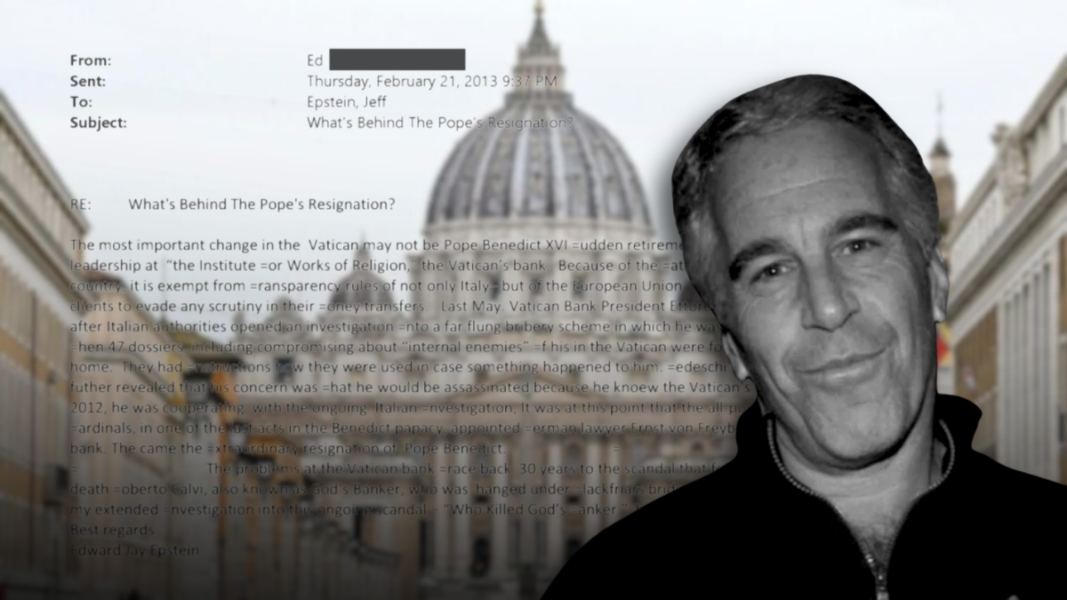
The recent publication of emails linked to financier Jeffrey Epstein has reignited an old media focus of suspicion on the Institute for the Works of Religion (IOR), known as the Vatican Bank. In particular, some messages have been used to suggest that the Vatican—and specifically its financial system—would have been at the center of opaque maneuvers surrounding the resignation of Benedict XVI.
Read also: Epstein’s emails and the Vatican Bank
However, a detailed analysis of these documents, conducted by The Pillar, requires carefully separating verifiable facts from interested interpretations.
The disputed claim: emails that “splash” the Vatican
The core of the controversy revolves around an email dated February 21, 2013, sent by Epstein to economist Larry Summers, just days before the end of Benedict XVI’s pontificate. In that message, Epstein claims that the change in the presidency of the Vatican Bank was “the most important event” in the Vatican at that time, even above the papal resignation.
The claim, reproduced with little context on social media and some outlets, has been presented as proof that the IOR played a decisive role in Benedict XVI’s departure or as an indication of serious covered-up financial irregularities. However, such a reading far exceeds the actual content of the email and the evidentiary weight of the document.
What the emails really say and their context
As The Pillar explains, Epstein’s message does not constitute an internal revelation or a documented denunciation, but rather the transmission of a personal opinion, likely taken from a third party. Everything indicates that the text comes from journalist Edward Jay Epstein and that Jeffrey Epstein simply forwarded or reformulated it.
The content of the email relies on a known premise: the Vatican Bank, due to its sovereign nature, is not subject to European Union financial regulation, which historically made it an object of external suspicions. But at no point does the message provide concrete data, documentary evidence, or verifiable accusations. It is a speculative assessment, not a statement of facts.
Moreover, the emails contain no direct assertion implicating the IOR in specific financial crimes, much less a demonstrable link between the bank and Benedict XVI’s resignation. What appears is an interested reading of the Vatican situation from the outside, typical of someone who views the Church through categories of political and economic power, foreign to its spiritual nature.
The Vatican Bank in historical perspective
It is no secret that the IOR dragged a problematic reputation for decades, fueled by episodes like the Banco Ambrosiano case or real deficiencies in transparency matters. Precisely for this reason, during Benedict XVI’s pontificate, reforms were promoted aimed at greater supervision and institutional cleansing, a process that would continue afterward under his successors.
In this context, the change in the IOR presidency in 2013 was part of a reform dynamic already underway, not a covert operation or a traumatic rupture. Epstein’s emails add no new element to this story, nor do they reveal facts unknown to justice or international bodies that have since evaluated the Vatican on financial matters.
Nor do those messages provide any support for the repeatedly insinuated thesis that Benedict XVI was forced to resign due to economic pressures. The Pope Emeritus himself clearly explained the reasons for his decision, and the now-published emails do not contradict that explanation with facts, but only with conjectures.
Between media suspicion and documented reality
The massive publication of the so-called Epstein files has generated a climate conducive to interested reinterpretations and eye-catching headlines. In that context, the Vatican Bank is once again used as a symbol of opacity and hidden power. However, as The Pillar emphasizes, the emails attributed to Epstein do not constitute any proof of current or past irregularities in the IOR, nor do they support the theories linking its management to Benedict XVI’s resignation.
Once again, the reputation of Vatican institutions is affected not so much by new facts, but by the uncritical amplification of private opinions. The pending task remains the same: to inform with rigor, distinguish between documents and speculations, and not confuse media noise with the truth.