


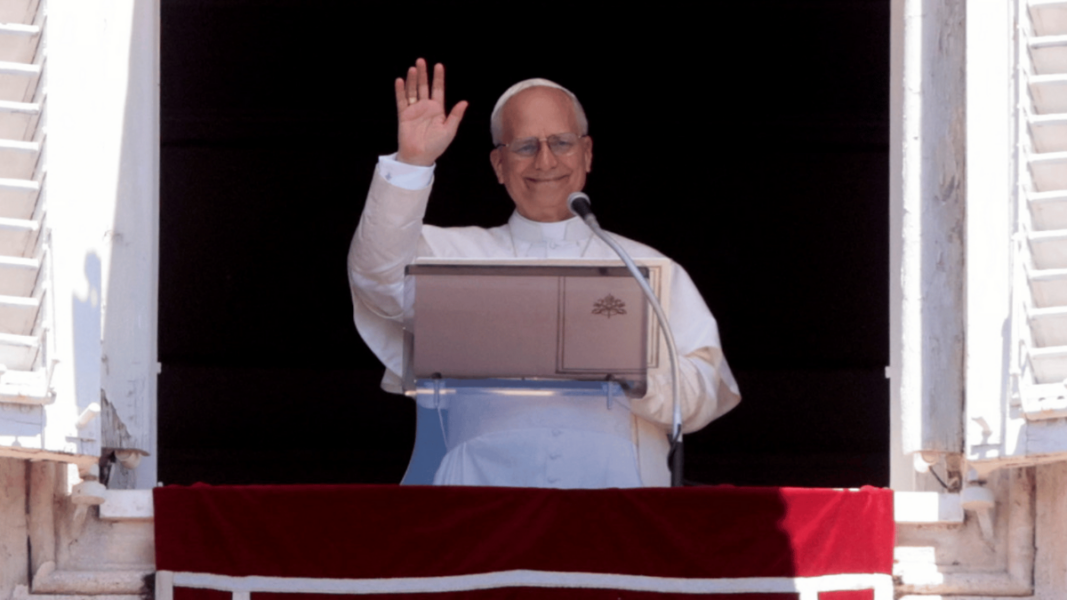
Pope Leo XIV presided over the recitation of the Angelus this Sunday, February 1, from the window of the Vatican Apostolic Palace, where, before the faithful and pilgrims gathered in St. Peter’s Square, he centered his reflection on the Gospel of the Beatitudes, emphasizing that they are not a naive ideal nor a simple spiritual consolation, but the revelation of the way God acts in history, giving hope to the poor, the afflicted, and the persecuted, and dismantling the illusion of those who identify happiness with power, wealth, or success, remembering that only in Christ—poor, meek, and given up to the cross—the apparent defeat of the world is transformed into the authentic joy of the redeemed.
We leave below the words of Leo XIV in the Angelus:
Dear brothers and sisters, happy Sunday!
In today’s liturgy, a splendid page of the Good News that Jesus announces to all humanity is proclaimed: the Gospel of the Beatitudes (Mt 5,1-12). These, in fact, are lights that the Lord kindles in the penumbra of history, revealing the plan of salvation that the Father carries out through the Son, with the power of the Holy Spirit.
On the mountain, Christ delivers to the disciples the new law, the one written in hearts, no longer on stone: it is a law that renews our life and makes it good, even when it seems failed and miserable to the world. Only God can truly call the poor and the afflicted blessed (cf. vv. 3-4), because He is the supreme good that He gives to all with infinite love. Only God can satisfy those who seek peace and justice (cf. vv. 6.9), because He is the just judge of the world, author of eternal peace. Only in God do the meek, the merciful, and the clean of heart find joy (vv. 5.7-8), because He is the fulfillment of their expectation. In persecution, God is the source of rescue; in lies, He is the anchor of truth. That is why Jesus proclaims: “Rejoice and be glad!” (v. 12).
These Beatitudes remain a paradox only for those who consider God different from how Christ reveals Him. Those who expect the arrogant to always be masters of the earth are surprised by the Lord’s words. Those who are accustomed to thinking that happiness belongs to the rich might believe that Jesus is naive. And yet, the illusion lies precisely in the lack of faith in Christ: He is the poor one who shares His life with all, the meek one who perseveres in pain, the artisan of peace persecuted to death on the cross.
This is how Jesus illuminates the meaning of history: not the one written by the victors, but the one that God accomplishes by saving the oppressed. The Son looks at the world with the realism of the Father’s love; at the opposite extreme are, as Pope Francis said, “the professionals of illusion. We must not follow them, because they are incapable of giving us hope” (Angelus, February 17, 2019). God, on the other hand, grants this hope above all to those whom the world discards as desperate.
Then, dear brothers and sisters, the Beatitudes become for us a test of happiness and lead us to ask ourselves if we consider it a conquest that is bought or a gift that is shared; if we deposit it in objects that are consumed or in relationships that accompany us. It is, in fact, “because of Christ” (cf. v. 11) and thanks to Him that the bitterness of trials is transformed into the joy of the redeemed: Jesus does not speak of a distant consolation, but of a constant grace that sustains us always, especially in the hour of affliction.
The Beatitudes exalt the humble and scatter the proud in the thoughts of their hearts (cf. Lc 1,51-52). For this reason, we ask for the intercession of the Virgin Mary, servant of the Lord, whom all generations call blessed.