


By Kristen Ziccarelli
From the beginnings of Pope Leo XIV’s pontificate, speculations have abounded about his stance on artificial intelligence (AI). Although an official encyclical on AI has not yet been published, the Holy Father has made several comments on the matter, some of them recently in a speech addressed to young Americans at the end of last year. Then he stated emphatically that «AI cannot offer real wisdom. . . . It will not pause in wonder, in authentic wonder, before the beauty of God’s creation. . . . AI can never replace the unique gift that you are to the world».
As his words suggest, the dangers of a pseudo-spiritual AI culture are, in effect, related to the demographic crisis unfolding across the West. A generation incapable of marveling at Creation, without «wonder» or «wisdom», will have difficulty welcoming new life into it. The younger generation no longer dreams of having children, and the consequences are profound. The advance of demographic decline is becoming a serious problem: fertility rates are well below the replacement level, populations are aging, and the cracks created by demographic pressure are beginning to become visible.
At this moment, Europe already has an average total fertility rate (TFR) of around 1.4 children per woman, significantly below the 2.1 replacement rate needed to maintain the population. Within the European Union in 2023, the TFR stood at around 1.38 live births per woman, and more than one-third of EU countries had rates equal to or below 1.3.
The persistent spiritual void, especially in the United States and Europe, is marked by a widespread climate of disillusionment, lacking a sense of mystery and transcendence. Our ongoing cultural crisis has already produced negative demographic effects and will continue to do so if we do not recover the spirit of sacrifice and service to which the Pope referred in his speech.
Many rush to relegate the demographic crisis to a merely economic problem. But the desire to have children arises from something much deeper than financial stability or the possibility of buying a home. People have been poor before and still welcomed large families into their lives. My generation grew up alongside technology, in an era obsessed with optimization. Now we are beginning to interact with AI. Our sense of wonder has been definitively dulled. How can anyone expect us to bring new life into the world when spiritually we are not willing to renew it?
To the ears of an average secular man from Gen Z, having a wife and family sounds like taking on an absorbing burden that will only worsen his position in a materialistic and finite universe. If we believe that our birth is an accident and not a gift from God, how will we conceive of children as anything other than an obligation?
As far back as most of us can remember, our world has been mediated by feeds algorithmic, quantified by metrics, and now shaped by AI. The radical leap of faith required to welcome new life —another human being, a child— is, in effect, unimaginable. If we cannot imagine a world different from the one we already inhabit, why imagine children, a decision that inherently admits unpredictability?
As the Church has frequently affirmed, technology can make life better and safer. But, of course, it cannot replace the innate desire of our hearts for a meaning that goes beyond consumption or comfort. From this perspective, our current demographic decline is almost inevitable. How do we expect to avoid extinction as a people if we do not value life, do not conceive of parenthood as a vocation, and do not ground our policies and culture in a pro-life ethic? If the West truly wants to flourish —not just survive, but flourish—, the answer cannot be more devices, more subsidies, or more tax breaks.
What is needed is a renewal of vision, beginning with recovering the sense of the sacred in human life, opening our hearts to mystery, to the transcendent, to miracles. Art, music, nature, prayer, and community are important channels of culture and have the power to transmit the ancient wisdom that children are gifts and expressions of hope.
Secondly, a cultural shift from individualism to generativity is required. We must reorient ourselves from the typical secular calculation of «what do I want for myself?» toward the deeper question: «what will my generation leave behind?». Family and children are the crown of Creation and the roots of community; we must treat them as such. The Church’s teaching, that our lives are for God and our worldly impact is secondary, is vital at this point.
Thirdly, we must ground politics in a correct Christian anthropology: the preservation of life from conception to natural death. Policies that ignore the sanctity of life are wrong even in a secular context if they lead to our extinction. This is one of the mistakes of the sexual revolution, which has lied to women by telling them that their ultimate happiness lies in their career and has led to presenting marriage as an oppressive institution.
Fourthly, an intentional spiritual renewal must be reflected in public policies and social institutions. As Pope Leo XIV has recently reminded us, a truly pro-life stance involves much more than opposing abortion. It is also worth working for a cultural consensus that celebrates life in all its stages, supports families economically, and conveys that families are a good. All of this sends a necessary signal to young people that their society celebrates children and wants to welcome them.
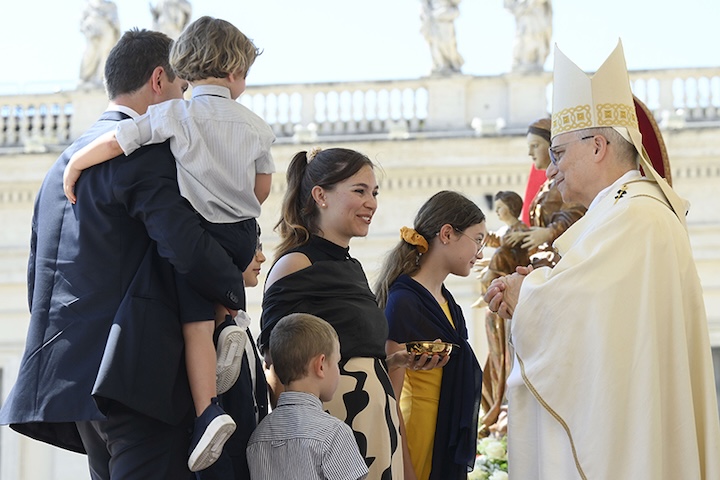
Equipping those of childbearing age with imagination and courage will require strategy and reflection. Simply telling Gen Z «you should have children» won’t work. We have to show them why they should have them. And parents who already unapologetically defend their decision to have children offer a better witness than any speech.
They show that being open to life and forming a family is the greatest adventure of hope in a world laden with negativity. Our demographic decline is a symptom of the spiritual emptiness of our world; the lack of imagination in young people is its manifestation. And children are the cure.
About the author
Kristen Ziccarelli is a Catholic professional living in Washington, D.C.