


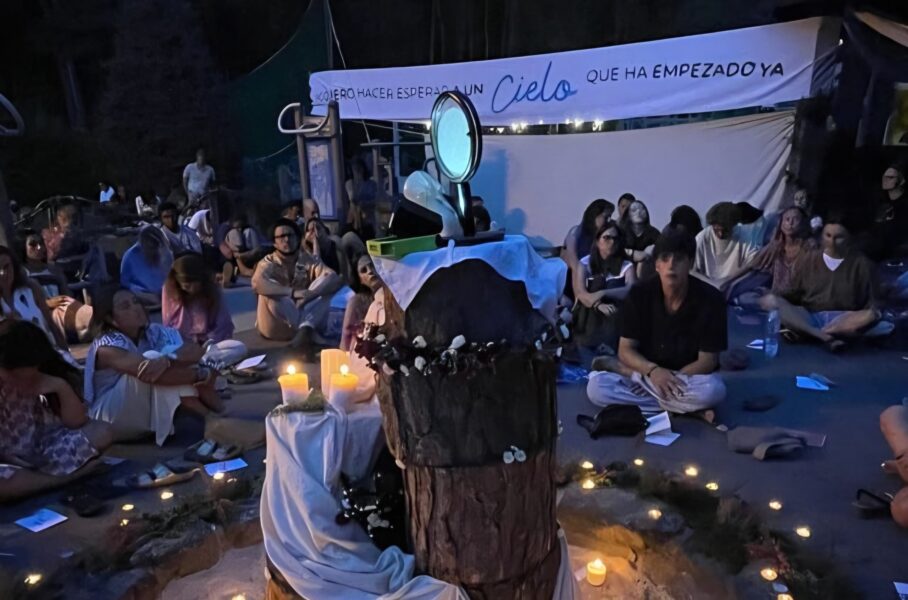
The reaction provoked by some criticisms of certain texts and forms of Hakuna has been, to say the least, revealing. We have received harsh, angry emails, some frankly disproportionate, and we have also noted articles in which we are disqualified and even insulted for pointing out something that is not a personal opinion or an aesthetic whim, but the constant doctrine of the Church. It is significant that the mere appeal to objective criteria—theological and liturgical—generates such commotion. Precisely for that reason, it is appropriate to go to the bottom of the matter, calmly, clearly, and without fear.
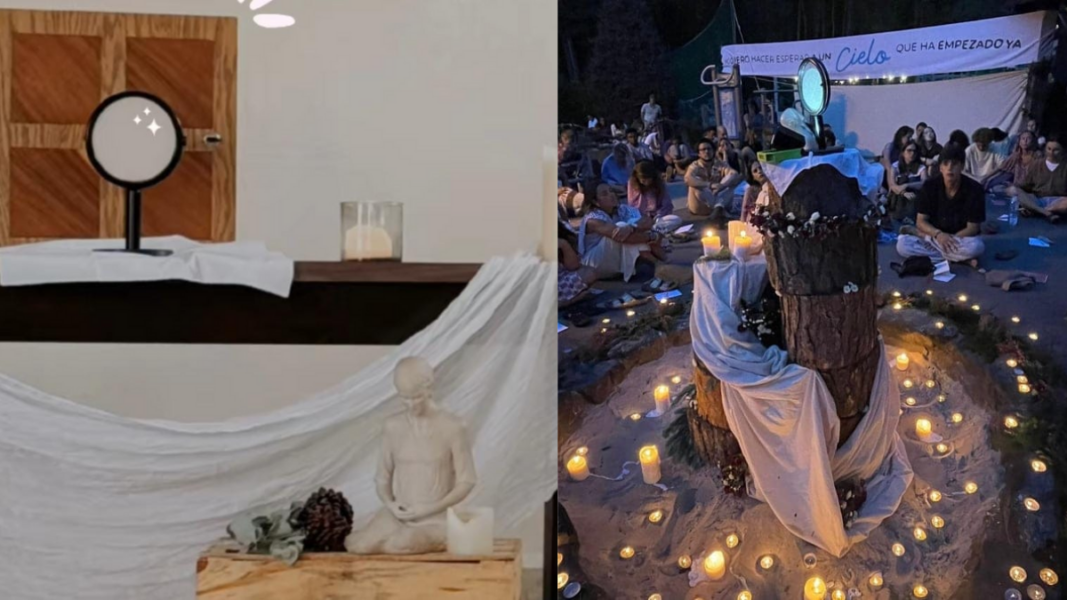
There is a theology in the texts and in the words. And, almost always—although it may be uncomfortable for some to admit it—there is also a theology in the forms. Both feed each other. What is said about God ends up being expressed in how He is treated. And what is done with the sacred ends up revealing, sooner or later, what God is really being preached.
The theology underlying many of the texts, songs, and speeches of Hakuna is markedly anthropocentric. The center of the narrative is not God in His absolute sovereignty, but the experience of the subject: how I feel, what it brings me, how it accompanies me, how it heals me. While this is not necessarily bad, the danger is to exclusivize it, limiting ourselves to a Christ who is constantly referred to man, to his wounds, to his processes, to his emotional experience. The truth of what is said is not denied, but the order is altered.
Christianity does not begin with man’s experience, but with God’s initiative. Not with what I feel before Christ, but with what Christ is. When the language systematically shifts toward the “I” and the “we,” when the centrality of the mystery is diluted in favor of experience, a profound theological shift is taking place, even if it is not explicitly confessed. God ceases to be the center to become, de facto, a function of the subject.
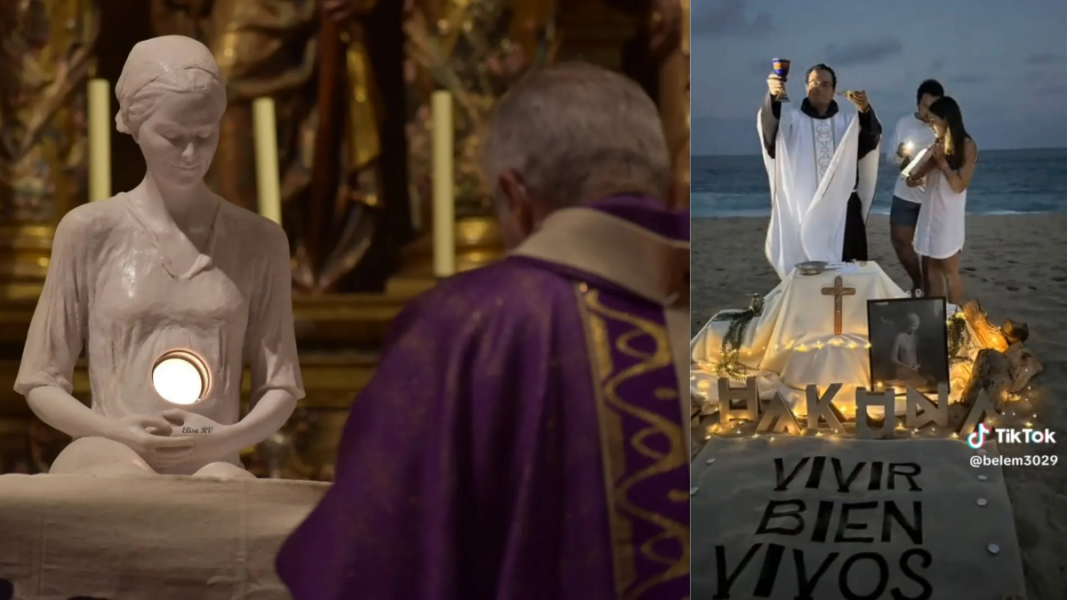
This theology of words finds its coherence—and its confirmation—in the theology of forms. Because when the Most Holy Sacrament of the Altar is exposed in a cardboard box, placed on the floor, without a monstrance, without an altar, and without the objective signs of adoration that the Church has always demanded, we are not faced with a mere practical error. We are faced with the gestural translation of a theology already previously displaced.
If what is central is the communal experience, emotional closeness, and horizontality, then the forms cease to serve the mystery and begin to serve the group. The Most Holy no longer appears as the Lord before whom the Church prostrates itself, but as an element integrated into a human dynamic, almost domestic, functional to the emotional climate of the encounter. It is not explicitly denied, but it is implicitly downgraded.
The Church, however, has always been radically clear: the Eucharist is Christ Himself, truly, really, and substantially present. And that truth does not admit creative translations that blur it. That is why the liturgy, the monstrance, the altar, the genuflection, and vigilant adoration are not cultural additions or remnants of a past era, but visible confessions of faith. They are dogma made gesture.
Accepting that there are good fruits in Hakuna does not equate to canonizing the theology that accompanies them. God acts with mercy even in doctrinally poor or misoriented contexts, but that does not make the orientation good. The Church has never discerned truth by pastoral success or by the emotional intensity of the experience, but by conformity with the faith received.
This is not a matter of aesthetic or generational discussion. It is not a battle between “stiffs” and moderns. It is a doctrinal issue of first order: who occupies the center, God or man. And when the center shifts, everything else is reordered accordingly, also—and especially—the way of treating the Most Holy Sacrament.
That is why it is necessary to say it clearly, even if it discomforts: there is in Hakuna an anthropocentric theology, expressed both in its words and in its forms, which ends up blurring the absolute centrality of God. Pointing it out is not attacking people or denying the partial goods that may exist. It is, simply, proposing with charity the doctrine of the Church. Because when man becomes the measure of the sacred, the sacred ends up losing its real weight. And then, inevitably, Christ stops being adored to start being used.