


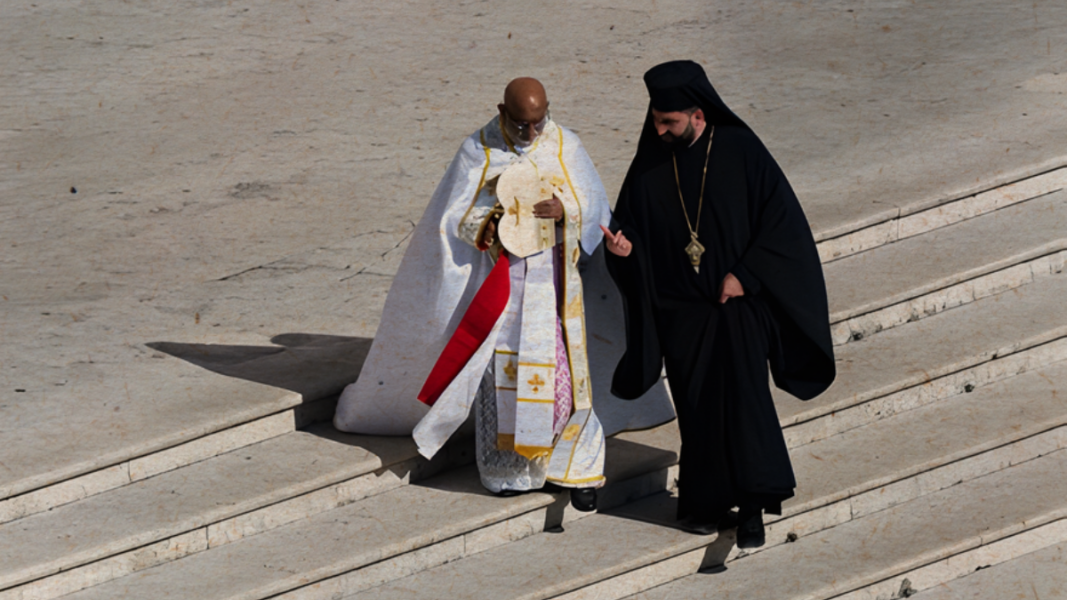
Very esteemed brother Nikolaos Mannis:
As I indicated to you in the first letter, I have left for a second the Trinitarian matter, whose climax is the famous Filioque, so denounced by the schismatic Eastern churches, which is how Catholics see everything you call “orthodoxy”, since, for us, authentic orthodoxy resides in the pontifical magisterium.
First of all, it is evident that in the divinity there can only be one personal principle, and this is the Father, who is therefore innascible or fontal, while the Son cannot be understood as a second Father or personal principle of the Holy Spirit, which would make no sense, because the relation of origin, which, as a perfect relation, is the one that entirely constitutes the divine persons as purely relative terms, being synonymous with procession, by making some proceed from others, cannot have two emitting terms, but must occur only between two terms, which, acting like the two pillars of the arch, behave as one emitter and the other as receiver.
It may then seem that I am giving reason to the Eastern thesis, which affirms that the Spirit proceeds only from the Father; but no, because, as St. Thomas clearly teaches, if there were no relation of origin between the Son and the Spirit, there would be no difference either, since the only real difference possible in the divinity, without entailing limitation, is that of relative opposition, which is proper to the terms, and which is based on the procession as a relation of origin between two terms; therefore, the mere relation to the Father as originating term is not sufficient to distinguish two originated terms, if these are not also distinct from each other by a mutual relation of origin, without which both would coincide as a single term originated by the unique originator.
The same reason used before to say that the Son cannot be a second Father to the Spirit can now also be applied inversely, insofar as the Spirit cannot be a second Son to the Father, but there can only be one Son as well: the Only Begotten, since, as any multiplicity not strictly relative implies imperfection by its limiting character, which is impossible in the divinity, then perfect filiation, to be properly divine, cannot be more than one, and its final term can only be one as well, just like its fontal term.
In the Bible as well, phrases can be found that prove convincingly how the Spirit does not proceed only from the Father, for, in saying: “He will take from what is mine” (Jn 16:14), referring to the Spirit, Jesus was not speaking of a merely occasional taking, for in God there is nothing occasional or accidental, but was expressing the same internal Trinitarian dynamic, which makes the missions correspond to the processions, being their external or salvific translation, as seen when Jesus also affirmed his own capacity to send the Spirit (cf. Jn 15:26 and 16:7), who thus proceeds from Him, as He Himself is sent ad extra by Him from whom He proceeds ad intra (cf. Jn 6:57).
Even a Church Father as important to the Orientals as St. Basil the Great has these eloquent statements:
As the Father is contemplated in the Son, the Son is contemplated in the Spirit. (…) In the same way that we say that worship must be done in the Son, since He is the image of God the Father, we say that it must also be done in the Spirit, since the Spirit expresses in Himself the divinity of the Lord (Book on the Holy Spirit, ch. 26, nos. 61 and 64: PG 32, 179-182 and 186).
It is pure logic that, on the one hand, if the Father is contemplated in the Son because He proceeds from Him, and the Son is contemplated in the Spirit, it will be because the latter also proceeds from the former; and, on the other, if the Son is the image of the Father, expressing Him from whom He proceeds, the Spirit, who expresses the divinity of the Son, will consequently also have to proceed from Him.
Having established the necessity that the Spirit also proceeds from the Son, however, the objection arises that, since the Father would no longer be the unique principle of the Spirit, two principles would be placed in the divinity, contrary to what was said earlier.
It must be warned beforehand that denying the Filioque is the subtlest way to downgrade the Son, which, in the end, implies, since conceding a subordination fully accommodates subordinationism, sliding without restraint toward Arianism, which was precisely what was condemned by the Nicene Council; thus, it would not cease to be shocking that, under the excuse of the strict defense of that council, its central thesis ends up being emptied: the homooúsios. And not only that, for downgrading the Son inexorably leads to downgrading the Spirit as well and to denying Constantinople I, thus giving reason also to the Pneumatomachi.
The only way to maintain these two seemingly incompatible extremes—that the Spirit also proceeds from the Son and that, however, there is only one personal principle, which must be the Father—lies in the thesis that only the latter is active, for a personal principle is that which emits the procession, while the Son, like the Spirit, is only passive and, therefore, receiver; but, to understand this, it is necessary to address the psychological theory, already developed by the Fathers of the Church, and which is not a mere hypothesis, but the only possibility to explain, psychologically linking the processional schemes, the ordering and interrelation of the procession of the Son and that of the Spirit, as authentically divine works and merely relative, since, as has been said, relative plurality is the only one that implies no imperfection; only thus can account be given of Trinitarian life, for the only acts that fit in the divinity are psychological or spiritual ones: understanding and loving, which, therefore, come to found the processions, from which, in turn, the constitutive relations of the terms or persons are derived.
The first psychological act must, obviously, be the intellective one, in which the Father, knowing Himself, makes the Son proceed, projecting Himself upon Him and constituting Him as His self-knowledge, since intellection expresses the relative sense of outgoing; here it is already clear that in the divinity there can be only one act of knowledge, since the appearance of a second would be due to the imperfection of the first; hence the Spirit cannot be explained from the intellective operativity, which is fulfilled entirely and exclusively in the Son, but from the complementary one: the volitive, which, in turn, expresses the relative sense of return and which is embodied in the second psychological act, by which the Father loves the already constituted person, the Son, but not for Himself, reflecting him toward Himself—with which He would absorb him—but for a new person: the Spirit, who is thus constituted as the beneficiary of the love of the loving Father for the beloved Son; that is the radical difference between divine love and all other love, which simply returns to the emitter, implying egoism by the subordination of the beloved to the lover, whereas, on the contrary, the oblativity of divine love constitutes a distinct beneficiary; now, since volition depends on intellection, for one can only love what is already known, it is evident that the procession of the Spirit depends on that of the Son, and in that sense it is rightly said that the Spirit also proceeds from the Son from the ordering of their respective processions, founded on respective psychological acts no less ordered among themselves, which corroborates that there can only be one procession: the first, which springs solely from the Father and has as its term another person, which is proper to the intellective procession and which, as divine, is full and perfect and needs nothing more, but the necessary addition must come from the volitive side, from which another procession springs that, as distinct, by also depending on the second person, constitutes a really distinct person as well: the third.
In short, it can be seen how the Son does not intervene in the procession of the Spirit actively or as a personal principle, by not emitting said procession, but only in a passive way, first limiting himself to receiving the intellective procession that constitutes him and then to enabling the volitive one, which, although directed to Him, does not constitute Him Himself, who is already perfectly constituted, but the Spirit, who is thus the receiving term of the procession founded volitively; hence, as the Son is neither emitter nor receiver, his intervention in the procession of the Spirit is not directly personal either, but indirect, insofar as the procession of the Spirit depends on that of the Son, which is enough to say that the former proceeds from the latter, not personally, but insofar as the procession of the first is derived from that of the second, while denying all procession of the Spirit with respect to the Son would certainly lead to cutting off all dependence on him to limit it to dependence on the Father, but at the cost of understanding the procession of the Spirit as identical to the intellective one of the Son, ignoring the volitive operativity, which is what gives meaning to the former, since one knows in order to love and thus achieve fullness, which obviously cannot be alien to the being characterized by supreme perfection: the divine one.
The affirmation that the Spirit proceeds from the Father and the Son as from a single principle must be understood according to the analogy that the dogmatic text itself (cf. Dz 704) presents, which is that of creation, in which the three divine persons indeed act as a single principle, by not doing so directly as persons, since the person only acts directly before another person, but indirectly, that is, through the divine nature, which is what directly acts upon created nature; the analogy then lies in that, if the divine persons do not act in a directly personal way in creation, the Son also does not act in a directly personal way upon the Spirit, by simply not intervening actively, but his intervention is carried out from his procession, which, by being founded on a psychological act, can be assimilated to nature; therefore, the unique personal principle of the Spirit is the Father, while the Son intervenes as a single principle with the former, by not intervening personally, not doing so actively, but processionally, insofar as his psychologically intellective procession provokes the volitive one of the Spirit, which comes to fulfill the text that indicates (cf. Dz 691) that the intervention of the Son is embodied in what is received from the Father, which is intellectivity, and not paternity, as is specified there, nor filiation either, for both are constituted as the reciprocal and intransferable senses of the intellective donation, so that neither the being emitter nor the being receiver can be donated, which are the functions that in the procession of the Spirit, which is a volitive donation, come to be called respectively active and passive spiration, neither of which is applicable to the Son, who is neither active nor receiver of any spiration, but his intervention lies in sustaining the psychological dependence that all volitive, whether active or passive spiration, presents toward the intellective, for, if the Father depends on what is known to love, the Spirit equally depends on that same known and also loved to be, as expressed, the beneficiary of such love.
Although, as has been demonstrated, the expression of the Filioque is fully valid, however, it must be recognized that, as in the unique procession of the Spirit the Father and the Son are not on the same level, but only the first intervenes as active principle, while the intervention of the second is as passive as the resulting person herself, the expression Per Filium is more precise, which indicates the subordinated character of the Son to the Father in the procession of the Spirit; but, not affecting the person of the Son herself, but only her procession, when the processions are effectively at the service of the persons, this subordination presents no problem for the divinity of the Son, who, from his own relation to the Father, is fully equalized to Him.
The dangerous subordination, on the contrary, is the one derived from denying all intervention of the Son and of his procession in that of the Spirit, because that supposes disconnecting the two processions relatively and would require the other type of distinction: the temporal one; now, as divinity is pure simultaneity, which only admits a relative distinction, it would result that such processions would no longer be strictly divine nor ad intra, but, having to be distinguished by temporal precedence, for lacking strict interrelative precedence, they would be akin to any ad extra work, like that of creation, from which the equally creaturely character of the Son and the Spirit would be inferred insofar as resulting from respective works not ordered relatively but temporally.
More precisely, it can be said that there is no direct relation of origin between the Son and the Spirit, for the fontal term of both—and thus the unique intratrinitarian one—is exclusively the Father: the unique direct emitter and originator both of the Son and of the Spirit; but, as it was already emphasized that there must be some relation of origin between these for them to be effectively distinguished, it must be recognized that it is then a relation of origin indirect, based on the psychological consideration of the procession of each; of course, that indirect relation is sufficient for the relative distinction between both, because, although the opposition proper to emitter and receiver, which is the direct terminative opposition, does not occur between them themselves, it is no less true that the emitter in both cases is not so in the same way, but, before the Son, does not depend on any other term, thus being his Father, by being his exclusive origin, while, before the Spirit, does depend on another term: the Son, thus not being his Father, by not being his exclusive origin, but his exact denomination is that of spirant, for whose function he depends both on his own as generator and on the generated term; therefore, it can already be seen how the indirect relation establishes distinction by affecting the direct relation, so that the receiving terms cannot coincide, which, although they have the same emitting term, do not have it in the same way, but, in one case, it is independent emitter and, in the other, not, by being dependent precisely on one of the receiving terms, which, consequently, can no longer be identified with the other receiver, insofar as between them an indirect dependence occurs: through the direct dependence that the emitter presents toward only one.
To rigorously fine-tune the terms, the denomination of the Son as spirant must be rejected, which is an exclusive function of the Father as the unique active person and, thus, as exclusive emitter, but, intervening indirectly—which is the only way compatible with his passive character—in the spiration, the Son must be denominated in the relation of origin that he maintains with the Spirit: originated as originator, just like the Father, only that, unlike the latter, who is direct, the former is indirect, with which his function is fully ordered and all confusion with that of the Father is avoided, as well as with the origin of the Spirit.
It can still be delved deeper, for, if, according to what was said, the relation is direct only between the terms constituted by it, however, it must be considered that the constitution is double: of origin and of confirmation, since, psychologically, the relation of origin may not be sufficient for full constitution, as seen in the case of the intellective origin, which would then be annulled volitively with the absorption of the beloved term, if another person did not intervene appearing as beneficiary, so that it is not the emitter; and whose intervention does not affect the origin, determined by the mentioned emitter, but does provoke the confirmation, which is no less important for the constitution, insofar as the effect of its non-existence is equally the disappearance, already explained, of the terms; this consideration allows recognizing that, if the Father and the Son are related directly in the relation of origin of the second—generated—with respect to the first—generator—, and if the Father and the Spirit are also related directly in the relation of origin of the second—spirated—with respect to the first—spirant—, while the Son and the Spirit are only related indirectly in the relation of origin, also indirect, of the second—spirated—with respect to the first—indirect originator—, already, however, within the Trinitarian sphere itself, a direct relation between these last two persons can be spoken of in the relation of confirmation between both, in which one is confirmed—the Son—and the other confirming—the Spirit—.
It must be specified, first of all, that in the relation of confirmation the term that appears as active can, in reality, be passive, because confirmation is not properly an action, like generation or spiration, which are relations of origin, but a derived effect, although determining; and, second, that the direct relation of confirmation between the Son and the Spirit founds another indirect one between the latter and the Father, since it is evident that, by preventing the latter from absorbing the Son and, by annulling him, annulling himself—since relative constitution is always mutual—, the confirmation of the Son by the Spirit ends up confirming the Father as well.
Recapitulating, everything can be synthesized by saying that the Father is direct originator, as generator, of the Son, and as spirant, of the Spirit, while the Son is indirect originator of the Spirit, and the latter is direct confirmer of the Son and indirect of the Father.
From the perfect harmonization of the processions and psychological acts, the entire wonderful divine life is justified, for, as the acts are, in purity, relations, and the reality of the relation requires that of its terms, constituted really from the procession, the psychological acts explain the processional dynamic, and the processions, in turn, found the reality of the psychological acts, with the consequence that only the Trinitarian God presents a real activity and life, while every unitarian conception of God leads to the most absolute inactivity, synonymous with death.
Perhaps it could be alleged that, according to what was exposed, the Son and the Spirit, who appear as merely passive within the Trinity, would seem dead; but it is not so, for dead is he who neither acts nor suffers, as the unitarian God would be, while the Son and the Spirit are very much alive from the constitutive relation with the Father and from the reception of the procession that founds that relation; moreover, if only the one who acts were alive, it could not be said of us that we have supernatural life, which for us is only received passively.
Evidently, full vitality occurs in psychological activity; but, above all, logical coherence must be maintained, deriving to the last consequences, and I am not to blame for the fact that, as, after what has been said, the reality of the relation depends on that of its terms, and these are constituted in the psychological act that founds the procession, it results that, once the three divine persons are constituted, it is no longer possible to constitute within the divinity any other term: the one that, receiving the psychological acts of the Son and the Spirit, would really distinguish them from those of the Father, for there are no more divine persons than the Trinitarian ones, the only necessary ones for the development of psychological life and, thus, for the constitution of divinity itself, characterized by necessity.
From another perspective, it is no less obvious that the reality of every act resides in that of its emitter and receiver terms; now, an act only differs from the others—unless there is temporal difference, which is as imperfect as time itself and, consequently, has no place in God—by the difference of its terms, so that only a new term can also distinguish a new act within the divinity; therefore, the Son and the Spirit could not refer their respective acts to any other Trinitarian person, including the Father, for, moreover, the perfection of the divine acts requires the full constitution of the term to which each of these is directed, which cannot be fulfilled in terms already constituted by other acts, insofar as, since the reality of an act lies in what it contributes, it cannot be that something can be added to the perfect acts of the Father, when neither can the persons fully constituted by the previous ones be completed in anything necessary.
Note: The articles published as Tribune express the opinion of their authors and do not necessarily represent the editorial line of Infovaticana, which offers this space as a forum for reflection and dialogue.